
Serotonin syndrome (SS) is a constellation of signs and symptoms arising from excessive serotonergic activity in the central nervous system that can occur with exposure to typically more than 1 serotonergic agent.1 SS is a clinical diagnosis ranging from mild to severe and can potentially be fatal if untreated. Kratom is a tropical plant with opioid-like and stimulant-like properties and is increasingly being used as an unregulated herbal supplement in the United States.2 There is limited literature linking kratom to SS. Here, we present the case of a patient on a stable regimen of psychotropic medication who developed SS after heavy kratom use.
Case Report
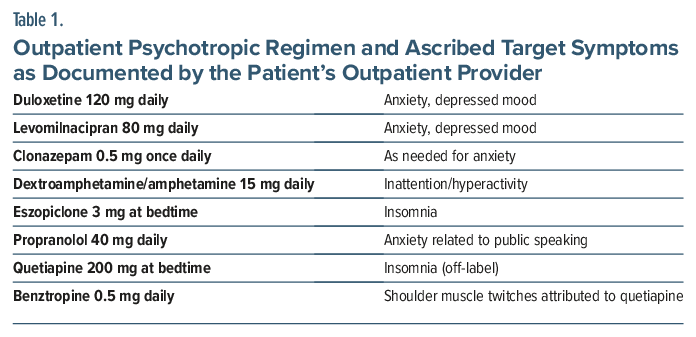
The patient is a 38-year-old man with a past medical history of unspecified depressive and anxiety disorders who was brought to the emergency department (ED) by ambulance when he was found speaking incoherently and walking around unclothed in an apartment that was not his. On arrival at the ED, he appeared hypervigilant and anxious with rapid speech, disorganized thought process, delusional thought content, and psychomotor restlessness. Initially, he reported no recent substance use; however, he later mentioned using kratom earlier that day. The patient’s self-reported history was limited by his inattentiveness and inability to coherently carry a conversation. The patient’s medical record listed his outpatient oral medication regimen as follows: duloxetine 120 mg daily, dextroamphetamine/amphetamine 15 mg daily, levomilnacipran 80 mg daily, propranolol 40 mg daily, quetiapine 200 mg at bedtime, eszopiclone 3 mg at bedtime, clonazepam 0.5 mg once daily as needed for anxiety, and benztropine 0.5 mg daily. There had been no changes to his outpatient medications in the preceding 2 years except for the recent addition of benztropine. Table 1 shows the indications for the patient’s home psychotropics as documented by his outpatient provider.
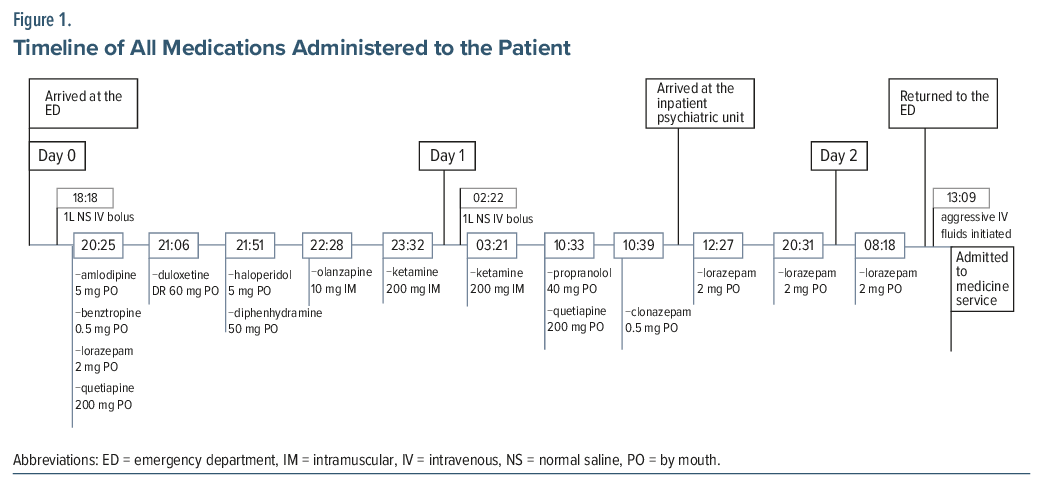
On initial evaluation in the ED at 3:30 PM (day 0), he was tachycardic to the 120s and otherwise normotensive, afebrile, with normal oxygen saturation on room air. His mental status was altered, and he was unable to meaningfully participate in the interview. A formal neuromuscular examination was not documented. The electrocardiogram showed sinus tachycardia, and noncontrast computed tomography of the head was negative for acute intracranial pathology. Complete blood count, comprehensive metabolic panel, thyroid-stimulating hormone, HIV, and syphilis tests were all negative, as was the urinalysis. Urine drug screen was positive for amphetamines, consistent with his prescribed medication. On reevaluation approximately 2 hours later, the patient was still tachycardic with worsening confusion and had developed dry lips and oral mucosa, for which he was given an intravenous bolus of 1-liter normal saline. By 7:00 PM, he became hypertensive to the 140s/90s, for which he was given 5 mg oral amlodipine. At 8:30 PM, he was observed to be diaphoretic with increased psychomotor agitation, and 2-mg oral lorazepam was administered. It was nearing the time for the patient’s usual bedtime medications, and he was given his home benztropine 0.5 mg and quetiapine 200 mg orally. This was followed by his home duloxetine 120 mg given at 9:00 PM. The patient’s psychomotor hyperactivity persisted, and he was then given oral haloperidol 5 mg and diphenhydramine 50 mg concurrently. His psychomotor hyperactivity persisted, and he was unable to remain calmly in his bed, for which 10-mg intramuscular olanzapine was administered at 10:30 PM. By 11:30 PM, he was placed in 4-point restraints and given intramuscular ketamine 200 mg. At 12:00 AM (day 1), repeat laboratory studies showed a creatine kinase (CK) of 236 units/L and lactic acid of 5.5 mmol/L, for which he received another bolus of 1-L normal saline. His elevated CK, lactic acidosis, hypertension, and tachycardia were all attributed to his psychomotor agitation, and another dose of 200-mg intramuscular ketamine was given at 3:00 AM. He remained in 4-point restraints for several more hours and was noted to struggle to remain still while in restraints with ongoing physical agitation despite all the medications he had received. Figure 1 shows a graphic timeline of all medications administered to the patient.
At this point, the patient’s altered mental status and physical agitation were presumed to represent psychosis, and the plan was for transfer to the inpatient psychiatric unit. Prior to transfer, the patient received his usual morning medications of propranolol 40 mg, quetiapine 200 mg, and clonazepam 0.5 mg. He arrived at the psychiatric unit at 12:00 PM (day 1), approximately 20 hours after his initial presentation to the ED. On arrival, he appeared anxious and hypervigilant with rapid speech and disorganized thought process. He was normotensive and afebrile with a heart rate of 104 bpm. The physical examination showed a bilateral upper extremity high-amplitude, brisk tremor suspicious for spontaneous clonus, hyperreflexia throughout, and inducible clonus bilaterally with stimulation of patellar reflexes. Concern was raised for SS, and oral lorazepam 2 mg was scheduled every 8 hours along with holding of all serotonergic medications.
The following morning (day 2), laboratory values showed elevated aspartate aminotransferase of 258 units/liter and CK of 20,373 units/liter. The patient was promptly transferred back to the ED, and he was admitted to the hospital medicine service for treatment of rhabdomyolysis. Lorazepam 2 mg every 8 hours was continued for symptomatic management. The patient’s mental status returned to baseline within 48 hours. Once at baseline, he shared that, in addition to taking his psychotropics as prescribed, he was using a kratom product marketed as 30-mg chewable tablets containing “super strength” 7-hydroxymitragynine for stress relief. He took 30 mg daily for 6 months but gradually increased his use, and in the week prior to presentation, he chewed 30 mg up to 8–10 times per day. He identified cravings for kratom and was concerned that he would return to using it after discharge. He was amenable to treatment of newly diagnosed kratom use disorder, and a 2 mg–0.5 mg buprenorphine-naloxone sublingual tablet twice daily was initiated in the hospital and continued at discharge. On hospital day 4, the patient’s home dextroamphetamine/amphetamine 15 mg and duloxetine 120 mg once daily and clonazepam 0.5 mg at bedtime were resumed. His home quetiapine dose was reduced to 100 mg at bedtime, and benztropine was discontinued. His home levomilnacipran, propranolol, and eszopiclone were recommended not to be resumed until outpatient follow-up with his psychiatric provider. The patient was discharged in stable condition on hospital day 4.
Discussion
On initial presentation, the patient’s symptoms of disorganized thoughts and behavior, inattentiveness, anxiety, and psychomotor hyperactivity, when coupled with tachycardia, hypertension, and diaphoresis, raised the possibility of serotonergic toxicity.1 These symptoms were initially misinterpreted as evidence of psychosis, and the pharmacologic agents commonly used for agitation (eg, lorazepam, haloperidol, olanzapine, and quetiapine) were given, though the patient’s physical agitation was refractory to these medications. The patient’s outpatient psychotropic regimen had been stable for 2 years, and SS was not suspected during the initial ED workup. As a result, the patient was given his home duloxetine, which likely further exacerbated excessive serotonergic activity. Moreover, several doses of ketamine arguably worsened psychomotor agitation, which, in the context of physical restraints, likely resulted in the initial elevations in CK and lactic acid. Apart from the physical examination, the only clues to potentially deciphering the patient’s presentation were his medication list and report of having used kratom earlier that day.
There are only 3 case reports connecting kratom to serotonin toxicity, and all are in the context of interactions with prescribed serotonergic agents.3–6 Brogdon et al described a 36-year-old man who developed SS in the context of kratom use and prescribed venlafaxine and quetiapine.3 Similarly, Eudaley et al.4 reported the case of a 63-year-old man with serotonin toxicity after 3 months of kratom use in the context of prescribed bupropion, buspirone, desvenlafaxine, trazodone, and ziprasidone.4 Most recently, Saber et al described a 28-year-old man with SS after using kratom along with prescribed sertraline and bupropion.5 Our case affirms and augments this small but growing repository of empirical evidence connecting kratom with serotonin-mediated toxic effects.
One proposed mechanism underlying the interaction between kratom and serotonergic agents involves the kratom alkaloid 7-hydroxymitragynine (including its precursor mitragynine) and enzymes in the cytochrome P450 (CYP) family.6Notably, our patient specifically used 7-hydroxymitragynine, a highly potent extract responsible for most of kratom’s psychoactive effects.7Mitragynine is thought to inhibit drug metabolism by CYP3A4 (in both liver and intestinal cells) and CYP2D6 (in liver cells).8 Given our patient’s heavy use of 7-hydroxymitragynine and its inhibition of drug metabolism, significantly higher serum levels of quetiapine (CYP3A4), levomilnacipran (CYP3A4), and duloxetine (CYP2D6) were likely responsible for the increased serotonergic drive and development of SS. Due to misdiagnosis of initial symptoms in the ED, the patient received additional serotonergic agents that further exacerbated serotonin toxicity. Once the diagnosis of SS was made and the precipitating serotonergic agents were stopped, the patient’s symptoms resolved within 48 hours.
Conclusion
In addition to expanding the evidence base on kratom’s role in serotonin toxicity, our case serves as a cautionary tale when patients present with possible signs of SS but no recent medication changes. This case highlights the need for clinicians to consider kratom use as a possible precipitant of serotonin toxicity in patients with symptoms of SS who were otherwise stable on their psychotropic medication regimen and serves as a reminder that prompt withdrawal of the offending serotonergic agents is necessary for symptom resolution.
Article Information
Published Online: September 24, 2026. https://doi.org/10.4088/PCC.26cr04244
© 2026 Physicians Postgraduate Press, Inc. Prim Care Companion CNS Disord 2026;28(5):26cr04244
Submitted: March 31, 2026; accepted June 4, 2026.
To Cite: Kapenstein T, Balasanova AA. Serotonin syndrome after kratom use in a patient on a stable psychotropic regimen. Prim Care Companion CNS Disord 2026;28(5):26cr04244.
Author Affiliations: Psychiatry Residency Program, Westchester Medical Center Health Network, Valhalla, New York (Kapenstein); Department of Psychiatry, University of Nebraska Medical Center, Omaha, Nebraska (Balasanova).
Corresponding Author: Alëna A. Balasanova, MD, Department of Psychiatry, Poynter Hall 5th Floor, University of Nebraska Medical Center, 985578 Nebraska Medical Center, Omaha, NE 68198-5578 ([email protected]).
Financial Disclosure: None.
Funding/Support: None.
Patient Consent: Consent was received from the patient to publish the case report, and information has been de-identified to protect patient anonymity.
Acknowledgment: The authors acknowledge Lidia Klepacz, MD, for her role in the clinical care of this patient.
ORCID: Alëna A. Balasanova: https://orcid.org/0000-0001-9735-2712
References (8)

- Simon LV, Torrico TJ, Keenaghan M. Serotonin Syndrome. StatPearls Publishing; 2024. Accessed March 26, 2026. https://www.ncbi.nlm.nih.gov/books/NBK482377/
- Hartley IIC, Bulloch M, Penzak SR. Clinical pharmacology of the dietary supplement kratom (Mitragyna speciosa). J Clin Pharmacol. 2022;62(5):577–593. PubMed CrossRef
- Brogdon HD, McPhee MM, Paine MF, et al. A case of potential pharmacokinetic kratom-drug interactions resulting in toxicity and subsequent treatment of kratom use disorder with buprenorphine/naloxone. J Addict Med. 2022;16(5):606–609. PubMed CrossRef
- Eudaley ST, Brooks SP, Hamilton LA. Case report: possible serotonin syndrome in a patient taking kratom and multiple serotonergic agents. J Pharm Pract. 2023;36(6):1523–1527. PubMed CrossRef
- Saber M, Zichichi A, Ammar M. Research snapshot 1342: serotonin syndrome due to kratom and antidepressant interaction: a case study. Crit Care Med. 2024;52(1):S642. CrossRef
- Hughes RL. Fatal combination of mitragynine and quetiapine – a case report with discussion of a potential herb-drug interaction. Forensic Sci Med Pathol. 2019; 15(1):110–113. PubMed CrossRef
- Hemby SE, McIntosh S, Leon F, et al. Abuse liability and therapeutic potential of the Mitragyna speciosa (kratom) alkaloids mitragynine and 7-hydroxymitragynine. Addict Biol. 2019;24(5):874–885 PubMed CrossRef
- Tanna RS, Cech NB, Oberlies NH, et al. Translating kratom-drug interactions: from bedside to bench and back. Drug Metab Dispos. 2023;51(8):923–935. PubMed CrossRef
Please sign in or purchase this PDF for $40.