
Phenibut (β-phenyl-γ-aminobutyric acid) is an unregulated γ-aminobutyric acid type B (GABA-B) receptor agonist with gabapentinoid activity, which is sold online as a “nootropic” supplement.1,2 Poison center data document a rising incidence of phenibut exposures, including fatalities, yet the substance is undetectable on routine urine drug screens, making withdrawal easily mistaken for primary psychiatric illness or alcohol withdrawal.3,4 We describe a case illustrating the severity and diagnostic complexity of phenibut withdrawal.
Case Report
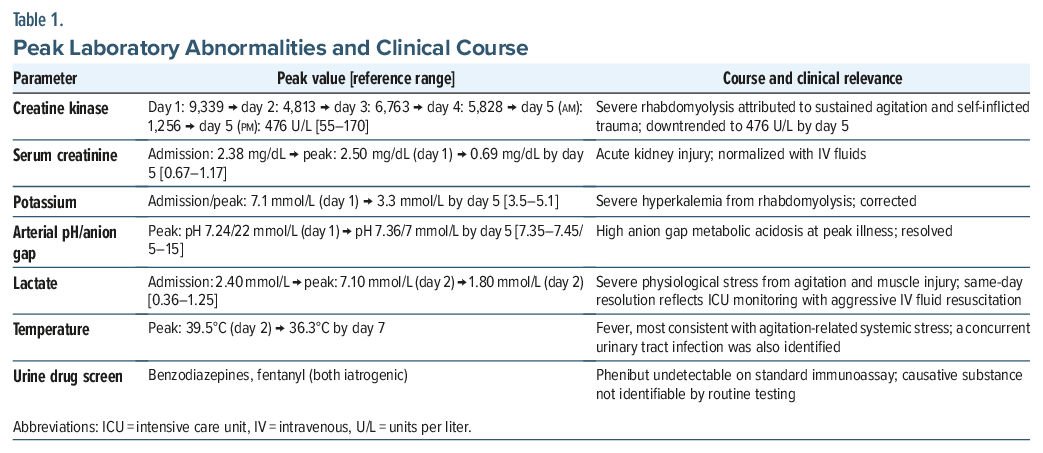
A 29-year-old man with a history of major depressive disorder, social anxiety disorder, and impulse control disorder was found alone striking his head against a wall in a locked hotel room and was brought to the emergency department by emergency medical services. The event was poorly recalled, and it could not be determined whether it reflected acute intoxication, emerging withdrawal, or an unwitnessed seizure. Escalating agitation and airway concern prompted intubation and intensive care unit admission. Head computed tomography confirmed a right orbital floor fracture and frontal scalp hematoma without intracranial hemorrhage. Initial evaluation revealed rhabdomyolysis, acute kidney injury, hyperkalemia, high anion gap metabolic acidosis, hyperlactatemia, and fever (Table 1). Admission blood ethanol was negative; urine drug screening detected only iatrogenic benzodiazepine and fentanyl (Table 1). Agitation persisted despite scheduled and as-needed olanzapine, requiring continuous dexmedetomidine infusion and physical restraints. A phenobarbital loading protocol and valproic acid were initiated empirically on hospital day 2 for presumed GABAergic withdrawal. On hospital day 3, collateral information from his mother identified phenibut powder containers in his hotel room. As delirium waned by day 5, the patient reported 4 months of escalating online-purchased phenibut use for anxiolytic and sedative effects, a recent self-directed taper for worsening insomnia, and an accidental overdose. Although his recall remained incomplete, he believed the initial episode reflected intoxication rather than withdrawal. On directed questioning, he denied suicidal intent and use of alcohol, standard toxicology panel substances, and other online or so-called “gas station” supplements and endorsed distant, but not current, kratom use. He met Diagnostic and Statistical Manual of Mental Disorders, Fifth Edition, Text Revision criteria for Other (Unknown) Substance Use Disorder. Confirmatory phenibut assays are not routinely available; commercial panels that include phenibut alongside other novel psychoactive substances (eg, Quest Diagnostics) exist but require send-out testing unlikely to return in time to guide acute management, so unrecognized coingestion cannot be definitively excluded. Baclofen was not initiated, as the acute withdrawal syndrome had largely resolved by the time phenibut was identified. He was discharged on sertraline, clonidine, and a short lorazepam taper, with outpatient psychiatric and substance use follow-up.
Discussion
This case underscores 3 practical points. First, phenibut use is increasing as online availability expands, yet it remains absent from standard toxicology panels3–5; clinicians should ask explicitly about online supplement use, which patients may not volunteer. Second, phenibut withdrawal can be life-threatening. Reported complications include seizures and severe delirium, and, as illustrated here, refractory agitation with self-inflicted trauma can independently precipitate rhabdomyolysis, acute kidney injury, hyperkalemia, and metabolic acidosis.6 Regardless of presentation timing, withdrawal can emerge within hours and progress rapidly, often worsening within 24 hours.4 Alternative etiologies merited consideration. Frontal trauma occurred during the episode, but absent intracranial injury and resolution of agitation with GABAergic treatment argued against a primary posttraumatic contribution. Third, diagnosis is frequently delayed, as this patient could not provide a reliable history until delirium resolved, and corroborating evidence came from collateral sources. Management remains empirical and GABAergic. Baclofen, benzodiazepines, and phenobarbital have each been used in reported cases, alone or in combination, although baclofen monotherapy in acute withdrawal has been associated with seizures, and antipsychotic monotherapy is generally insufficient.7–9 Early recognition and GABAergic treatment can prevent the cascade of agitation-driven complications seen here.
Article Information
Published Online: November 10, 2026. https://doi.org/10.4088/PCC.26cr04298
© 2026 Physicians Postgraduate Press, Inc.
Prim Care Companion CNS Disord 2026;28(6):26cr04298
Submitted: June 6, 2026; accepted August 16, 2026.
To Cite: Mancuso C, Rodulfo A, Vayner J, et al. Severe phenibut withdrawal with rhabdomyolysis and multiorgan injury requiring intensive care. Prim Care Companion CNS Disord 2026;28(6):26cr04298.
Author Affiliations: Department of Psychiatry, Memorial Healthcare System, Hollywood, Florida (all authors).
Corresponding Author: Alejandro Rodulfo, MD, Department of Psychiatry, Memorial Healthcare System, Hollywood, Florida ([email protected]).
Camilla Mancuso and Alejandro Rodulfo are co-first authors.
Financial Disclosure: None.
Funding/Support: None.
Previous Presentation: Presented in part at the Florida Psychiatric Society 2026 Spring Meeting; April 24–26, 2026; Orlando, Florida.
Patient Consent: Written informed consent was obtained from the patient for publication of this case report, and information has been de-identified to protect patient anonymity.
Additional Information: During the preparation of this work, the authors used Claude (Anthropic) to condense and edit the manuscript for length and clarity. The authors reviewed and edited the content as needed and take full responsibility for the content of the publication.
References (9)

- Lapin I. Phenibut (β-Phenyl-GABA): a tranquilizer and nootropic drug. CNS Drug Rev. 2001;7(4):471–481. PubMed CrossRef
- Gurley BJ, Koturbash I. Phenibut: a drug with one too many “buts.”. Basic Clin Pharmacol Toxicol. 2024; 135(4):409–416. PubMed CrossRef
- Graves JM, Dilley J, Kubsad S, et al. Notes from the field: phenibut exposures reported to poison centers, United States, 2009–2019. MMWR Morb Mortal Wkly Rep. 2020;69(35):1227–1228. PubMed CrossRef
- Feldman R, Autry B, Dukes J, et al. A systematic review of phenibut withdrawal focusing on complications, therapeutic approaches, and single substance versus polysubstance withdrawal. Clin Toxicol. 2023;61(11): 941–951. PubMed CrossRef
- Mash JE, Leo RJ. Phenibut: a novel nootropic with abuse potential. Prim Care Companion CNS Disord. 2020;22(4):19l02587. PubMed CrossRef
- Weleff J, Kovacevich A, Burson J, et al. Clinical presentations and treatment of phenibut toxicity and withdrawal: a systematic literature review. J Addict Med. 2023;17(4):407–417. PubMed CrossRef
- McDermott S, Johnson BE, Balasanova AA. Phenibut and bromazolam use disorders requiring hospitalization for medically supervised withdrawal.Prim Care Companion CNS Disord. 2022;24(4): 21cr03119. PubMed CrossRef
- Patt A, Fox H, Wells L, et al. Seizure occurring during baclofen monotherapy for phenibut withdrawal. Clin Neuropharmacol. 2023;46(2):79–81. PubMed CrossRef
- Penzak SR, Bulloch M. Phenibut: review and pharmacologic approaches to treating withdrawal. J Clin Pharmacol. 2024;64(6):652–671. PubMed CrossRef
Please sign in or purchase this PDF for $40.