
Adolescents with substance use disorders may obtain intoxicants through unconventional sources. We report a case of an adolescent who ingested what he believed to be an over-the-counter cold preparation obtained at an estate sale with the intent to “get a high.”
Case Report
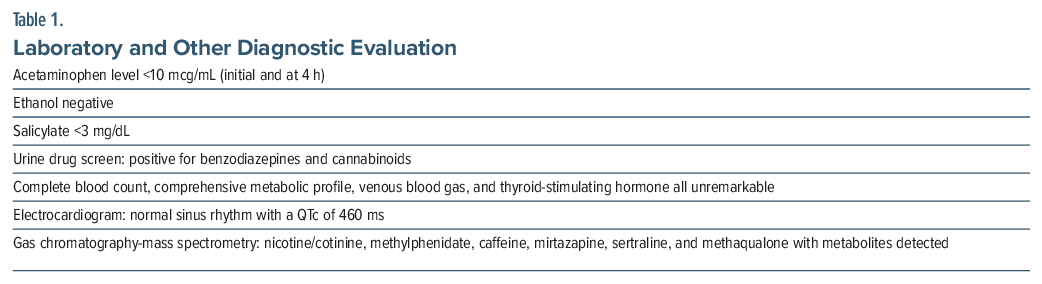
The patient is a 13-year-old boy with a history of attention-deficit/hyperactivity disorder, anxiety, and substance use disorder (marijuana, nicotine, and dextromethorphan) who presented to the emergency department with acute intoxication. Prior to arrival, the patient’s mother found him acutely agitated, followed shortly by multiple episodes of emesis. On presentation, the patient was markedly altered, agitated, and combative, limiting physical examination. Vital signs were notable for tachycardia and elevated blood pressure. Additional diagnostic evaluation is summarized in Table 1.
Shortly after arrival, the patient received lorazepam 2 mg and was placed in 4-point restraints due to severe agitation, presumed to be due to dextromethorphan intoxication. Initial management was supportive. However, agitation recurred hours later with an additional restraint episode, as well as administration of haloperidol and lorazepam.
His presentation differed from prior intoxication episodes with cannabis or dextromethorphan. The family located a bottle labeled “Therabreakers” (a discontinued product) and a vape cartridge in the patient’s bed. The bottle was later discovered to have been obtained by the patient at an estate sale. Subsequent identification of tablets and history supported a total estimated ingestion of 1,500 mg methaqualone, prompting prolonged monitoring and reassessment. The patient denied any suicidal ideation, self-injurious behavior, or suicidal intent with the ingestion. After extended observation, he returned to baseline and was discharged home with safety planning and ongoing outpatient mental health and substance use treatment.
Discussion
Methaqualone, also known by its brand name Quaalude, is a sedative-hypnotic substance popular in the 1960s–1980s.1 It has several similar properties to barbiturates, despite a different chemical structure.2 Initially marketed for sleep, it quickly was used as a substance of abuse with market discontinuation in 1984 due to its high risk for dependence and abuse potential.1 There is no medicinal value to the medication, and it is currently listed as a schedule I substance by the Drug Enforcement Administration. Methaqualone intoxication is characterized by tremulousness, myoclonus, muscle spasms, hyperreflexia, hypertonicity, seizures, altered mentation, central nervous system depression, lethargy with risk of coma, and cardiorespiratory suppression.1–4 The onset of effect is typically within 1 hour, with peak plasma concentrations by 3 hours and a long half-life of 20–60 hours.2 Recreational dosing is often 300 mg, with doses of 75–150 mg causing light sedation.1,2 Treatment of methaqualone ingestion is often supportive with use of benzodiazepines to manage muscular spasms.1,2 Delaying gastric absorption through use of activated charcoal and gastric lavage may also be considered.2
In adolescents with known substance use disorders, clinicians may anchor on the patient’s typical substances of use and overlook less common or discontinued agents obtained through secondary channels such as estate sales. Here, the patient’s severe agitation, vomiting, and atypical course, paired with the presence of a discontinued product, supported broad toxicologic evaluation. Confirmatory testing via gas chromatography-mass spectrometry revealed methaqualone, altering expectations regarding duration of symptoms and observation needs. This case highlights the importance of maintaining a broad differential for intoxication in youth with substance use disorders. It is important to consider discontinued products or secondhand sources as potential routes of substance access. Confirmatory toxicology can be critical when initial laboratory investigation is nondiagnostic, particularly when the patient’s presentation is inconsistent with history and initial diagnosis.
Article Information
Published Online: October 15, 2026. https://doi.org/10.4088/PCC.26cr04274
© 2026 Physicians Postgraduate Press, Inc.
Prim Care Companion CNS Disord 2026;28(5):26cr04274
Submitted: May 1, 2026; accepted July 16, 2026.
To Cite: Tomlinson PL, Malas N. Vintage find, modern emergency: unexpected methaqualone ingestion in an adolescent. Prim Care Companion CNS Disord 2026;28(5):26cr04274.
Author Affiliations: Department of Psychiatry, University of Michigan, Ann Arbor, Michigan (Tomlinson, Malas); Department of Pediatrics, University of Michigan, Ann Arbor, Michigan (Malas).
Corresponding Author: Patrick L. Tomlinson, MSN, CPNP-AC, Department of Psychiatry, University of Michigan, Ann Arbor, Michigan ([email protected]).
Financial Disclosure: Dr Malas has received grant support from Michigan Clinical Care and Consultation Program, Zero Suicide Initiative at C.S. Mott Children’s Hospital (principal investigator); has served on the Clinical Advisory Board for the Center, Precision Augmentation of Transitions in Healthcare in Suicidal Youth; and has served as a textbook editor for the APA 3rd edition of the Clinical Manual of Emergency Psychiatry. Mr Tomlinson has no financial disclosures.
Funding/Support: None.
Patient Consent: Consent to publish the case report was received from the patient’s parents, and information has been de-identified to protect patient anonymity.
ORCID: Nasuh Malas: https://orcid.org/0000-0002-7573-387X
References (4)

- Lund K, Srihari P, Suhandynata RT, et al. Qua-alluding to the past: a case of methaqualone analog ingestion. J Anal Toxicol. 2021;21:bkab103. PubMed CrossRef
- Bluth MH, Pincus MR. Narcotic analgesics and common drugs of abuse: clinical correlations and laboratory assessment. Clin Lab Med. 2016;36(4):603–634. PubMed
- Baggish D, Gray S, Jatlow P, et al. Treatment of methaqualone overdose with resin hemoperfusion. Yale J Biol Med. 1981;54(2):147–150. PubMed
- Gerald MC, Schwirian PM. Nonmedical use of methaqualone. Arch Gen Psychiatry. 1973;28(5):627–631. PubMed
Please sign in or purchase this PDF for $40.