
Abstract
Objective: Children with mental, emotional, developmental, or behavioral (MEDB) problems may face higher risk of vision concerns and more complicated care pathways. The objective of this study was to evaluate whether vision care utilization, screening/referral steps, and vision-related outcomes differ by MEDB status in US children.
Methods: A cross-sectional analysis was conducted using National Survey of Children’s Health (NSCH) Interactive Data Query outputs for children aged 3–17 years from 2019–2023. MEDB status was defined by the NSCH composite indicator (≥1 qualifying condition and/or meeting emotional/behavioral/developmental criteria). We extracted survey-weighted prevalence estimates (95% CIs) for eye doctor exam/visit, non–eye-doctor screening, postscreening recommendations, diagnosis of a nonrefractive vision disorder, unmet vision care need, and functional vision limitation despite correction. Between-group differences were tested using 2-sided comparisons of weighted proportions.
Results: In 2023, children with MEDB issues had higher rates of having seen an eye doctor, non–eye doctor vision screening, and recommendations for eye exams (P<.001). Diagnosis of a nonrefractive vision disorder was also higher in the MEDB group (P=.005). Unmet vision care need did not differ by MEDB status (P=.599). Functional vision limitation despite correction was numerically higher among children with MEDB in most years but not significant in 2023 (P=.274).
Conclusion: US children with MEDB problems report more screening, referrals, and eye doctor contact and higher rates of nonrefractive vision disorder diagnosis compared with peers without MEDB. Differences in unmet need were minimal, suggesting that follow-up and care coordination after screening/referral may be targets for improving vision-related outcomes.
Prim Care Companion CNS Disord 2026;28(5):26m04278
Author affiliations are listed at the end of this article.
From the Editors

Are you a healthcare provider?
Add your NPI to personalize your JCP experience.
Mental, emotional, developmental, or behavioral (MEDB) problems are one of the most common health conditions in children with 1 in every 4 to 5 meeting criteria for a mental disorder in the United States.1 The National Survey of Children’s Health (NSCH) defines MEDB as a child having 1 or more of the following disorders: Tourette syndrome, anxiety problems, depression, behavioral and conduct problem, developmental delay, intellectual disability, speech or other language disorder, learning disability, autism or autism spectrum disorder (ASD), attention-deficit disorder (ADD), or attention-deficit/hyperactivity disorder (ADHD).2 Children with these disorders have increased educational and financial burdens on families, which can then be compounded by recent evidence showing that children with MEDB have an increased risk of developing ophthalmic problems.3,4 These problems include both refractive problems and nonrefractive disorders that compound and lead to an even greater burden on families.3,4
Emerging literature suggests children with developmental disabilities may face a higher burden of vision issues. One study using a 3-year school-based cross-sectional dataset found that those with developmental disabilities were associated with more astigmatism and severe astigmatism than their typically developing peers.4 Articles looking specifically at children with ASD found similar results, with 39%–71% of children having at least 1 ophthalmologic diagnosis including significant refractive error, strabismus, and amblyopia.5,6 This increase in ophthalmologic diagnosis is also seen in children with ADHD.7 One large population-based cross-sectional study found that ADHD was associated with a statistical increase in amblyopia, heterotropia, hypermetropia, and astigmatism compared to the general public.5–7 In addition, a systematic review found that children with ASD and ADHD aged 6–17 years had different ocular characteristics compared to children going through typical development. It was concluded that, compared to those with typical development, children with ASD had significantly longer pupillary light reflex latencies, and children with ADHD had thinner inferior ganglion cells and thicker nasal macular thickness.8
In addition, there is evidence to suggest that those with acquired disorders such as anxiety and depression also have increased ophthalmologic issues.9,10 A systematic review found a positive correlation between mental disorders and myopia, while another found that adults with a baseline of depression/anxiety later reported vision impairment.9,11 Children with depression and anxiety were also found to have an increased risk of myopia.12
It is important that the quality and quantity of ophthalmic issues impacting MEDB be determined for proper resource allocation to meet the needs of children suffering from these ophthalmic issues. We utilized nationally representative data of US children from the 2019–2023 NSCH surveys to investigate the differences and trends in ophthalmic issues and needs among children diagnosed with MEDB compared to their peers without MEDB diagnoses.
METHODS
Study Design and Data Source
This cross-sectional study used publicly available survey data from the NSCH across survey from 2019 through 2023. The NSCH is a nationally representative survey of US children that collects parent- or guardian-reported information on health conditions, health care utilization and access, and child and family well-being among non-institutionalized children from the ages of 0–17 years. The survey is funded and directed by the Maternal and Child Health Bureau within the Health Resources and Services Administration and is administered by the US Census Bureau. NSCH data are disseminated through the Data Resource Center as part of the Child and Adolescent Health Measurement Initiative.
The NSCH uses an address-based sampling design derived from the Census Bureau’s Master Address File. Data collection follows a 2-stage structure: an initial household screener identifies whether children aged 0–17 years live in the household and how many; subsequently, 1 child per household is randomly selected for a more detailed topical questionnaire. Households are contacted by mail and can complete the survey online, via a paper questionnaire, or using telephone assistance. Reminder mailings are sent to nonresponding households to encourage participation, and materials are available in English and Spanish.
We obtained the data using the NSCH Interactive Data Query (IDQ) system available through the NSCH Data Resource Center website. This modality allows users to define the survey year, analytic population, subgroup stratifications, and outcome measures and then returns standardized survey-weighted prevalence estimates with corresponding 95% CIs that account for the NSCH’s complex sampling design. For each survey year and each measure, query results were exported and saved as downloadable tables/PDF outputs. All estimates reported in this study reflect the weighted values produced by the IDQ system and were not reweighted or recalculated from restricted microdata as part of this workflow.
Study Population, Exposures, and Outcomes
Across the NSCH years covered in this analysis, we used the standard nonoverlapping year blocks available in the IDQ for the MEDB indicator (Indicator 2.10) to avoid double-counting participants. Restricting the sample to children aged 3–17 years at the national level, the unweighted “sample count” denominators were 26,572 children for the 2019–2020 block (6,449 classified as having MEDB problems and 20,123 classified as not having MEDB problems), 87,658 children for the 2021–2022 block (23,412 MEDB and 64,246 non-MEDB), and 45,693 children for the 2023 survey year (12,921 MEDB and 32,772 non-MEDB). Summed across these nonoverlapping blocks, the total analytic denominator for 2019–2023 was 159,923 children aged 3–17 years, including 42,782 classified as MEDB and 117,141 classified as non-MEDB.
The primary exposure was MEDB status, defined using the NSCH indicator framework available in the IDQ system. A child is classified as MEDB if the caregiver reports the child currently has at least 1 of the following conditions: Tourette syndrome, anxiety problems, depression, behavioral or conduct problems, developmental delay, intellectual disability, speech or other language disorder, learning disability, ASD, or ADD/ADHD and/or if the child meets the CSHCN screener criteria for an ongoing emotional, developmental, or behavioral condition requiring services (eg, treatment or counseling) expected to last ≥12 months. Because this indicator is constructed within the NSCH reporting system, MEDB classification was taken directly from the IDQ output and was not reconstructed manually.
We evaluated a set of NSCH vision and eye-care measures that reflect access and utilization along the vision care pathway as well as functional visual difficulty. Core outcomes included (1) unmet vision care need (caregiver report that the child needed vision care but did not receive it within the specified timeframe) and (2) functional vision limitation despite correction, based on NSCH items assessing blindness/serious difficulty seeing and/or difficulty seeing even when wearing glasses or contact lenses. We also extracted additional measures when available, including eye exam by an eye doctor, whether the child saw an eye doctor, vision screening by a noneye provider, recommendations for eye exam/additional services following screening, and parent-reported diagnosis of a nonrefractive vision disorder.
Not every vision measure was available in every survey year block. In particular, several items related to the screening/referral pathway (eye doctor visit/exam, non–eye provider screening, and postscreening recommendations) were added later and are only available starting in the more recent NSCH files (2021–2023), whereas unmet vision care need and functional vision limitation measures were available earlier. For that reason, comparisons and P values are reported only for years in which a given measure was queried and available through the IDQ system.
Statistical Analysis
Analyses were conducted separately by survey year block and then summarized across blocks to describe multiyear patterns. For each available outcome, we extracted survey-weighted prevalence estimates with 95% CIs among children with and without MEDB problems. Because the IDQ provides prevalence estimates and CIs, SEs were derived from the reported 95% CIs using a normal approximation, and z-tests were used to compute 2-sided P values for each outcome-by-year comparison. We also calculated absolute differences (Δ) as the weighted prevalence in the MEDB group minus the weighted prevalence in the non-MEDB group (percentage points) to summarize the direction and magnitude of gaps over time.
Exports from the NSCH IDQ were used as the source data for each measure and year block. Statistical calculations (SE derivation, z-tests, P values, and absolute differences) were performed in Python using standard scientific computing libraries. Figures were created in Excel. This study used deidentified, publicly available NSCH data and did not involve direct interaction with human participants.
RESULTS
Study Population
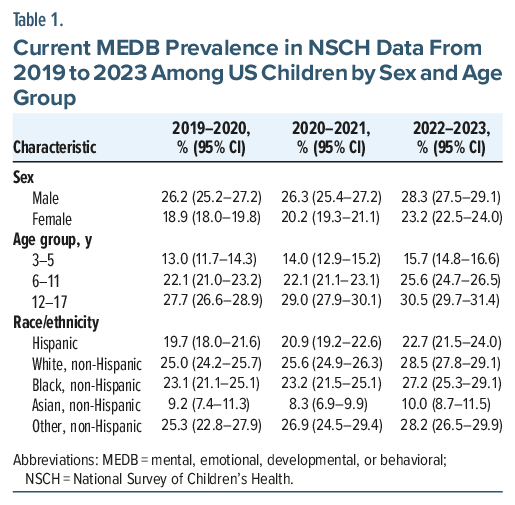
The analytic sample included US children aged 3–17 years from NSCH 2019–2023. Across the study period, the weighted prevalence of children meeting criteria for MEDB problems (as defined by the NSCH composite indicator) increased modestly over time, as summarized in Table 1. In every survey cycle, MEDB prevalence was higher in males than in females and increased stepwise with age, with the highest burden consistently seen in adolescents. By race/ethnicity, Asian non-Hispanic children had the lowest MEDB prevalence across cycles, while prevalence was higher among white non-Hispanic, black non-Hispanic, and other non-Hispanic children in the most recent cycle. Overall, these subgroup patterns were stable across cycles, with the main change over time being a gradual upward shift in MEDB prevalence.
Primary Comparisons in 2023
In 2023, several steps along the vision care pathway differed by MEDB status, as summarized in Table 2. Children with MEDB problems had higher reported rates of (1) eye exam by an eye doctor and (2) having seen an eye doctor, and these differences were statistically significant (both P<.001). The same pattern held for intermediate pathway measures. Children with MEDB problems were more likely to have had a vision screening performed by a non–eye doctor provider and more likely to have been recommended for an eye exam or additional vision services (both P< .001). Finally, parent-reported diagnosis of a nonrefractive vision disorder was more common in children with MEDB problems than in those without MEDB (P=.005).
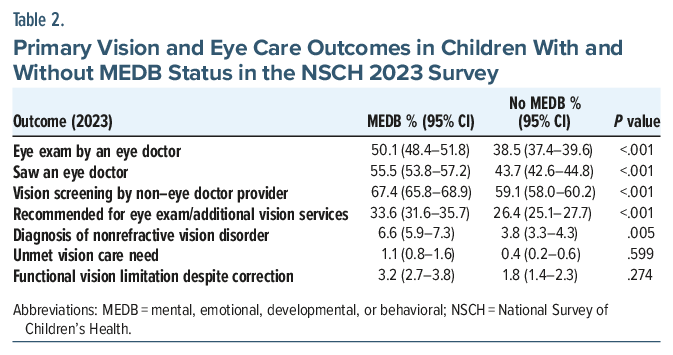
Functional vision limitation despite correction was numerically higher in children with MEDB problems, but the difference did not reach statistical significance (P=.274), and unmet vision care need remained uncommon in both groups with no significant difference (P=.599). Taken together, the 2023 results suggest that children with MEDB are interacting with the vision care system more often (screening, eye doctor contact, referrals), and they also have higher reported rates of nonrefractive diagnoses, but the measured gaps in unmet need and functional limitation were smaller and not statistically significant in that year.
Multiyear Trends and Absolute Differences
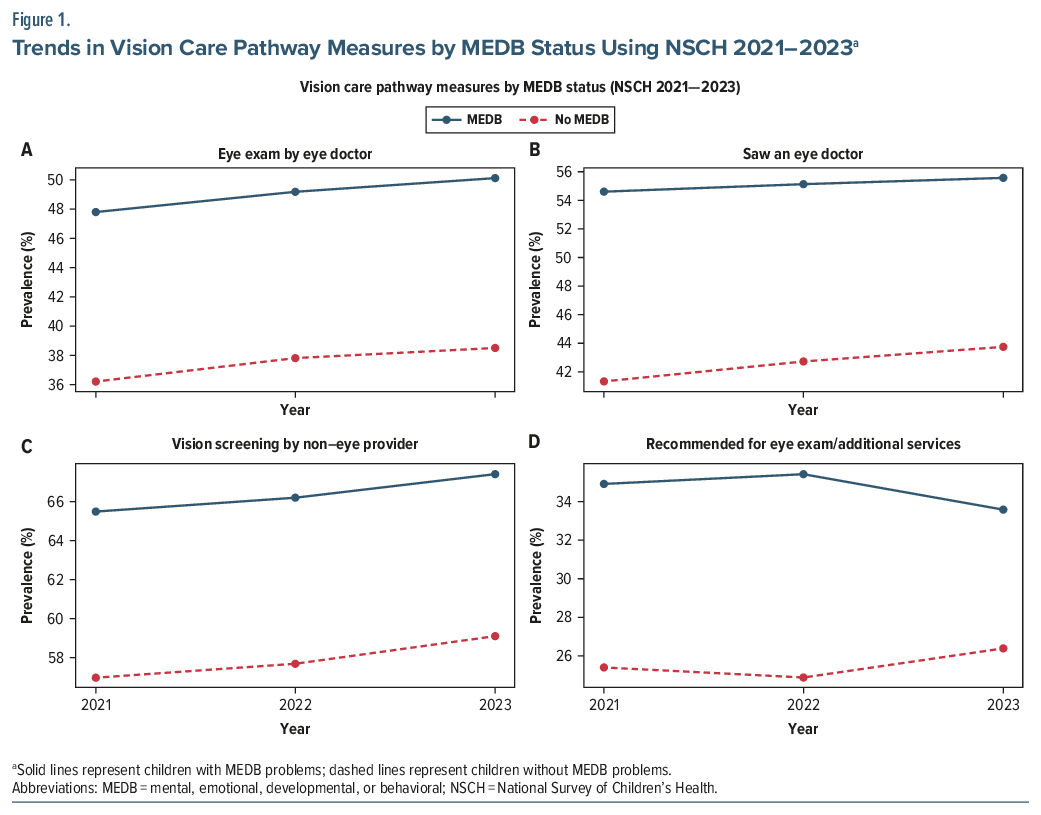
When looking across 2021–2023 as depicted in Figure 1, the overall shape of the pathway measures was consistent. Children with MEDB problems had higher reported rates than children without MEDB for every step shown, and those between-group differences were statistically significant in each year they were measured, as shown in Table 3 (all <.001 for pathway measures across 2021–2023). Both groups showed small upward movement over time in eye doctor contact and exam, as well as non–eye provider screening, as reflected by the gradual increase in the year-specific prevalence estimates from 2021 to 2023 for the categories of “eye exam by eye doctor,” “saw an eye doctor,” and “vision screening by a non–eye provider” in Figure 1. The recommendation for an eye exam or additional services measure was the 1 exception in terms of trajectory. While children with MEDB still had higher rates than their peers, the MEDB group dipped slightly in 2023 compared with 2021–2022 (34.9% in 2021, 35.4% in 2022, and 33.6% in 2023), which narrowed the gap that year, as shown in Table 4 (Δ=9.5% in 2021; 10.5% in 2022; 7.2% in 2023).
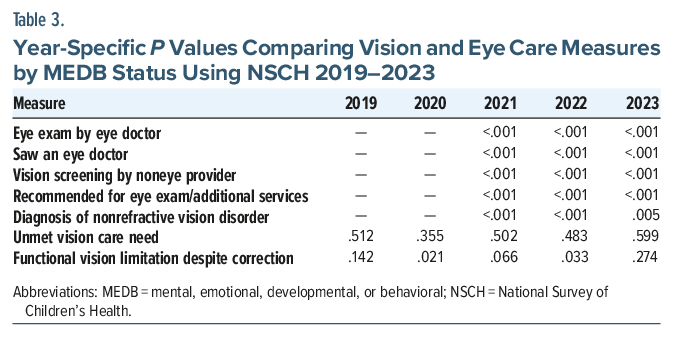
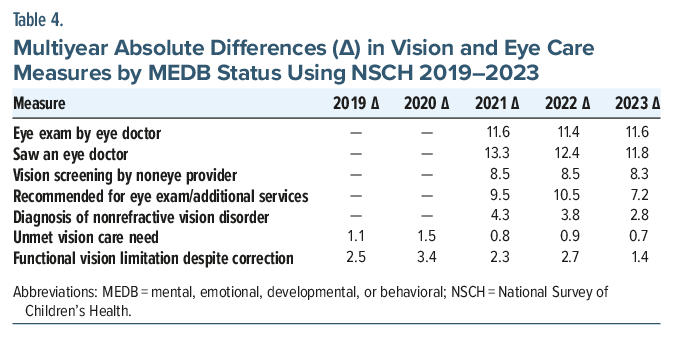
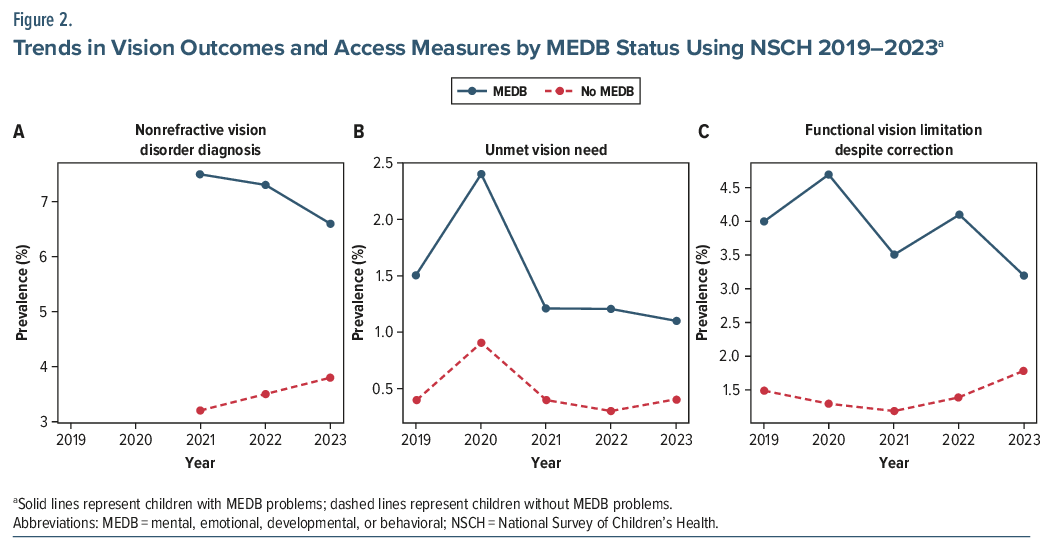
Across the full 2019–2023 window, functional vision limitation despite correction was consistently higher among children with MEDB problems than among children without MEDB as depicted in Figure 2, but the strength of that difference varied by year; some years showed clearer separation than others, as shown in Table 3. In contrast, unmet vision care need stayed low in both groups in every year, and group differences were small, reaching statistical significance only in 2020, but not in 2019 or 2021–2023. For nonrefractive vision disorder diagnosis, prevalence was higher in children with MEDB problems across 2021–2023 (Figure 2), and while the MEDB group remained elevated, the MEDB and non-MEDB gap narrowed over time (Table 4).
DISCUSSION
In this study, we used data from the NSCH to determine if children in the category of MEDB aged 3–17 years had ophthalmic differences compared to children not in this category. The survey questions were changed in 2021, resulting in differences in what was examined and found over the years. In the years 2021–2023, it was found that individuals with MEDB had an increase in diagnoses of nonrefractive vision disorders compared to children not in this category. This finding suggests a higher burden of clinically recognized ocular disease beyond routine refractive error in this population.
Our study demonstrated that children with MEDB were more likely to receive a non–eye doctor vision screening, to be referred to an eye doctor, and to receive an eye exam by an eye doctor. This line of questions seems to reveal that those with MEDB who have eye issues have resources to help them receive ophthalmic care. This pattern of children with MEDB needing more resources has been shown in the literature, in which young children with anxiety, depression, and severe impairment were more likely to have office visits.13 It also highlights the importance of other areas in these children’s lives in referring them to get help, with over 60% of children with MEDB having their vision screened by a non–eye provider.
Despite higher utilization and referral, functional vision limitation “even when wearing glasses” was nonstatistically higher among children with MEDB through 2019–2023, with absolute gaps ranging from 1.4 to 3.4 percentage points. This may be due to ineffective detection and management of children with MEDB due to many factors such as the child’s limited testability and physicians being undertrained when it comes to dealing with children with various learning, emotional, and behavior disorders.14,15 We also found that the largest MEDB to no MEDB gap in functional limitation, despite correction, to be in 2020. This could be due to a pandemic-era disruption that affected timely detection, follow-up, and continuity of therapy.
Not only have various psychiatric disorders been associated with eye diseases, but these diseases are also independently associated with increased risk of mood and anxiety disorders in children.16 One study using a large US commercial insurance claims database found that serious eye disease is associated with a higher prevalence of anxiety and depression.16 Other studies have also consistently shown an association between serious eye diseases such as glaucoma and macular degeneration in both depression and anxiety.17–19 Vision impairment can exacerbate emotional and psychiatric disorders, which then may complicate the detection and management of ocular disease.16,20,21
The findings of our study resulted in various recommendations on how children with MEDB can be better served by physicians and the medical system at large. Our finding that children with MEDB had an increase in diagnoses of nonrefractive vision disorder in the years 2021–2023 highlights the importance of proper screening in this population, because early treatment has been shown to have greater improvement in certain diseases.22–25 It is also important to empower the caretakers of these children to maintain a low threshold to escalate from screening to comprehensive evaluation, especially when these children show frequent squinting, headaches, reading avoidance, or regression in school performance.26 Individuals who take care of children with MEDB must also understand the importance of detection, follow-up, and continuity of therapy because if this is not maintained, then delays during sensitive windows for visual development contribute to worsening functional status in subsequent years.27
Although studies have shown that various disorders under the MEDB category have a high number of ophthalmic issues, many studies lack rigorous research. While our suggestion should be integrated for all children with MEDB to improve their ophthalmic outcomes, future studies should stratify MEDB into specific diagnostic categories. This may allow detection of specific disorders with a disproportionate number of ophthalmic comorbidities, which would then dictate the implementation of appropriate resources.
Limitations
These findings should be interpreted with a few important limitations in mind. First, all measures are parent-reported and not independently verified. Second, this is a repeated cross-sectional analysis, meaning we can describe associations but cannot say that MEDB causes differences in eye care utilization or vision outcomes (and the relationship could plausibly run in either direction). Third, several vision pathway measures were not included in earlier NSCH years and only appear in later survey files, so trend analyses for screening/referral and eye-doctor-contact outcomes are limited to 2021–2023 and are not directly comparable to outcomes available across the full 2019–2023 window. Fourth, the MEDB exposure is a broad composite indicator that groups together very different conditions (eg, ADHD, anxiety/depression, developmental delay), which likely have different mechanisms and health care patterns; this approach improves sample size but can mask diagnosis-specific effects.
CONCLUSION
In this national NSCH analysis of children aged 3–17 years, children with MEDB problems consistently showed higher reported engagement with the vision care pathway (screening, referrals, and eye doctor contact) and higher reported rates of nonrefractive vision disorder diagnosis compared with peers without MEDB. In contrast, unmet vision care need remained uncommon and functional vision limitation despite correction was higher numerically in the MEDB group but was not consistently significant year to year. Overall, these results suggest that children with MEDB are getting “into the system” more often but may still carry a higher burden of visual diagnoses and symptoms, supporting the need for more targeted follow-up and coordination after screening and referral.
Article Information
Published Online: September 10, 2026. https://doi.org/10.4088/PCC.26m04278
© 2026 Physicians Postgraduate Press, Inc.
Submitted: May 14, 2026; accepted July 14, 2026.
To Cite: Riestra JM, Alabed ST, Riestra DB, et al. Vision care pathway measures and vision outcomes in US children with mental, emotional, developmental, or behavioral problems: National Survey of Children’s Health 2019–2023. Prim Care Companion CNS Disord 2026;28(5):26m04278.
Author Affiliations: Institute of Ophthalmology and Visual Science, Rutgers New Jersey Medical School, Newark, New Jersey (JM Riestra, Alabed, Jaffry, Guo, Iyer, Szirth, Khouri); Rowan-Virtua School of Osteopathic Medicine, New Jersey (DB Riestra); Department of Psychiatry, Rutgers New Jersey Medical School, Newark, New Jersey (Hussain).
JM Riestra and ST Alabed contributed equally.
Corresponding Author: Najeeb U. Hussain, MD, Department of Psychiatry, Rutgers New Jersey Medical School, 185 South Orange Ave, Newark, NJ 07103 ([email protected]).
Financial Disclosure: Dr Khouri has served as a consultant for Glaukos, Bausch & Lomb, and Alcon and on the speaker’s bureaus of Bausch & Lomb and Alcon and has received grant support from NJ Health Foundation and the Fund for the NJ Blind. The other authors have no financial disclosures to report.
Funding/Support: Funding received from NJ Health Foundation and the Fund for the NJ Blind to Dr Khouri.
Role of the Sponsor: The funding agencies had no role in the design and conduct of the study; collection, management, analysis, and interpretation of data; or preparation, review or approval of the manuscript.
Data Availability Statement: Deidentified data and analysis code are available from the corresponding author on reasonable request.
Acknowledgments: The authors thank the Rutgers Institute of Ophthalmology and Visual Science and Department of Psychiatry faculty for critical feedback on study design and manuscript editing.
Additional Information: During the preparation of this work, the authors used ChatGPT (OpenAI) to improve language/readability. The authors have reviewed the content and take full responsibility for the content of the publication.
References (27)

- Merikangas KR, He JP, Burstein M, et al. Lifetime prevalence of mental disorders in U.S. Adolescents: results from the national comorbidity survey replication-Adolescent Supplement (NCS-A). J Am Acad Child Adolesc Psychiatry. 2010;49(10):980–989. PubMed CrossRef
- Bureau USC. National Survey of Children’s Health (NSCH); 2025.
- Kiely C, Douglas KAA, Douglas VP, et al. Overlap between ophthalmology and psychiatry - a narrative review focused on congenital and inherited conditions. Psychiatry Res. 2024;331:115629. CrossRef
- Li X, Li L, Liu X, et al. Elevated ocular and visual disorder risk in developmental disabilities: insights from cross-sectional study and Mendelian randomization analysis. J Autism Dev Disord. 2025. doi: 10.1007/s10803-025-06989-4. CrossRef
- Chang MY, Gandhi N, O’Hara M. Ophthalmologic disorders and risk factors in children with autism spectrum disorder. J AAPOS. 2019;23(6):337 e1–337 e6.
- Khanna RK, Kovarski K, Arsene S, et al. Ophthalmological findings in children with autism spectrum disorder. Graefes Arch Clin Exp Ophthalmol. 2020;258(4):909–916. PubMed
- Ho JD, Sheu JJ, Kao YW, et al. Associations between attention-deficit/hyperactivity disorder and ocular abnormalities in children: a population-based study. Ophthalmic Epidemiol. 2020;27(3):194–199. doi:10.1080/09286586.2019.1704795. PubMed CrossRef
- Dastamooz S, Tham CCY, Yam JCS, et al. A systematic review and meta-analysis on the ocular characteristics in children and adolescents with neurodevelopmental disorders. Sci Rep. 2023;13(1):19397. doi:10.1038/s41598-023-46206-9. PubMed CrossRef
- Frank CR, Xiang X, Stagg BC, et al. Longitudinal associations of self-reported vision impairment with symptoms of anxiety and depression among Older adults in the United States. JAMA Ophthalmol. 2019;137(7):793–800. doi:10.1001/jamaophthalmol.2019.1085. PubMed CrossRef
- Seong HJ, Kim J, Yook TM, et al. Association between vision impairment and depression: a 9-year, longitudinal, nationwide, population-based cohort study in South Korea. Br J Ophthalmol. 2023;107(9):1390–1394. doi:10.1136/bjophthalmol-2021-320970. PubMed CrossRef
- Li D-L, Yu S-T, Zhang L-J, et al. Bidirectional relationship between myopia and mental disorders. depress anxiety. 2025/01/01 2025;2025(1):3543589. https://doi.org/10.1155/da/3543589 PubMedCrossRef
- Xu S, Wang X, Xu J, et al. Causal relationships between depression, anxiety, and myopia: a two-sample Mendelian randomization study. Eye (Lond). 2025;39(11):2204–2210. PubMed
- Vish NL, Stolfi A. Relationship of children’s emotional and behavioral disorders with health care utilization and missed school. Acad Pediatr. 2020;20(5):687–695. PubMed
- McMillan JA, Land M Jr., Leslie LK. Pediatric residency education and the behavioral and mental health Crisis: a call to action. Pediatrics. 2017;139(1):e20162141. PubMed CrossRef
- Green C, Leyenaar JK, Turner AL, et al. Competency of future pediatricians caring for children with behavioral and mental health problems. Pediatrics. 2020;146(1):e20192884. PubMed CrossRef
- Meer EA, Lee YH, Repka MX, et al. Association of mood disorders, substance Aabuse, and anxiety disorders in children and Teens with serious structural eye diseases. Am J Ophthalmol. 2022;240:135–142. CrossRef
- Eramudugolla R, Wood J, Anstey KJ. Co-morbidity of depression and anxiety in common age-related eye diseases: a population-based study of 662 adults. Front Aging Neurosci. 2013;5:56. PubMed CrossRef
- Zhou C, Qian S, Wu P, et al. Anxiety and depression in Chinese patients with glaucoma: sociodemographic, clinical, and self-reported correlates. J Psychosom Res. 2013;75(1):75–82. PubMed CrossRef
- Augustin A, Sahel JA, Bandello F, et al. Anxiety and depression prevalence rates in age-related macular degeneration. Invest Ophthalmol Vis Sci. 2007;48(4):1498–1503. PubMed
- Parravano M, Petri D, Maurutto E, et al. Association between visual impairment and depression in patients attending eye clinics: a meta-analysis. JAMA Ophthalmol. 2021;139(7):753–761. PubMed
- Zhang X, Bullard KM, Cotch MF, et al. Association between depression and functional vision loss in persons 20 years of age or older in the United States, NHANES 2005-2008. JAMA Ophthalmol. 2013;131(5):573–581. PubMed CrossRef
- Hutchinson AK, Morse CL, Hercinovic A, et al. Pediatric eye evaluations preferred practice pattern. Ophthalmology. 2023;130(3):P222–P270. PubMed
- Jonas DE, Amick HR, Wallace IF, et al. Vision Screening in children ages 6 Months to 5 Years: a systematic Review for the US Preventive services Task Force. 2017. US Preventive services Task Force evidence Syntheses. Agency for Healthcare Research and Quality (US); 2017.
- American OA. Comprehensive Adult Eye and Vision Examination: Evidence-Based Clinical Practice Guideline (Second Edition). 2022. Accessed February 2, 2026. https://www.visionmonday.com/CMSDocuments/2022/09/EBO.AEE.REVIEW_2_9_16_22.pdf
- American Academy of O, American Association for Pediatric O, Strabismus. Vision Screening for Infants and Children. Clinical Statement (Joint Policy Statement). 2022. Accessed February 6, 2026. https://www.aao.org/education/clinical-statement/vision-screening-infants-children-2022
- Handler S, Fierson WM. Learning disabilities, dyslexia and vision. 2009. Policy Statement (Joint Statement). Accessed February 6, 2026. https://www.aao.org/education/clinical-statement/joint-statement-learning-disabilities-dyslexia-vis
- Holmes JM, Beck RW, Kraker RT, et al. Risk of amblyopia recurrence after cessation of treatment. J AAPOS. 2004;8(5):420–428. PubMed
Please sign in or purchase this PDF for $40.