
Abstract
Electroconvulsive therapy (ECT) induces changes in brain functioning. It requires a generalized seizure to be effective and is associated with anterograde and retrograde amnestic deficits that are mostly mild and short-lasting. For these and other reasons, the treatment has been claimed to cause brain damage and has fueled the consequent question of whether it increases the long-term risk of dementia. The question related to dementia risk is important because ECT-treated cohorts tend to be older rather than younger. This article examines conceptual issues, methodological issues, and findings related to the long-term risk of dementia in patients treated with ECT. In summary, ECT-associated amnestic deficits bear no resemblance to the chronic, deteriorating, global impairment that characterizes dementia. There is no evidence that ECT is associated with macroscopic, microscopic, or biomarker indices of brain injury. ECT is not associated with cortical atrophy, medial temporal lobe atrophy, white matter changes, or cerebral microbleeds. Rather, ECT increases neuroplasticity; there is a dose-dependent increase in neurogenesis, dendritic arborization, and new synapse formation in the hippocampus. ECT also increases rather than decreases hippocampal volume in depressed patients. As a further consideration, because ECT is an effective treatment, it may favorably modify illness-magnified lifestyle risk factors for dementia. With this background, 4 cohort studies published in the last decade (ECT total, 8,994 patients; control total, 277,871 patients) examined the risk of dementia in ECT-treated patients. These studies had an average of 5–25 years of follow-up, modestly adjusted for confounding, including confounding by indication and confounding by severity of indication, as well as considered death as a competing risk. No study found evidence that ECT was associated with an increased risk of dementia.
J Clin Psychiatry 2026;87(4):26f16711
Author affiliations are listed at the end of this article.
From the Editors

Are you a healthcare provider?
Add your NPI to personalize your JCP experience.
Treatments in medicine and psychiatry may be associated with beneficial or adverse outcomes that appear years after the end of the intervention. These outcomes are hard to identify in randomized controlled trials (RCTs). One reason is that long-term effects are usually dichotomous (eg, patients did vs did not experience a cardiovascular event), and the sample size for an adequately powered RCT for an uncommon dichotomous event would run into several thousand subjects. Conducting such RCTs would require a very large time-cost-energy effort, and such efforts tend to be reserved for studies that are financially rewarding, such as to the pharmaceutical industry.
Another reason why long-term outcomes are hard to identify (with confidence) in RCTs is that postintervention treatments and environmental exposures are not controlled during extended follow up, and so postrandomization biases (many of which are difficult to identify and/or quantify; eg, changes in lifestyle, experience of stress) compromise the balance of the initial randomization.
For these and other reasons, answers to an increasingly large number of research questions are being sought from retrospective studies using data that already exist in national registries, health care databases, insurance databases, and other electronic records. In recent years, retrospective studies have examined long-term outcomes after the use of electroconvulsive therapy (ECT). Examples of such long-term outcomes include cardiovascular events, dementia, and death.1
An earlier article in this column discussed data that suggested that ECT-treated depressed patients are at lower risk of all-cause mortality, suicide mortality, and nonsuicide mortality.2 The present article examines conceptual issues, methodological issues, and findings related to the long-term risk of dementia in patients treated with ECT.
ECT and the Risk of Dementia: Conceptual Issues
There are many reasons why psychiatrists, patients, and caregivers may be unsure about the long-term risk of dementia following the use of ECT. ECT induces changes in brain functioning and has been claimed to cause brain damage. In contrast, ECT has long been known to stimulate hippocampal neuroplasticity. Finally, because ECT is an effective treatment, it may favorably modify illness-magnified lifestyle risk factors for dementia. These issues are briefly considered in the next sections.
ECT and Alterations in Brain Functioning
Dementia is a disorder of the brain. If an intervention alters brain functioning, especially in older patients, it could be relevant to the future risk of dementia.
ECT alters brain functioning by inducing a seizure; it has long been recognized that a generalized seizure is necessary for ECT to be effective. ECT also produces anterograde and retrograde amnesia, and forms of ECT that are considered more effective (high dose ECT, bilateral ECT) are associated with greater amnesia. More frequent ECT and a larger number of ECT treatments are also associated with greater amnesia.3
The risk of dementia increases with age, and ECT is commonly used in older patients. So, there is room for concern that ECT-induced alteration of brain functioning may increase the risk of cognitive disturbance and dementia, especially when used to treat depression in old age. As a counterargument, the anterograde amnesia is mild, and there is full recovery within weeks3; this ought to be reassuring, given that anterograde amnestic deficits are a hallmark of incipient dementia. Furthermore, ECT does not obtund intellectual capacity, nor does it produce adverse personality change, both of which are also features of dementia. Finally, no studies have shown that ECT-induced amnestic deficits are a marker for dementia risk.
In short, ECT-associated transient anterograde amnestic deficits (or longer-lasting retrograde amnestic deficits) do not resemble the chronic, deteriorating, global impairment that characterizes dementia.
Brain Damage vs Neuroplasticity
An extensive landmark review as well as a more recent review observed that amnestic effects notwithstanding, there is no evidence that ECT is associated with macroscopic, microscopic, or biomarker indices of brain injury; in fact, the kinetic, thermal, and electrical effects of ECT are well below levels that are associated with harm. Anti-ECT lobbies base their claims of brain damage on fallaciously interpreted data and data that are not representative of the modern practice of ECT.4–6
ECT is not associated with adverse radiological changes. As an example, a study that obtained brain MRI scans at 4 time points between baseline and a 6-month follow up found that ECT was not associated with indices of cortical atrophy, medial temporal lobe atrophy, white matter changes, or cerebral microbleeds.7
ECT, in contrast, increases neuroplasticity; there is dose-dependent increase in neurogenesis, dendritic arborization, and new synapse formation in the hippocampus.8,9 ECT, in fact, may be the most potent inducer of neuroplasticity in the brain, reversing the impaired neuroplasticity associated with stress, hypercortisolemia, and depression in critically important brain territories. ECT increases cell proliferation 2.5-to 4.0-fold, compared with 1.5-fold with antidepressant drugs; ECT induces neurogenesis within 3 days of a seizure; antidepressant drugs can take 2–4 weeks; ECT induces both neural stem cells and neural progenitor cells; fluoxetine induces only the latter.10
In humans, serial MRI brain scans have shown that ECT increases the volume of the dentate gyrus, that this change is greater with ECT than with other antidepressant interventions, and that this change correlates with improvement in core depressive symptoms.11
ECT, Efficacy in Depression, and Hypothetical Downstream Effects
ECT is arguably a gold standard treatment for depression, especially depression that is severe, depression that is associated with psychotic symptoms or suicide risk, and depression that is treatment-resistant. ECT, in fact, is associated with high response and remission rates in older adults and may be more effective for depression in older patients than in younger patients; this also applies to the very old.12–15
The efficacy of ECT in major mental illness is relevant because of potential downstream benefits. Depression and other disorders for which ECT is used are associated with an increased risk of dementia.16–18 When patients with major mental illness improve after ECT, lifestyle behaviors that were compromised by illness may change for the better. As examples, recovered patients may eat in more healthy ways, exercise more, lose weight, and adhere better to medical guidance. This could reduce cardiovascular, cerebrovascular, metabolic, and other risk factors for dementia. It is therefore reasonable to speculate that, through improved lifestyle and other mechanisms, ECT that effectively treats major mental illness may reduce the long-term risk of dementia in patients with major mental illness.
Difficulties in Interpreting the Data
There are many difficulties in interpreting the results of longitudinal studies of the risk of dementia in cohorts treated with ECT vs other interventions. The most important are confounding by indication and confounding by severity of indication; as stated earlier, major mental illness is associated with an increased risk of dementia,16–18 and if patients receiving ECT are more severely ill than control cohort patients, confounding rather than ECT may drive the dementia risk.
On the flip side, baseline cognitive impairment can be a confounder that biases outcomes in the opposite direction. Older patients with depression who already have evidence of cognitive impairment (and who are therefore more likely to progress to dementia) may be deliberately treated with interventions other than ECT because of the known risk of ECT-induced short-term cognitive impairment. This bias in treatment assignment would work in favor of ECT because it would tend to be associated with lower dementia rates in ECT-treated cohorts.
Finally, death is an important competing risk. In explanation, especially in older samples, patients may die during long-term follow up. Patients who die cannot develop dementia. So, if death does not occur at random, whatever predisposes patients to survive for longer will be associated with higher dementia rates. Data already suggest that ECT reduces nonsuicide mortality risk.2 Therefore, death as a competing risk must necessarily be factored into analysis; else, the results of analysis may be biased against ECT.
ECT and the Long-Term Risk of Dementia
In the background of the previous sections, Kassar et al19 described a systematic review and meta-analysis of the long-term risk of dementia following treatment with ECT. These authors searched 4 electronic databases, reference lists, and other sources and identified 4 retrospective observational studies that compared ECT-treated cohorts with disease controls that had not received ECT.20–23 These 4 studies included 8,994 patients who had received ECT and 277,871 control patients. The mean follow up duration ranged from 5 to 25 years. All studies presented adjusted analyses, and the adjusted hazard ratios (HRs) were pooled.
In the main analysis, the meta-analysis19 found that ECT was not associated with an increased risk of dementia (HR, 0.98; 95% confidence interval [CI], 0.79–1.21; 4 studies). However, this analysis was compromised. Only 1 HR was from an analysis with death as a competing risk22; 2 HRs were from main analyses and not from competing risk analyses21,23; and 1 HR could not be identified from the source study.20
Kassar et al19 did pool HRs obtained from analyses with death as a competing risk, but presented the forest plot only in supplementary materials; again, ECT was not associated with an increased risk of dementia (HR, 1.08; 95% CI, 0.95–1.23; 3 studies). However, this analysis was also compromised. Two HRs were correctly presented,21,23 1 eligible HR was not included,22 and 1 HR could not be identified from the source study.20
As a side note here, the unidentified HRs from the study by Chu et al20 may have been obtained by pooling results from bipolar disorder and major depressive disorder subcategories, but how this pooling was done was neither shown nor stated. This is of concern because, for example, there could have been double representation of control patients in the pooling process.
Results From the Source Studies
Kassar et al19 provided an insightful discussion on their findings. However, because their pooled analyses were problematical, the findings of the source studies are presented for the benefit of the reader. Box 1 displays the HRs for the long-term risk of dementia in patients treated vs not treated with ECT; all HRs were derived from analyses that considered death as a competing risk. The HRs for Osler et al21 and Kirov et al23 are as presented in the source studies. The HR for Hjerrild et al22 was recalculated because it was presented for control (ECT-untreated) patients, with ECT-treated patients as the reference. The HR for Chu et al20 was taken from the table which presented unadjusted and adjusted HRs; a different value was presented in their text (HR, 0.99; 95% CI, 0.90–1.10).
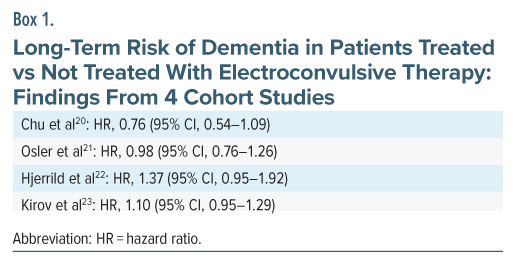
Noteworthy points are that, in these 4 studies, there was adjustment for confounding built into the study design because in all studies the control subjects were psychiatric patients who had not been treated with ECT, rather than population controls. Furthermore, all studies adjusted for at least some medical comorbidities. Finally, 2 studies22,23 used previous psychiatric admissions as a proxy to adjust for confounding by severity of indication. However, adjustment for unmeasured and unknown confounds was, by definition, impossible. Nevertheless, ECT was not associated with a significantly increased long-term risk of dementia in any study.
Take-Home Message
Four cohort studies with an average follow up of 5 to 25 years found that, after modest adjustment for confounding, including confounding by indication and confounding by severity of indication, and after considering death as a competing risk, ECT was not associated with an increased risk of dementia. This finding is reassuring because it was obtained even though incomplete adjustment (for confounding by indication and confounding by severity of indication) could have prejudiced the results against ECT.
Article Information
Published Online: October 26, 2026. https://doi.org/10.4088/JCP.26f16711
© 2026 Physicians Postgraduate Press, Inc.
To Cite: Andrade C. Electroconvulsive therapy and the long-term risk of dementia: conceptual issues, methodological issues, and recent findings. J Clin Psychiatry 2026;87(4):26f16711.
Author Affiliations: Department of Clinical Psychopharmacology and Neurotoxicology, National Institute of Mental Health and Neurosciences, Bangalore, India; Department of Psychiatry, Kasturba Medical College, Manipal Academy of Higher Education, Manipal, India.
Corresponding Author: Chittaranjan Andrade, MD, Department of Clinical Psychopharmacology and Neurotoxicology, National Institute of Mental Health and Neurosciences, Bangalore 560029, India ([email protected]).
Relevant Financial Relationships: None.
Funding/Support: None.
 Each month in his online column, Dr Andrade considers theoretical and practical ideas in clinical psychopharmacology with a view to update the knowledge and skills of medical practitioners who treat patients with psychiatric conditions.
Department of Clinical Psychopharmacology and Neurotoxicology, National Institute of Mental Health and Neurosciences, Bangalore, India. Please contact Chittaranjan Andrade, MD, at Psychiatrist.com/contact/andrade.
References (23)

- Kaster TS, Rhee TG, Adler E, et al. Electroconvulsive therapy: improved understanding of long-term risks and benefits from advances in administrative health data. Br J Psychiatry. 2026;16:1–6. CrossRef
- Andrade C. Electroconvulsive therapy and all-cause mortality, nonsuicide mortality, and suicide mortality. J Clin Psychiatry. 2026;87(4):26f16659.
- Andrade C, Arumugham SS, Thirthalli J. Adverse effects of electroconvulsive therapy. Psychiatr Clin North Am. 2016;39(3):513–530.
- Devanand DP, Dwork AJ, Hutchinson ER, et al. Does ECT alter brain structure?. Am J Psychiatry. 1994;151(7):957–970.
- Swartz CM. What is brain damage and does electroconvulsive therapy cause it?. J ECT. 2024;40(2):72–77. CrossRef
- McCall WV. Electroconvulsive therapy does not cause "brain damage. J ECT. 2024;40(2):67–68.
- Erchinger VJ, Evjenth Sørhaug OJ, Aukland SM, et al. Effects of electroconvulsive therapy on brain structure: a neuroradiological investigation into white matter hyperintensities, atrophy, and microbleeds. Biol Psychiatry Cogn Neurosci Neuroimaging. 2025;10(8):814–822. PubMed
- Smitha JS, Roopa R, Sagar BK, et al. Images in electroconvulsive therapy: ECS dose-dependently increases cell proliferation in the subgranular region of the rat hippocampus. J ECT. 2014;30(3):193–194. PubMed CrossRef
- Smitha JS, Roopa R, Khaleel N, et al. Images in electroconvulsive therapy: electroconvulsive shocks dose-dependently increase dendritic arborization in the CA1 region of the rat hippocampus. J ECT. 2014;30(3):191–192. PubMed CrossRef
- Segi-Nishida E. Exploration of new molecular mechanisms for antidepressant actions of electroconvulsive seizure. Biol Pharm Bull. 2011;34(7):939–944. PubMed
- Takamiya A, Ueda R, Kamiya K, et al. Hippocampal dentate gyrus plasticity and its association with dimensional clinical improvement across four depression treatment interventions. Am J Psychiatry. 2026;26:appiajp20251330. CrossRef
- Kellner CH, Husain MM, Knapp RG, et al. Right unilateral ultrabrief pulse ECT in geriatric depression: phase 1 of the PRIDE study. Am J Psychiatry. 2016;173(11):1101–1109. PubMed
- Sarma S, Zeng Y, Barreiros AR, et al. Clinical outcomes of electroconvulsive therapy (ECT) for depression in older old people relative to other age groups across the adult life span: a CARE network study. Int J Geriatr Psychiatry. 2024;39(8):e6133. PubMed
- Arnison T, Eriksson A, Nordenskjöld A. Electroconvulsive therapy in the oldest-old patients with depression: response and remission rates, prognostic factors, adverse events and mortality. Am J Geriatr Psychiatry. 2025;33(10):1065–1076. PubMed
- Zilles-Wegner D, von Mücke-Heim IA, Yrondi A, et al. Clinical and biological markers of electroconvulsive therapy effectiveness: a narrative review. Transl Psychiatry. 2026;16(1):87. PubMed
- Elser H, Horváth-Puhó E, Gradus JL, et al. Association of early-middle-and late-life depression with incident dementia in a Danish cohort. JAMA Neurol. 2023;80(9):949–958.
- Ribe AR, Laursen TM, Charles M, et al. Long-term risk of dementia in persons with schizophrenia: a Danish population-based cohort study. JAMA Psychiatry. 2015;72(11):1095–1101. PubMed
- Stafford J, Chung WT, Sommerlad A, et al. Psychiatric disorders and risk of subsequent dementia: systematic review and meta-analysis of longitudinal studies. Int J Geriatr Psychiatry. 2022;37(5).
- Kassar O, Makhlouf HA, Mansour MEM, et al. Long-term dementia risk following electroconvulsive therapy: a GRADE-assessed systematic review and meta-analysis. Int Psychogeriatr. 2026;38(3):100159. PubMed
- Chu CW, Chien WC, Chung CH, et al. Electroconvulsive therapy and risk of dementia-a nationwide cohort study in Taiwan. Front Psychiatry. 2018;9:397. PubMed
- Osler M, Rozing MP, Christensen GT, et al. Electroconvulsive therapy and risk of dementia in patients with affective disorders: a cohort study. Lancet Psychiatry. 2018;5(4):348–356. PubMed CrossRef
- Hjerrild S, Kahlert J, Buchholtz PE, et al. Long-term risk of developing dementia after electroconvulsive therapy for affective disorders. J ECT. 2021;37(4):250–255. PubMed
- Kirov G, Simmonds E, Kaster T, et al. Risk of dementia after electroconvulsive therapy: a cohort study on the population of Wales. Acta Psychiatr Scand. 2025;152(4):270–277. CrossRef
Please sign in or purchase this PDF for $40.