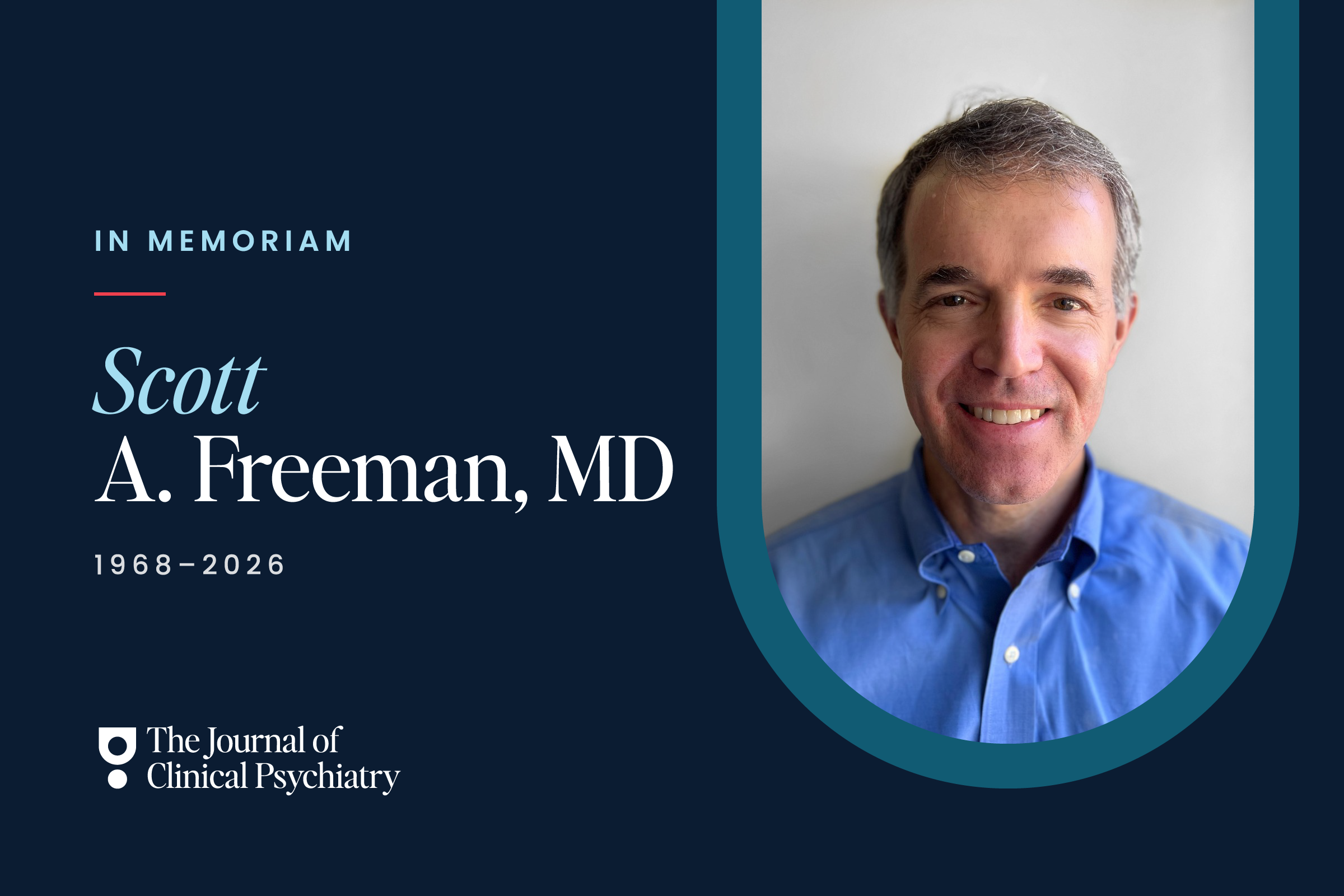

My husband, Scott A. Freeman, MD, died by suicide at age 58. He suffered from unrelenting chronic neuropathic pain.
My daughters and I are trying to imagine our lives without him, and we are deeply grieving. We are still processing the loss of an amazing person.
I met Scott during orientation week in medical school, where we both chose the field of psychiatry. We had been together ever since for 36 years, married for 33 years. He was an outstanding father and husband. He was my soulmate and best friend. He was kind, loving, and funny. We have two daughters who are just launching careers as health care providers. He was devoted to family, friends, colleagues, and patients. I am privileged to have a career that means so much to me because my husband was my biggest supporter. We moved five times across the US for my opportunities at academic institutions. Wherever we were geographically, he devoted himself to caring for patients with serious psychiatric disorders, with focused compassion for the suffering of patients and their families.
My husband wanted to live, but his life became eclipsed by pain. He experienced two years of unremitting back and neuropathic pain and died by suicide to extinguish it. I am still in shock, as we constantly talked about the future, what we were looking forward to, our daughters’ milestones, the many more years together.
He was dedicated to his practice of psychopharmacology until the day he died, relying for most of two years on telehealth due to his pain, yet seeing patients in person at his office as often as he could. Many of his patients have written to our family about how he saved their lives, caring for them with personalized and persistent care.
The Profound Lack of Appreciation of and Treatments for Chronic Pain
In the US alone, more than 20% of adults experience chronic pain, and about 7% experience “high impact” chronic pain.1 The risk of suicide in individuals with chronic pain is at least twice that of those without it.2 Others may underestimate chronic pain if someone is functioning at work and appears outwardly healthy.
However, Scott’s functioning in general was constrained by pain. He reached out for help in all directions, researching every avenue for care. Even as a physician married to a physician, with health care insurance and a network of the finest colleagues to advise, he did not find relief. His first spinal surgery left him with permanent structural nerve damage that could not be repaired. Every treatment that followed, including additional surgical procedures, nonsurgical interventions, and neuromodulation, was an attempt to manage inescapable pain. In his situation, we were struck by how few treatments exist for complex spinal and neuropathic pain that really provide meaningful clinical relief. Those he tried failed him. He found no one to navigate and direct care for treatment resistant pain.
Suicide—Acute vs Chronic Risk Factors
According to the American Foundation for Suicide Prevention (AFSP), suicide is the tenth leading cause of death in the US, with 48,824 Americans dying by suicide in 2024.3 That is likely an underestimate. While we can identify chronic risk factors for suicide, the ability to identify acute risk eludes us. The rates of suicide underscore that someone determined to end their life might show no outward signs. I would not have written this if acute risk were reliably apparent.
I recognized my husband’s persistent pain and his wish not to suffer indefinitely. Nonetheless, his unexpected death is unbearably hard to reconcile. I am the person who knew him best, and we were together almost all the time. He was “future oriented,” with a full clinical schedule and his own medical appointments and consultations coming up. The day he died was routine. We both worked from home in the morning, and he left to see patients in his office that afternoon. We talked about seeing if he felt up to a short walk when he got home. We texted and emailed up until a few hours before his death. Then he stopped responding and did not come home. A surreal and traumatic night of finding him, having to tell our daughters. He left a note, telling me and our daughters how much he loved us, knew we loved him, and that he loved life, but needed peace from the pain.
The death of a loved one by suicide brings unique feelings of sorrow, anger, grief, constant questioning. Collectively, we speak about prevention, and indeed we should screen for and address any and all risk factors for suicide. Endorsed suicidal ideation on screenings seems very different from precisely ascertained acute suicide risk of someone who is determined to die by suicide. In JCP’s Focus on Suicide section, a commentary by Courtet and Baca-Garcia4 highlights the difficulty of screening for suicidal ideation and what endorsed suicidal ideation represents, whether acute risk can be truly detected versus the detection of intense distress.
The Trauma for Those Left Behind
The death of a loved one by suicide is extraordinarily difficult. Every future life event, big and small, will be steeped with his absence. I think about how he would have helped so many individuals and their families with his work as a psychopharmacologist. He loved being a psychiatrist and never planned to retire. The compassion of family, friends, colleagues, and Scott’s patients have provided an outpouring of support and a testament to who he was.
Concluding Thoughts
My heart goes out to everyone who has walked in my shoes. I also realize that without the neurological injury and intractable pain, Scott would not have died by suicide. I implore my colleagues to seek to understand the implications of chronic pain.
For our contribution, we intend to have papers specifically focused on chronic pain in JCP in the upcoming year, under the leadership of Dr Jenny Guidi of our Editorial Board. We will continue our long-running Focus on Suicide specialty section, edited by Dr Philippe Courtet.
I commend the clinicians, researchers, and advocates who passionately work to prevent suicide. I have the privilege of the vantage points as Editor in Chief of JCP and as a psychiatrist, and I wish to reach out to raise awareness about these issues. I am deliberately sharing all of this for the patients, families, healthcare providers, advocates, and researchers who might read this. I hope this will resonate with readers, and perhaps draw attention to areas in pain management, suicide, and psychiatry that still desperately need our attention.
Published online: November 10, 2026.
Acknowledgments: I would like to thank my friends and colleagues for their generous support, feedback, and suggested edits.
Marlene P. Freeman, MD
J Clin Psychiatry 2026;87(4):26f16760
To Share: https://doi.org/10.4088/JCP.26f16760
© 2026 Physicians Postgraduate Press, Inc.
References (4)

- Rikard SM, Strahan AE, Schmit KM, et al. Chronic Pain Among Adults—United States, 2019-2021. MMWR Morb Mortal Wkly Rep. 2023;72(15):379-385. doi:10.15585/mmwr.mm7215a1
- Chincholkar M, Blackshaw S. Suicidality in chronic pain: assessment and management. BJA Educ. 2023;23(8):320-326. doi:10.1016/j.bjae.2023.05.005
- https://afsp.org/suicide-statistics/, assessed 9-26-26
- Courtet P, Baca-García E. Enriching the assessment of suicidal ideation: learning from digital studies.J Clin Psychiatry. 2024;85(1):23com15205. doi:10.4088/JCP.23com15205
This PDF is free for all visitors!