
Financial exploitation is a form of abuse involving the misuse of an individual’s finances for another person’s benefit.1 Common examples include scams, identity theft, misuse of joint accounts, and exploitation by caregivers.2 Older adults and psychiatric patients are particularly vulnerable due to cognitive impairment, psychiatric symptoms, and dependence on others.3 Despite its significant financial, physical, and mental health impact, financial exploitation remains underrecognized in psychiatric practice, placing psychiatrists in a key position to identify and address it through routine assessment of cognition, insight, judgment, and interpersonal relationships.4
Case Report
A 54-year-old man with a history of major depressive disorder, generalized anxiety disorder, polysubstance use, and postconcussion syndrome was admitted to an inpatient psychiatric unit for suicidal ideation following financial exploitation through an online romance scam. At the time of the exploitation, he was experiencing multiple psychosocial stressors, including a recent divorce from his wife of 29 years, financial strain, and social isolation. The patient reported being “love bombed” by an individual he met through a dating application who made repeated promises regarding a future relationship. During the relationship, he provided the individual with access to his banking information and ultimately lost approximately $11,000. He additionally reported discontinuing his prescribed antidepressant medications for several weeks at the encouragement of the individual.
Upon discovering that he had been deceived, the patient experienced worsening depression and developed suicidal ideation with a plan to die by cutting his wrists in a secluded location and initiated an attempt before abandoning it following contact with family members. He subsequently sought emergency psychiatric treatment. Urine toxicology was positive for cocaine and cannabis. During hospitalization, the patient’s psychiatric medications were restarted and optimized, resulting in resolution of suicidal ideation and improvement in mood. At discharge, he denied suicidal ideation and demonstrated improved insight into the relationship between the exploitation, medication nonadherence, substance use, and subsequent psychiatric decompensation.
Discussion
Individuals with psychiatric disorders are particularly vulnerable to financial exploitation due to impulsivity, impaired reality, paranoia, grandiosity, or severe depression, which can significantly distort financial judgment.3 Social factors such as loneliness, trauma histories, or emotional dependency may further increase vulnerability.5 In the present case, a recent divorce, social isolation, polysubstance use, and depression likely contributed to the patient’s susceptibility. The perpetrator’s use of “love bombing” and promises of a future relationship appeared to foster emotional dependence, ultimately leading not only to financial loss but also to medication nonadherence at the encouragement of the scammer.
In one study of adults receiving inpatient or intensive outpatient psychiatric treatment, 70% of participants experienced at least one form of financial exploitation within the preceding month, and 35% reported running out of money as a direct consequence of victimization. Risk factors included younger age, recurrent psychiatric hospitalizations, recent alcohol use, and impaired money management abilities.5 Not only are psychiatric patients at increased risk for financial exploitation, but the resulting emotional distress may also contribute to worsening depression, hopelessness, and suicidal ideation. In our case, the discovery of the deception precipitated psychiatric decompensation and suicidal ideation, highlighting how financial exploitation can lead to both financial and psychiatric crises.
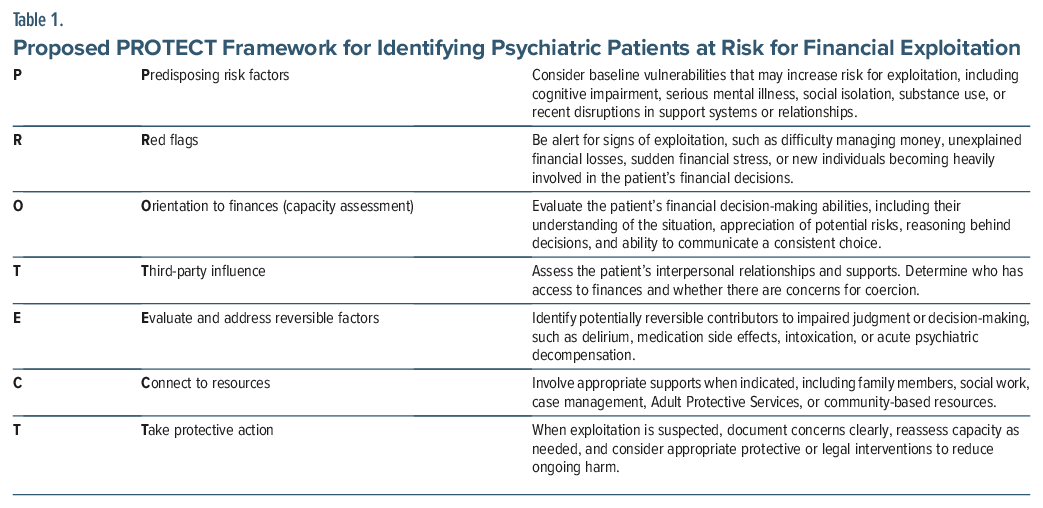
Psychiatrists are uniquely positioned to recognize financial exploitation, as many associated risk factors are routinely assessed during psychiatric evaluation. However, in the absence of structured screening tools or standardized approaches, financial exploitation may go unrecognized unless clinicians actively consider it. To support clinical recognition and response, we propose the PROTECT framework (Table 1), a practical, stepwise approach that can be integrated into routine care. By incorporating financial vulnerability into routine psychiatric evaluation, clinicians may be equipped to recognize early warning signs and intervene to preserve safety and autonomy.
Article Information
Published Online: November 26, 2026. https://doi.org/10.4088/PCC.26cr04304
© 2026 Physicians Postgraduate Press, Inc.
Prim Care Companion CNS Disord 2026;28(6):26cr04304
Submitted: June 15, 2026; accepted August 14, 2026.
To Cite: Lee H, Noe G, Baadal V, et al. Recognizing financial exploitation in psychiatric patients.
Prim Care Companion CNS Disord 2026;28(6):26cr04304.
Author Affiliations: Department of Psychiatry, Wake Forest School of Medicine, Winston-Salem, North Carolina (all authors).
Corresponding Author: Hannah Lee, BS, Department of Psychiatry, Wake Forest School of Medicine, Winston Salem, NC 27101 ([email protected]).
Financial Disclosure: None.
Funding/Support: None.
Patient Consent: Consent was obtained from the patient for publication of this case report, and information has been de-identified to protect patient anonymity.
References (5)

- Dong XQ. Elder abuse: systematic review and implications for practice. J Am Geriatr Soc. 2015;63:1214–1238. PubMed CrossRef
- Price T, King PS, Dillard RL, et al. Elder financial exploitation: implications for future policy and research in elder mistreatment. West J Emerg Med. 2011;12(3):354–356. PubMed
- Sells DJ, Rowe M, Fisk D, et al. Violent victimization of persons with co-occurring psychiatric and substance use disorders. Psychiatr Serv. 2003;54(9):1253–1257. PubMed CrossRef
- Marson DC, Savage R, Phillips J. Financial capacity in persons with schizophrenia and serious mental illness: clinical and research ethics aspects. Schizophr Bull. 2006;32(1):81–91.PubMed CrossRef
- Claycomb M, Black AC, Wilber C, et al. Financial victimization of adults with severe mental illness. Psychiatr Serv. 2013;64(9):918–920. PubMed CrossRef
Please sign in or purchase this PDF for $40.