
Abstract
Objective: Lumateperone is an atypical antipsychotic to treat schizophrenia, bipolar I or II depression, and major depressive disorder (MDD). Randomized phase 3 Study 502 (NCT05061706) investigated the impact of adjunctive lumateperone 42 mg/day on sexual functioning, per Changes in Sexual Functioning Questionnaire 14-item version (CSFQ-14).
Methods: Adults meeting DSM-5 criteria for MDD with inadequate response to 1-2 antidepressant therapies (ADTs) in the current depressive episode, Montgomery-Åsberg Depression Rating Scale Total score ≥24, Clinical Global Impression Scale-Severity score ≥4, and Quick Inventory of Depressive Symptomatology-Self Report-16-item score ≥14 were randomized to 6-week lumateperone 42 mg+ADT or placebo+ADT. Sexual function was assessed by CSFQ-14 Total and domain scores in the intent-to-treat (ITT) population and subgroups.
Results: Of 480 patients in the ITT population, 82.5% had sexual dysfunction at baseline (women=284; men=112). Lumateperone+ADT significantly improved CSFQ-14 Total score at Day 43 vs placebo+ADT (least squares mean difference [LSMD]=2.7; effect size [ES]=0.38; P<.0001). Significantly greater improvements were observed in patients with baseline sexual dysfunction (LSMD=3.1; ES=0.42; P<.0001), with no change in those without. Improvements were observed in women (LSMD=3.5; ES=0.47; P<.0001) and in men (LSMD=1.9; ES=0.33; P=.08). Significant improvements in CSFQ-14 Total score at Day 43 were observed across age groups and CSFQ domain scores, with both sexes having significant improvements in pleasure and desire/interest. Improvements in depressive symptoms may be linked to improvement in sexual functioning.
Conclusions: Adjunctive lumateperone 42 mg did not worsen sexual functioning and was not associated with treatment-related sexual dysfunction in patients with MDD with inadequate response to ADT.
Trial Registration: ClinicalTrials.gov identifier: NCT05061706
J Clin Psychiatry 2026;87(3):26m16387
Author affiliations are listed at the end of this article.
Clinical Points
- Sexual dysfunction in major depressive disorder (MDD) is underreported and can be worsened by first-line treatments (eg, SSRIs/SNRIs). Therefore, treatments with minimal sexual adverse effects are needed.
- Adjunctive lumateperone 42 mg improves depressive symptoms without worsening sexual function, suitable for patients with MDD with inadequate antidepressant therapy response seeking to avoid sexual dysfunction as an adverse effect of treatment.
From the Editors

Are you a healthcare provider?
Add your NPI to personalize your JCP experience.
Major depressive disorder (MDD) is one of the most burdensome illnesses worldwide, reducing quality of life due to the disorder itself as well as related comorbidities.1–3 Approximately 68% of patients with MDD are affected by comorbid sexual dysfunction (SD),4–6 with validated questionnaires demonstrating a higher prevalence than that seen with spontaneous reports. While a common adverse effect of antidepressant therapies (ADTs), SD is one of the most underreported adverse effects in clinical trials and clinical practice.5,6
SD and MDD are bidirectionally linked, with SD increasing risk of MDD, while MDD and its treatment being a cause of SD.7–11 Comorbid SD spontaneously resolves in only 5%–30% of cases,4 but adequate MDD treatment can improve sexual functioning, particularly sexual desire, in some patients.10,12 However, ADT can induce or worsen SD.4,6,13–15 Selective serotonin reuptake inhibitors (SSRIs) and serotonin-norepinephrine reuptake inhibitors (SNRIs) are associated with increased prevalence of SD,16–19 with SSRI-induced incidence believed to be as high as 80%.10 A study in patients with MDD treated with 1 ADT in primary care showed that 36%–43% of those on SSRIs or venlafaxine had Changes in Sexual Functioning Questionnaire (CSFQ; a validated measure of SD)20–22 Total scores indicative of SD; lower rates (<25%) were seen with the norepinephrine-dopamine reuptake inhibitor bupropion.23 This may support a class effect, as the serotonergic inhibition of the dopaminergic and noradrenergic pathways is involved in sexual desire and arousal.23–26
Sexual adverse effects typically emerge early in the course of ADT,27 are a primary cause of treatment discontinuation in patients, contribute to nonadherence,10,27–29 and are associated with poor quality of life.30 In a study of the SSRI paroxetine, onset of SD occurred in the first 2 weeks of treatment in patients with MDD without baseline SD.31 Accommodation to serotonin reuptake inhibitor–induced SD occurs in 6–12 months in <10% of patients.32
To manage treatment-emergent SD linked to SSRI and SNRI use in patients with MDD, clinicians may consider lowering the medication dose, introducing adjunctive treatments such as dopamine-enhancing agents (eg, bupropion) or serotonin-targeting therapies (eg, buspirone), switching to an alternative ADT associated with less SD, or recommending nonpharmacologic interventions.12,13,33–36 Switching ADT because of sexual adverse effects is common and appears to be supported by indirect comparisons of clinical trial data,9,37,38 although few randomized trials have explored the effectiveness of this strategy for maintaining effective treatment of depression.34 Importantly, SD may also be associated with risk of depression relapse.13,39 Therefore, novel, effective MDD treatments that improve depression symptoms with minimal sexual adverse effects are needed.
Lumateperone is an atypical antipsychotic for the treatment of schizophrenia, depressive episodes associated with bipolar I or II disorder as monotherapy and as adjunctive therapy with lithium or valproate, and MDD as adjunctive therapy to ADT.40 Lumateperone modulates several key neurotransmitters implicated in serious mental illness.41,42 Specifically, lumateperone is a potent serotonin 5-HT2A receptor antagonist, a dopamine D2 receptor presynaptic partial agonist and postsynaptic antagonist, a D1 receptor–dependent indirect modulator of AMPA (α-amino-3-hydroxy-5-methyl-4-isoxazolepropionic acid) and NMDA (N-methyl-D-aspartate) currents, and a serotonin reuptake inhibitor.41,42 This novel mechanism of action may be efficacious in MDD due to the involvement of glutamate in depression and the effects of lumateperone on the glutamatergic system.43
The efficacy of adjunctive lumateperone 42 mg/day + ADT in patients with MDD with inadequate ADT response has been demonstrated in the phase 3, randomized, double-blind, placebo-controlled clinical trial Study 502 (NCT05061706).44 Lumateperone 42 mg adjunctive to ADT significantly improved depressive symptoms and disease severity compared with placebo adjunctive to ADT, as measured by both clinician- and patient-rated outcomes. In this analysis of Study 502, the impact of lumateperone 42 mg+ ADT on sexual functioning, as measured by the CSFQ 14-item version (CSFQ-14), was assessed.
METHODS
Study Design and Patients
This post hoc analysis of SD was based on data from Study 502, a phase 3, randomized, double-blind, placebo-controlled trial that included patients with MDD with inadequate response to ADT. Detailed methods for Study 502 have been previously published.44 Briefly, the study consisted of a screening period (up to 2 weeks), a 6-week double-blind treatment period, and a 1-week safety follow-up period. Participants were randomized 1:1 to oral lumateperone 42 mg+ADT or placebo +ADT once daily.
Eligible male and female patients (aged 18–65 years) met the Diagnostic and Statistical Manual of Mental Disorders, Fifth Edition, diagnostic criteria for MDD, as confirmed by the Mini-International Neuropsychiatric Interview.44,45 Participants had inadequate response to 1 or 2 courses of ADT in the current depressive episode, defined as <50% improvement with ≥6 weeks of ADT monotherapy, as confirmed by the Antidepressant Treatment Response Questionnaire. Participants were experiencing a major depressive episode, defined as Montgomery-Åsberg Depression Rating Scale (MADRS) Total score ≥24,46 and had Clinical Global Impression–Severity score ≥447 and Quick Inventory of Depressive Symptomatology−Self Report 16-item score ≥1448 at screening and baseline; duration of the current major depressive episode was ≥8 weeks but ≤18 months prior to screening.
Exclusion criteria included a lifetime psychiatric diagnosis other than MDD (eg, schizophrenia, schizoaffective disorder, bipolar disorder, other psychotic disorders) and alcohol/substance use disorders within 6 months.
The study protocol complied with the Declaration of Helsinki and Good Clinical Practice guidelines and was approved by an institutional review board or ethics committee/government agency; written informed consent was obtained from study participants.
Assessments
The primary endpoint was the change from baseline to Day 43 in MADRS Total score in the modified intent-to-treat (mITT) population. Sexual function was evaluated in post hoc analyses, based on changes in CSFQ-14 Total score in the intent-to-treat (ITT) population. Changes from baseline to Day 43 in CSFQ-14 domain scores (pleasure, desire/frequency, desire/ interest, arousal/excitement, and orgasm/completion) were also evaluated. Higher CSFQ-14 Total scores indicate better sexual functioning; CSFQ-14 Total scores ≤41 in female patients and ≤47 in male patients are categorized as SD. Changes or differences of 2 or 3 points in the CSFQ-14 Total score vs placebo are considered clinically meaningful.7,22,34,49,50
Statistical Analysis
Analyses were conducted in the ITT population and in subgroups by baseline SD (CSFQ-14 Total score ≤41 for female patients and ≤47 for male patients), sex (female vs male), and age (<45 vs ≥45 years). The ITT population was defined as all randomized patients who received ≥1 dose of study treatment and had a baseline MADRS Total score.
Details of the primary statistical analysis are included in the Supplementary Materials.
This post hoc analysis was exploratory, and results are therefore descriptive rather than confirmatory; no adjustment for multiplicity was applied. All reported P values are nominal and should be interpreted descriptively.
RESULTS
Patient Population
All 480 randomized patients received adjunctive treatment and were included in the ITT population (lumateperone +ADT, n=242; placebo +ADT, n=238); 89.4% of patients completed treatment. Baseline demographics and disease characteristics were similar between treatment groups (Supplementary Table 1). The mean age of the study population was 46 years, and the majority of patients were women (69.6%) and White (95.4%). During double-blind treatment, the most commonly administered ADTs were SSRIs (lumateperone +ADT, 66.1%; placebo +ADT, 60.5%), followed by SNRIs (lumateperone+ ADT, 27.7%; placebo +ADT, 33.6%). Most patients (82.5%) met the criteria for SD at baseline (women, 85.0%; men, 76.7%).
Efficacy Outcomes
The primary endpoint was met with lumateperone +ADT, with significantly greater MADRS Total score improvement from baseline to Day 43 vs placebo +ADT in the mITT population (lumateperone +ADT, n=232; placebo +ADT, n=237; least squares mean difference [LSMD] vs placebo +ADT, −4.5; effect size [ES], −0.56; P<.0001); improvements in the CGI-S score (LSMD, −0.5; ES, −0.51; P<.0001) and QIDS-SR-16 Total score (LSMD, −2.2; ES, −0.45; P <.0001) were also significant. 44
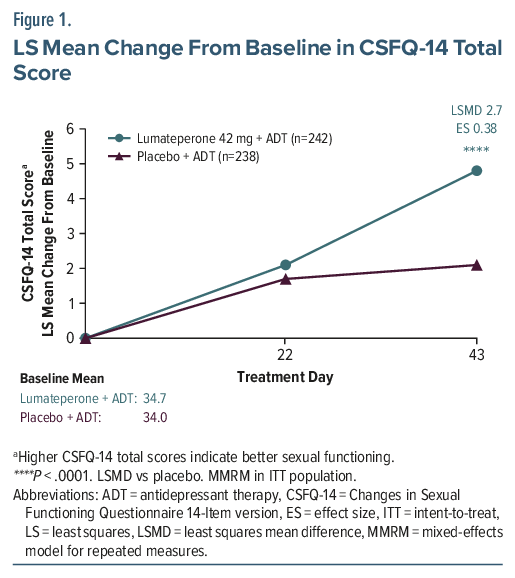
Lumateperone + ADT provided statistically significant, clinically meaningful (2-or 3-point difference).7,22,34,49,50 improvement in CSFQ-14 Total score at Day 43 vs placebo+ADT in the ITT population (LSMD, 2.7; ES, 0.38; P <.0001) (Figure 1) in this post hoc analysis.
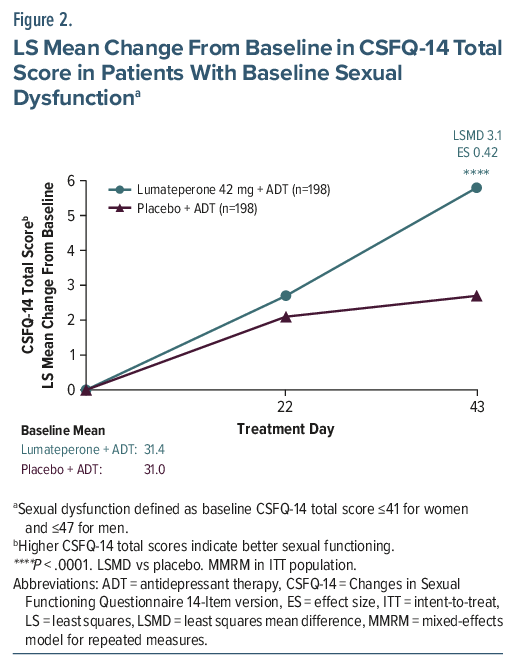
Lumateperone+ADT significantly improved CSFQ-14 Total score at Day 43 vs placebo +ADT in patients with SD at baseline (lumateperone+ADT, n=198; placebo +ADT, n= 198) (Figure 2), in this exploratory subgroup analysis. In this post hoc analysis, in women with SD at baseline (lumateperone +ADT, n=142; placebo +ADT, n= 142), lumateperone +ADT demonstrated significant improvement in CSFQ-14 Total score at Day 43 (baseline mean: lumateperone+ADT, 28.7; placebo +ADT, 28.5; change at Day 43: LSMD, 3.8; ES, 0.50; P<.0001). In men with SD at baseline (lumateperone+ADT, n=56; placebo+ADT, n=56), the CSFQ-14 Total score showed a numerical improvement at Day 43 (baseline mean: lumateperone+ADT, 38.3; placebo +ADT, 37.2; change at Day 43: LSMD, 2.2; ES, 0.36; P=.0975). In patients without SD at baseline, CSFQ-14 Total score remained unchanged at Day 43 (baseline mean: lumateperone+ADT, 50.1; placebo +ADT, 49.1; change at Day 43: LSMD, −0.4; ES, −0.10; P=.7266).
In this post hoc analysis, a similar proportion of patients with normal sexual functioning at baseline retained it at the end of treatment with lumateperone+ADT and placebo +ADT (74.4% in both groups) (Supplementary Table 2). Among those with normal sexual functioning at baseline, a slightly lower proportion of patients receiving lumateperone+ADT shifted to SD compared with placebo +ADT (20.9% vs 25.6%). Additionally, among patients with sexual dysfunction at baseline, a greater proportion receiving lumateperone+ADT improved to normal sexual function compared with placebo +ADT (26.3% vs 15.2%).
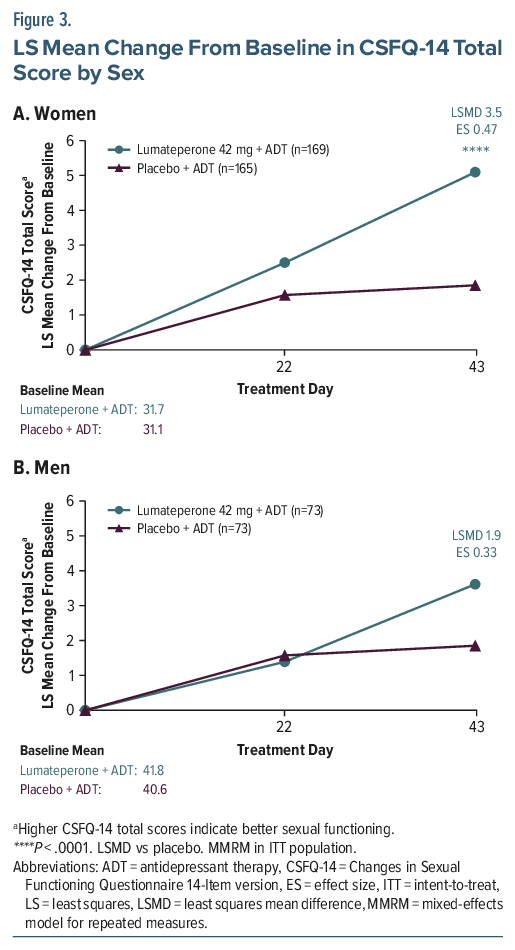
CSFQ-14 Total score significantly improved with lumateperone+ADT vs placebo+ADT from baseline to Day 43 in women (LSMD, 3.5; ES, 0.47; P <.0001) (Figure 3), meeting the criteria for clinically meaningful improvement (defined as a difference of ≥2 points). In men, numerical improvements in CSFQ-14 Total score from baseline to Day 43 were observed (LSMD, 1.9; ES, 0.33; P=.0791), which did not meet the criteria for clinical meaningfulness.
A significant improvement in CSFQ-14 Total score from baseline to Day 43 with lumateperone+ADT vs placebo+ADT was observed in both younger (<45 years; LSMD, 3.0; ES, 0.41; P<.05) and older (≥45 years; LSMD, 3.0; ES, 0.43; P<.001) patient subgroups (Supplementary Figure 1).
Analysis of change from baseline in CSFQ-14 Total score by antidepressant class is presented in the Supplement (Supplementary Figure 2).
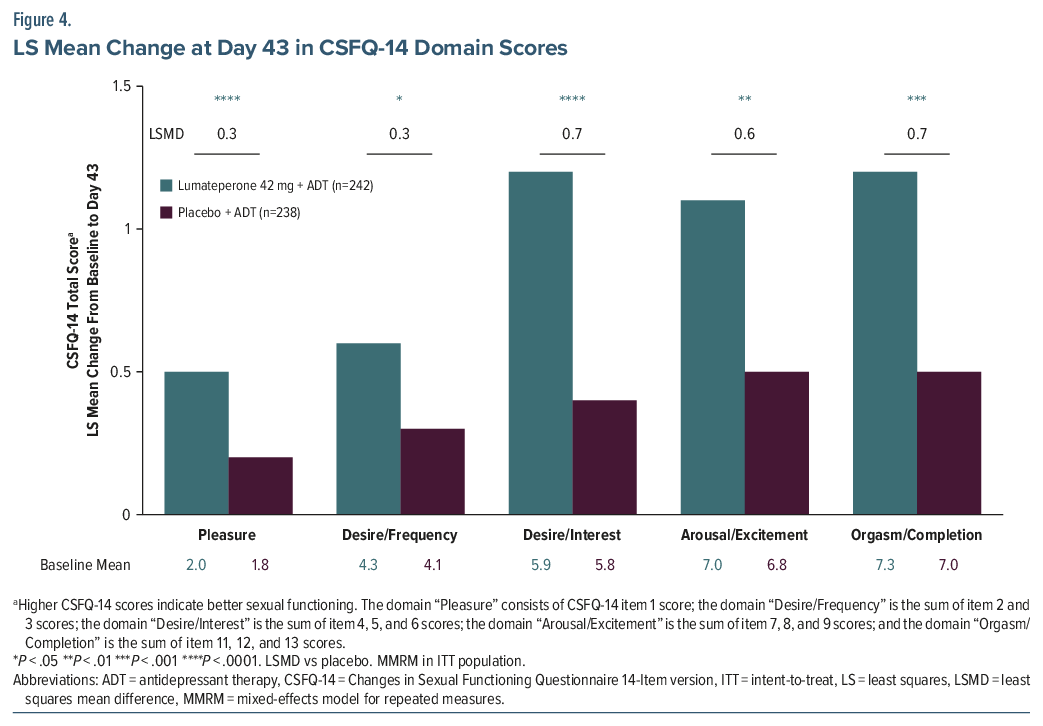
Improvements with lumateperone+ADT were statistically significant across all CSFQ-14 domain scores at Day 43 vs placebo+ADT (Figure 4). This included improvements in pleasure (LSMD, 0.3; ES, 0.39; P<.0001), desire/frequency (LSMD, 0.3; ES, 0.24; P<.05), desire/interest (LSMD, 0.7; ES, 0.39; P<.0001), arousal/excitement (LSMD, 0.6; ES, 0.28; P<.01), and orgasm/completion (LSMD, 0.7; ES, 0.33; P<.001).
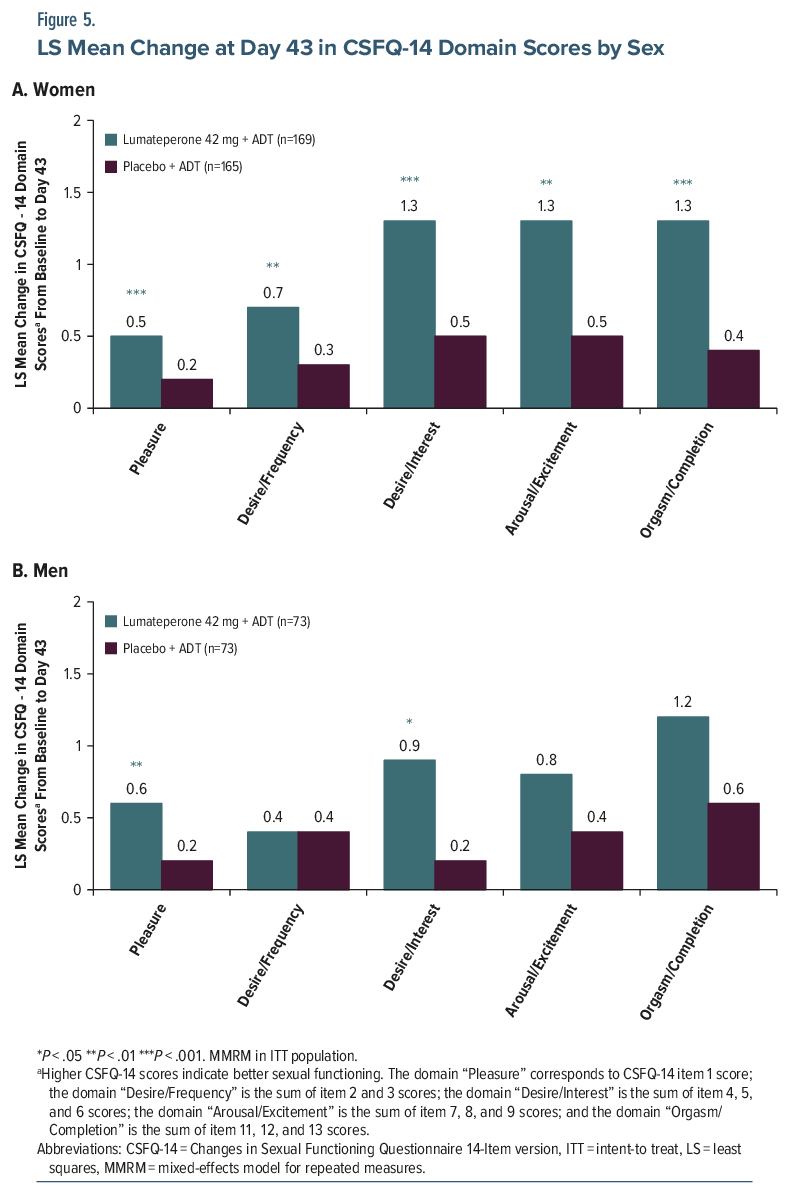
Lumateperone+ ADT significantly improved outcomes, with both sexes showing significant changes from baseline in pleasure and desire/interest. Statistically significant improvements in desire/frequency, arousal/excitement, and orgasm/completion were observed in women only, with numerical improvements observed in men for these domains (Figure 5). Analysis of CSFQ-14 Total and domain score distributions at baseline showed no evidence of substantial ceiling or floor effects (Supplementary Table 3).
Additional post hoc analyses were conducted to examine the relationship between changes in depressive symptoms and sexual function. A correlation analysis demonstrated a moderate association between the change from baseline in MADRS Total score and CSFQ-14 Total score at Day 22 (r =−0.262) and Day 43 (r =−0.378). A mixed-effects model for repeated measures analysis assessed change from baseline in CSFQ Total score with change in MADRS Total score as a covariate. After adjusting for improvements in depressive symptoms, the effect of adjunctive lumateperone on the CSFQ-14 Total score was not statistically significant (P=.09). Finally, an exploratory analysis further indicated that approximately 66.2% of the treatment effect on CSFQ-14 Total score was mediated through changes in MADRS Total score (depressive symptoms).
DISCUSSION
This post hoc analysis of the phase 3, randomized, double-blind, placebo-controlled Study 502 demonstrated that adjunctive lumateperone treatment improves sexual functioning as measured by the CSFQ score vs placebo +ADT in patients with MDD with inadequate response to ADT. These results expand on the primary analysis, in which lumateperone+ADT improved overall depression (MADRS Total score) vs placebo +ADT.44
In this post hoc analysis, lumateperone +ADT was associated with significant improvement in sexual functioning at Day 43 vs placebo+ADT in the overall ITT population, per CSFQ-14 Total score. A 2-to 3-point change in CSFQ Total score has been suggested as clinically meaningful based on prior comparative studies of ADT with differing effects on sexual functioning; therefore, the observed LSMD of 2.7 points is consistent with modest improvement in sexual functioning.34 At baseline, when treated with ADT alone, 82.5% of patients met the criteria for SD, with a higher proportion of women (85.0%) than men (76.7%) experiencing SD. This is aligned with previous studies in this setting, in which a similarly high proportion of patients (>80%) had preexisting SD before treatment initiation.50 The difference in incidence between men and women at baseline also aligns with previous findings in a post hoc analysis of a phase 4 trial in patients with MDD receiving treatment with ADTs (vilazodone and citalopram).7
Significant improvements in CSFQ-14 Total score with lumateperone+ADT vs placebo +ADT were observed in the subgroup of patients who reported SD at baseline in this exploratory analysis, with over 25% of patients with SD at baseline having normal sexual function at the end of the double-blind treatment period. Improved sexual functioning during MDD treatment may reflect overall symptom improvement.7 Additionally, compared with placebo +ADT, fewer patients treated with lumateperone+ADT shifted from sexual functioning at baseline to sexual dysfunction at the end of treatment, and a greater proportion of patients with sexual dysfunction at baseline improved to normal sexual function. The pharmacologic profile of lumateperone differs from that of other atypical antipsychotics, which may be relevant to its effects on sexual functioning; however, the exact mechanisms underlying these differences were not assessed in this study.51
In the subgroup of patients without baseline SD, CSFQ-14 Total score remained stable throughout the treatment period. A shift analysis showed that approximately 75% of these patients retained normal sexual function at the end of treatment. These findings suggest no evidence of worsening sexual function over the 6-week treatment period; long-term effects were not assessed. In contrast, commonly used antidepressants such as the SSRIs paroxetine and sertraline52 and the SNRI venlafaxine,53 as well as atypical antipsychotics such as risperidone and olanzapine,54 have been associated with treatment-emergent SD in patients with normal baseline sexual function.
Women had statistically significant improvements in CSFQ-14 Total score from baseline to Day 43, whereas in the male population, numerical improvement did not reach statistical significance. These exploratory findings should be interpreted cautiously given the post hoc nature of the analyses, lack of adjustment for multiple comparisons, and the relatively small sample size in men; although it is possible that the magnitude of benefit differs by sex, conclusions cannot be drawn on this result in men. However, these results are consistent with clinical trials of the atypical antipsychotics brexpiprazole and aripiprazole adjunctive to ADT in the treatment of MDD, in which women showed significant improvements in sexual functioning, while men had numerical, nonsignificant improvements.55,56 Although antipsychotics generally demonstrate comparable efficacy in men and women as adjunctive therapy in MDD,55,56 some agents in this class have been associated with elevated prolactin levels, which may contribute to SD.57,58 These adverse effects are more pronounced in women than in men, but more common in men than in women.57,58 Across clinical studies in patients with MDD, bipolar disorder, and schizophrenia, lumateperone+ADT was not associated with increases in prolactin levels.44,59–66
A significant improvement in CSFQ-14 Total score from baseline to Day 43 was observed with lumateperone +ADT vs placebo +ADT in all patients regardless of age in this post hoc analysis. Previous research has indicated that ADT-associated SD is commonly reported in older adults, likely due to age-related physiological changes such as reduced sex hormone levels, vascular problems, and the presence of comorbid medical conditions.58,67,68 Some studies have reported associations between age and SD,27,69 suggesting that age and related health factors may influence sexual functioning outcomes during ADT treatment. Additionally, in older women, menopause may be associated with changes in sexual function and response to ADT, potentially due to declining estrogen levels.58,68
Treatment with lumateperone +ADT was associated with improvements across all CSFQ-14 domain scores vs placebo +ADT. Although the study included twice as many women as men, which may have contributed to the observed differences in sexual functioning, both sexes showed improvements from baseline in pleasure and desire/interest, while improvements in desire/frequency, arousal/excitement, and orgasm/completion were significant only in women. However, because clinically meaningful change thresholds have not been established for CSFQ-14 domains, these results should be interpreted as exploratory.
SD may be linked to performance anxiety, often presenting as premature ejaculation and reduced sexual satisfaction in men, and as impaired desire, arousal, sexual activity, and satisfaction in women.33,70 Moreover, experiencing SD (eg, inability to climax or loss of sensation) may also lead to frustration, lowered self-esteem, and relationship strain contributing to emotional blunting.71,72 However, research also suggests that physiological impairments, such as difficulties with arousal and orgasm, are directly linked to ADT use, particularly SSRIs.10,27,72 Some atypical antipsychotics, such as risperidone, have been associated with sexual adverse effects, including reduced sexual desire and orgasmic dysfunction following treatment.54,73 Overall, these findings describe sexual functioning outcomes with lumateperone+ADT in patients with MDD, addressing both physiological and emotional dimensions of sexual health.
Post hoc analyses showed that improvements in sexual functioning were moderately associated with improvements in depressive symptoms. After adjusting for MADRS Total score, the treatment effect on CSFQ-14 Total score was no longer significant, and mediation analysis suggested that the effect on sexual function was largely related to improvements in mood. These findings suggest that improvement in depressive symptoms, which were observed for the primary efficacy outcome, may also be associated with improvement in sexual functioning. These results are consistent with prior literature suggesting that adequate treatment may be associated with improvement in sexual functioning.12
The strengths of this post hoc analysis include a large study population, the inclusion of patients with and without baseline SD, and the use of a validated sexual function scale, the CSFQ-14, to assess sexual functioning over time.
A limitation of this study is the short-term duration (6 weeks), which may not have captured the long-term effects of lumateperone on sexual functioning. Due to the post hoc, exploratory nature of the analyses, no adjustments for multiplicity were performed, and P values are nominal. Improvement in depressive symptoms may also have contributed to improved sexual function. Additionally, SD was assessed using self-reported measures, which can be influenced by personal bias, recall inaccuracy, or reluctance to disclose sensitive information. Sexual activity and partnership were not assessed, which may limit the interpretation of these sexual functioning data. Furthermore, the study population comprised predominantly White patients and a relatively small population of men (∼30%), which may have resulted in the analyses in the male population being underpowered. Therefore, the results may not be generalizable to the wider population of patients with MDD. This may limit interpretation of the findings in real-world clinical settings.
In summary, this post hoc analysis of the phase 3 Study 502 demonstrated that lumateperone 42 mg+ ADT significantly improved SD compared with placebo + ADT, as measured by the CSFQ-14 Total score, in patients with MDD with inadequate response to ADT. Significant improvements in sexual function with lumateperone 42 mg + ADT were observed across multiple patient subgroups, including those with baseline SD, women, and both younger and older adults, as well as across individual CSFQ-14 domains. In patients without baseline SD, no evidence of worsening sexual function was observed over the 6-week treatment period.
These findings indicate that lumateperone 42 mg+ADT did not worsen sexual functioning, with additional analyses showing that it is unlikely to be associated with treatment-related SD. These results support its potential as an effective, well-tolerated adjunctive therapy in patients with MDD with inadequate ADT response.
Article Information
Published Online: September 2, 2026. https://doi.org/10.4088/JCP.26m16387
© 2026 Physicians Postgraduate Press, Inc.
Submitted: February 18, 2026; accepted June 29, 2026.
To Cite: Clayton AH, Earley WR, Kozauer SG, et al. Evaluation of sexual function with adjunctive lumateperone in patients with major depressive disorder.
J Clin Psychiatry 2026;87(3):26m16387.
Author Affiliations: University of Virginia School of Medicine, Charlottesville, Virginia (Clayton); Former Employee of Intra-Cellular Therapies, A Johnson & Johnson company, Bedminster, New Jersey (Kozauer); Intra-Cellular Therapies, A Johnson & Johnson company, Bedminster, New Jersey (Earley, Mo, Edwards, Durgam).
Corresponding Author: Anita H. Clayton, MD, Univ Virginia, 2955 Ivy Road, Northridge Suite 210, Charlottesville 22901, VA 22903 ([email protected]).
Notice of Correction 9/17/26: Text in the abstract, Results, and Discussion has been corrected to reflect that the CSFQ domain desire/interest demonstrated statistically significant improvement in both sexes, while the arousal/excitement domain demonstrated statistically significant improvement in women only.
Author Contributions: Drs Clayton, Earley, Kozauer, Mo, Edwards, and Durgam participated in study design and study conduct. All authors participated in data analysis/interpretation and writing/critical review and approved the final manuscript for publication.
Financial Disclosure: Drs Mo, Edwards, Earley, and Durgam are full-time employees of Intra-Cellular Therapies, a Johnson & Johnson company. Dr Kozauer is a former employee of Intra-Cellular Therapies, a Johnson & Johnson company. Dr Clayton has received grant funding from Janssen, Neumora Therapeutics, Neurocrine Biosciences, Otsuka, Relmada Therapeutics, Reunion Neuroscience, S1 Biopharma; has received consulting fees from AbbVie, Inc., ACCUMIN, Actinogen, AdhereTech, Axsome Therapeutics, Biogen, Inc., Initiator Pharma, Intra-Cellular Therapies Inc., Janssen Research & Development, LLC, LiveNova PLC, MycoMedica Life Sciences, PBC, Neumora Therapeutics, Inc., Neurocrine Biosciences, P/S/L Group Services, Reunion Neuroscience, S1 Biopharma, Seaport Therapeutics, Sertsei Pharmaceuticals, Inc., Vella Bioscience, Inc; has received royalties/copyright from Ballantine Books/Random House, Changes in Sexual Functioning Questionnaire, Guilford Publications; and may hold shares or restricted stock units in Mediflix LLC and S1 Biopharma.
Funding/Support: This study was funded by Intra-Cellular Therapies, a Johnson & Johnson company, Bedminster, New Jersey.
Role of the Funder: Intra-Cellular Therapies, a Johnson & Johnson company, was responsible for the design, analysis, interpretation, and publication of this study.
Previous Presentation: Presented as a poster at the European College of Neuropsychopharmacology (ECNP) Annual Congress; October 11–14, 2025; Amsterdam, the Netherlands.
Acknowledgments: The authors thank all study investigators, research staff, and patients for their participation. Medical writing support was provided by Keri Ramessar, PhD, of Nucleus Global, an Inizio company, and funded by Intra-Cellular Therapies, a Johnson & Johnson company.
Supplementary Material: Available at Psychiatrist.com.
Clinical Points
- Sexual dysfunction in major depressive disorder (MDD) is underreported and can be worsened by first-line treatments (eg, SSRIs/SNRIs). Therefore, treatments with minimal sexual adverse effects are needed.
- Adjunctive lumateperone 42 mg improves depressive symptoms without worsening sexual function, suitable for patients with MDD with inadequate antidepressant therapy response seeking to avoid sexual dysfunction as an adverse effect of treatment.
References (73)

- Marx W, Penninx B, Solmi M, et al. Major depressive disorder. Nat Rev Dis Primers. 2023;9(1):44.
- World Health Organization. Mental health action plan 2013-2020. Accessed October 2025. http://apps.who.int/iris/bitstream/10665/89966/1/9789241506021_eng.pdf?ua=1
- Proudman D, Greenberg P, Nellesen D. The growing burden of major depressive disorders (MDD): implications for researchers and policy makers. Pharmacoeconomics. 2021;39(6):619–625. PubMed CrossRef
- Jacobsen P, Zhong W, Nomikos G, et al. Paroxetine, but not vortioxetine, impairs sexual functioning compared with placebo in healthy adults: a randomized, controlled trial. J Sex Med. 2019;16(10):1638–1649. CrossRef
- Williams VS, Baldwin DS, Hogue SL, et al. Estimating the prevalence and impact of antidepressant-induced sexual dysfunction in 2 European countries: a cross-sectional patient survey. J Clin Psychiatry. 2006;67(2):204–210. PubMed CrossRef
- Williams VS, Edin HM, Hogue SL, et al. Prevalence and impact of antidepressant-associated sexual dysfunction in three European countries: replication in a cross-sectional patient survey. J Psychopharmacol. 2010;24(4):489–496. PubMed CrossRef
- Clayton AH, Gommoll C, Chen D, et al. Sexual dysfunction during treatment of major depressive disorder with vilazodone, citalopram, or placebo: results from a phase IV clinical trial. Int Clin Psychopharmacol. 2015;30(4):216–223. PubMed CrossRef
- Lorenz T, Rullo J, Faubion S. Antidepressant-induced female sexual dysfunction. Mayo Clin Proc. 2016;91(9):1280–1286. PubMed CrossRef
- Reichenpfader U, Gartlehner G, Morgan LC, et al. Sexual dysfunction associated with second-generation antidepressants in patients with major depressive disorder: results from a systematic review with network meta-analysis. Drug Saf. 2014;37(1):19–31. PubMed CrossRef
- Rothmore J. Antidepressant-induced sexual dysfunction. Med J Aust. 2020;212(7):329–334. CrossRef
- Atlantis E, Sullivan T. Bidirectional association between depression and sexual dysfunction: a systematic review and meta-analysis. J Sex Med. 2012;9(6):1497–1507. PubMed CrossRef
- Clayton AH, El Haddad S, Iluonakhamhe JP, et al. Sexual dysfunction associated with major depressive disorder and antidepressant treatment. Expert Opin Drug Saf. 2014;13(10):1361–1374. PubMed CrossRef
- Higgins A, Nash M, Lynch AM. Antidepressant-associated sexual dysfunction: impact, effects, and treatment. Drug Healthc Patient Saf. 2010;2:141–150. PubMed CrossRef
- Delgado PL, Brannan SK, Mallinckrodt CH, et al. Sexual functioning assessed in 4 double-blind placebo-and paroxetine-controlled trials of duloxetine for major depressive disorder. J Clin Psychiatry. 2005;66(6):686–692. PubMed CrossRef
- Clayton A, Kornstein S, Prakash A, et al. Changes in sexual functioning associated with duloxetine, escitalopram, and placebo in the treatment of patients with major depressive disorder. J Sex Med. 2007;4(4 Pt 1):917–929. PubMed CrossRef
- Clayton AH, Montejo A. Major depressive disorder, antidepressant, and sexual dysfunction. J Clin Psychiatry. 2006;67(Suppl 6):33–37.
- Corona G, Ricca V, Bandini E, et al. Selective serotonin reuptake inhibitor-induced sexual dysfunction. J Sex Med. 2009;6(5):1259–1269. PubMed CrossRef
- Kennedy SH, Rizvi S. Sexual dysfunction, depression, and the impact of antidepressants. J Clin Psychopharmacol. 2009;29(2):157–164. PubMed CrossRef
- Hirsch M, Birnbaum R. Sexual dysfunction caused by selective serotonin reuptake inhibitors (SSRIs): clinical features and management. 2024. Accessed October 17, 2025. https://www.uptodate.com/contents/sexual-dysfunction-caused-by-selective-serotonin-reuptake-inhibitors-ssris-clinical-features-and-management
- Clayton AH, McGarvey EL, Clavet GJ. The Changes in Sexual Functioning Questionnaire (CSFQ): development, reliability, and validity. Psychopharmacol Bull. 1997;33(4):731–745. PubMed
- Clayton AH, McGarvey EL, Clavet GJ, et al. Comparison of sexual functioning in clinical and nonclinical populations using the Changes in Sexual Functioning Questionnaire (CSFQ). Psychopharmacol Bull. 1997;33(4):747–753. PubMed
- Keller A, McGarvey EL, Clayton AH. Reliability and construct validity of the Changes in Sexual Functioning Questionnaire short-form (CSFQ-14). J Sex Marital Ther. 2006;32(1):43–52. PubMed CrossRef
- Clayton AH, Pradko JF, Croft HA, et al. Prevalence of sexual dysfunction among newer antidepressants. J Clin Psychiatry. 2002;63(4):357–366.PubMed CrossRef
- Graf H, Malejko K, Metzger CD, et al. Serotonergic, dopaminergic, and noradrenergic modulation of erotic stimulus processing in the male human brain. J Clin Med. 2019;8(3):363. PubMed CrossRef
- Just MJ. The influence of atypical antipsychotic drugs on sexual function. Neuropsychiatr Dis Treat. 2015;11:1655–1661. PubMed CrossRef
- Santana Y, Montejo AL, Martin J, et al. Understanding the mechanism of antidepressant-related sexual dysfunction: inhibition of tyrosine hydroxylase in dopaminergic neurons after treatment with paroxetine but not with agomelatine in male rats. J Clin Med. 2019;8(2):133. CrossRef
- Safak Y, Inal AS, Alptekin FB, et al. Antidepressant-associated sexual dysfunction in outpatients. BMC Psychiatry. 2025;25(1):317. PubMed CrossRef
- Pompili M, Venturini P, Palermo M, et al. Mood disorders medications: predictors of nonadherence -review of the current literature. Expert Rev Neurother. 2013;13(7):809–825. PubMed CrossRef
- Zeiss R, Malejko K, Connemann B, et al. Sexual dysfunction induced by antidepressants—a pharmacovigilance study using data from VigiBaseTM. Pharmaceuticals. 2024;17(7):826. PubMed CrossRef
- Jacobsen PL, Thorley EM, Curran C. Real-world patient experience with sexual dysfunction and antidepressant use in patients with self-reported depression: a cross-sectional survey study. Neurol Psychiatry Brain Res. 2020;36:57–64. CrossRef
- Dunn JA, Arakawa R, Greist JH, et al. Assessing the onset of antidepressant-induced sexual dysfunction using interactive voice response technology. J Clin Psychiatry. 2007;68(4):525–532. PubMed CrossRef
- Ashton AK, Rosen RC. Accommodation to serotonin reuptake inhibitor-induced sexual dysfunction. J Sex Marital Ther. 1998;24(3):191–192. PubMed CrossRef
- Clayton AH, Croft HA, Handiwala L. Antidepressants and sexual dysfunction: mechanisms and clinical implications. Postgrad Med J. 2014;126(2):91–99. PubMed CrossRef
- Jacobsen PL, Mahableshwarkar AR, Chen Y, et al. Effect of vortioxetine vs. escitalopram on sexual functioning in adults with well-treated major depressive disorder experiencing SSRI-induced sexual dysfunction. J Sex Med. 2015;12(10):2036–2048. PubMed CrossRef
- Rizvi SJ, Kennedy SH. Management strategies for SSRI-induced sexual dysfunction. J Psychiatry Neurosci. 2013;38(5):E27–E28. PubMed CrossRef
- Taylor MJ, Rudkin L, Bullemor-Day P, et al. Strategies for managing sexual dysfunction induced by antidepressant medication. Cochrane Database Syst Rev. 2013;2013(5):CD003382. PubMed CrossRef
- Gartlehner G, Hansen RA, Morgan LC, et al. Comparative benefits and harms of second-generation antidepressants for treating major depressive disorder: an updated meta-analysis. Ann Intern Med. 2011;155(11):772–785. PubMed CrossRef
- Serretti A, Chiesa A. Treatment-emergent sexual dysfunction related to antidepressants: a meta-analysis. J Clin Psychopharmacol. 2009;29(3):259–266. PubMed CrossRef
- Croft H, Settle EJ, Houser T, et al. A placebo-controlled comparison of the antidepressant efficacy and effects on sexual functioning of sustained-release bupropion and sertraline. Clin Ther. 1999;21(4):643–658. PubMed CrossRef
- Caplyta. Prescribing information. Intra-Cellular Therapies Inc.; 2025.
- Snyder GL, Vanover KE, Zhu H, et al. Functional profile of a novel modulator of serotonin, dopamine, and glutamate neurotransmission. Psychopharmacol Berl. 2015;232(3):605–621. PubMed CrossRef
- Titulaer J, Radhe O, Danielsson K, et al. Lumateperone-mediated effects on prefrontal glutamatergic receptor-mediated neurotransmission: a dopamine D(1) receptor dependent mechanism. Eur Neuropsychopharmacol. 2022;62:22–35. CrossRef
- Khoodoruth MAS, Estudillo-Guerra MA, Pacheco-Barrios K, et al. Glutamatergic system in depression and its role in neuromodulatory techniques optimization. Front Psychiatry. 2022;13:886918. PubMed CrossRef
- Durgam S, Earley WR, Kozauer SG, et al. Adjunctive lumateperone in patients with major depressive disorder: results from a randomized, double-blind, phase 3 trial. Am J Psychiatry. 2025;182(12):1072–1082. PubMed CrossRef
- Sheehan DV, Lecrubier Y, Sheehan KH, et al. The Mini-International Neuropsychiatric Interview (MINI): the development and validation of a structured diagnostic psychiatric interview for DSM-IV and ICD-10. J Clin Psychiatry. 1998;59(20):22–33. PubMed
- Montgomery SA, Åsberg M. A new depression scale designed to be sensitive to change. Br J Psychiatry. 1979;134(4):382–389. PubMed CrossRef
- Guy W. ECDEU. Assessment Manual for Psychopharmacology. U.S. Department of Health, Education, and Welfare; 1976.
- Rush AJ, Trivedi MH, Ibrahim HM, et al. The 16-Item Quick Inventory of Depressive Symptomatology (QIDS), Clinician Rating (QIDS-C), and Self-Report (QIDS-SR): a psychometric evaluation in patients with chronic major depression. Biol Psychiatry. 2003;54(5):573–583. CrossRef
- Lorenz T, Johnson M, Clayton A. Effects of gepirone-ER on sexual function in patients with major depressive disorder. J Clin Psychiatry. 2024;85(4):24m15357. PubMed CrossRef
- Clayton AH, Tsai J, Mao Y, et al. Effect of lurasidone on sexual function in major depressive disorder patients with subthreshold hypomanic symptoms (mixed features): results from a placebo-controlled trial. J Clin Psychiatry. 2018;79(5):18m12132. CrossRef
- Sowa-Kucma M, Panczyszyn-Trzewik P, Jaeschke RR. Exploring the pharmacological and clinical features of lumateperone: a promising novel antipsychotic. Int J Mol Sci. 2024;25(24):13289. PubMed CrossRef
- Kennedy SH, Eisfeld BS, Dickens SE, et al. Antidepressant-induced sexual dysfunction during treatment with moclobemide, paroxetine, sertraline, and venlafaxine. J Clin Psychiatry. 2000;61(4):276–281. PubMed CrossRef
- Winter J, Curtis K, Hu B, et al. Sexual dysfunction with major depressive disorder and antidepressant treatments: impact, assessment, and management. Expert Opin Drug Saf. 2022;21(7):913–930. PubMed CrossRef
- Khan AA, Nawaz H, Nazneen Z, et al. Anti-psychotics induced sexual dysfunction. Pak J Physiol. 2017;13(3):3–7.
- Clayton AH, Ivkovic J, Chen D, et al. Effect of brexpiprazole on prolactin and sexual functioning: an analysis of short-and long-term study data in major depressive disorder. J Clin Psychopharmacol. 2020;40(6):560–567. CrossRef
- Fava M, Dording CM, Baker RA, et al. Effects of adjunctive aripiprazole on sexual functioning in patients with major depressive disorder and an inadequate response to standard antidepressant monotherapy: a post hoc analysis of 3 randomized, double-blind, placebo-controlled studies. Prim Care Companion CNS Disord. 2011;13(1):PCC.10m00994. PubMed CrossRef
- Byerly M, Suppes T, Tran QV, et al. Clinical implications of antipsychotic-induced hyperprolactinemia in patients with schizophrenia spectrum or bipolar spectrum disorders: recent developments and current perspectives. J Clin Psychopharmacol. 2007;27(6):639–661. PubMed CrossRef
- Sramek JJ, Murphy MF, Cutler NR. Sex differences in the psychopharmacological treatment of depression. Dialogues Clin Neurosci. 2016;18(4):447–457. PubMed
- Durgam S, Earley WR, Kozauer SG, et al. Lumateperone as adjunctive therapy in patients with major depressive disorder: results from a randomized, double-blind, phase 3 trial. J Clin Psychiatry. 2025;86(4):25m15848. PubMed CrossRef
- Correll CU, Vanover KE, Davis RE, et al. Safety and tolerability of lumateperone 42 mg: an open-label antipsychotic switch study in outpatients with stable schizophrenia. Schizophr Res. 2021;228:198–205. CrossRef
- Suppes T, Durgam S, Kozauer SG, et al. Adjunctive lumateperone (ITI-007) in the treatment of bipolar depression: results from a randomized placebo-controlled clinical trial. Bipolar Disord. 2023;25(6):478–488. PubMed CrossRef
- Durgam S, Kozauer SG, Earley WR, et al. Lumateperone for the treatment of major depressive disorder with mixed features or bipolar depression with mixed features: a randomized placebo-controlled trial. J Clin Psychopharmacol. 2025;45(2):67–75. PubMed
- Tohen M, Durgam S, Kozauer SG, et al. Long-term safety and tolerability of lumateperone 42 mg in patients with bipolar disorder: results from a 6-month open-label extension study. Int Clin Psychopharmacol. 2026;41(2):130–137. PubMed CrossRef
- Correll CU, Durgam S, Kozauer SG, et al. Lumateperone monotherapy for major depressive episodes associated with bipolar disorder: efficacy and safety in a randomized placebo-controlled trial. Int Clin Psychopharmacol. 2025;10:1097.
- Calabrese JR, Durgam S, Satlin A, et al. Efficacy and safety of lumateperone for major depressive episodes associated with bipolar I or bipolar II disorder: a phase 3 randomized placebo-controlled trial. Am J Psychiatry. 2021;178(12):1098–1106. CrossRef
- Lieberman JA, Davis RE, Correll CU, et al. ITI-007 for the treatment of schizophrenia: a 4-week randomized, double-blind, controlled trial. Biol Psychiatry. 2016;79(12):952–961. PubMed CrossRef
- Romanelli F, Sansone A, Lenzi A. Erectile dysfunction in aging male. Acta Biomed. 2010;81(Suppl 1):89–94. PubMed
- Schneider LS, Small GW, Hamilton SH, et al. Estrogen replacement and response to fluoxetine in a multicenter geriatric depression trial. Fluoxetine collaborative study group. Am J Geriatr Psychiatry. 1997;5(2):97–106. PubMed
- Trajanovska AS, Pereska Z, Mitic Z. Antidepressant therapy and depression disorder. Pril Makedon Akad Nauk Umet Odd Med Nauki. 2025;46(2):75–81. CrossRef
- Laumann EO, Paik A, Rosen RC. Sexual dysfunction in the United States: prevalence and predictors. JAMA. 1999;281(6):537–544. PubMed CrossRef
- O’Neill-King FI, Jackowich RA, Pukall CF. Depression, selective serotonin reuptake inhibitors, and sexual wellbeing in assigned females: exploring the moderating role of sexual flexibility. J Sex Med. 2025;22(7):1206–1215. PubMed CrossRef
- Raisi F, Etesam F, Niari BG, et al. Association between SSRI-induced sexual dysfunction and emotional blunting in women treated with sertraline: a pilot stratified cross-sectional comparative study. Preprint (Version 1) available at Research Square. 2025:1–21.
- Downing L, Kim DD, Procyshyn RM, et al. Management of sexual adverse effects induced by atypical antipsychotic medication. J Psychiatry Neurosci. 2019;44(4):287–288. PubMed CrossRef
This PDF is free for all visitors!