
Lessons Learned at the Interface of Medicine and Psychiatry
The Psychiatric Consultation Service at Massachusetts General Hospital sees medical and surgical inpatients with comorbid psychiatric symptoms and conditions. During their twice-weekly rounds, Dr Stern and other members of the Consultation Service discuss diagnosis and management of hospitalized patients with complex medical or surgical problems who also demonstrate psychiatric symptoms or conditions. These discussions have given rise to rounds reports that will prove useful for clinicians practicing at the interface of medicine and psychiatry.
Prim Care Companion CNS Disord 2026;28(5):26f04248
Author affiliations are listed at the end of this article.
From the Editors

Are you a healthcare provider?
Add your NPI to personalize your JCP experience.
Have you ever felt a wave of discomfort, surprise, or even disbelief upon learning that a patient has inserted an object into their rectum? Have you wondered why they did it (eg, sexual curiosity, self-harm, or in response to psychosis)? Have you questioned whether your reactions might influence the care you provide? If so, you are not alone, and the following case vignette and discussion should prove useful.
CASE VIGNETTE
Mr R, a 34-year-old man with no prior psychiatric history, presented to the emergency department (ED) after reporting persistent rectal discomfort and difficulty defecating for approximately 12 hours. He initially attributed his symptoms to constipation, offering a vague and minimizing history. After gentle, nonjudgmental questioning by the treating clinician, he disclosed that he had inserted a glass bottle during solo erotic activity and was unable to remove it. He reported no prior similar episodes, denied any psychiatric symptoms, and had not attempted self-removal. He denied abdominal pain, fever, nausea, or vomiting. He reported drinking alcohol earlier in the evening but denied other substance use. He was hemodynamically stable and in mild distress.
On physical examination, his abdomen was soft with mild lower abdominal discomfort on deep palpation and no peritoneal signs. Digital rectal examination confirmed the presence of a retained object. Plain abdominal radiographs (anteroposterior and lateral views) identified a smooth, radiopaque cylindrical object in the mid-rectum without evidence of free air or bowel obstruction.
DISCUSSION
What Is Rectal Foreign Body Insertion, and How Common Is It?
Rectal foreign body insertion refers to the intentional or accidental placement of objects into the rectum. Patients most often present when the object cannot be removed without assistance or when complications (eg, pain, rectal bleeding, or obstruction) arise. Rectal foreign bodies are encountered regularly in EDs, with the incidence increasing from 1.2 to 1.9 per 100,000 persons annually in the United States between 2012 and 2021.1 Although historically considered to be rare, the rising incidence likely reflects both increased recognition and broader behavioral and social trends.1–3
Anal erotic stimulation is the most common cause of retained rectal foreign bodies, followed by assaults, accidental insertions, ingestion of objects, psychiatric conditions, and drug trafficking.4 Epidemiologic reviews have consistently indicated that men account for most of the reported cases, with 77%–85% of cases occurring in men, with a male-to-female ratio that reaches as high as 37:1.1,4,5 The age distribution of those who insert foreign bodies into their rectum is broad, but it demonstrates a bimodal pattern, with peaks in the second and fifth decades of life1,3; data from US EDs reveal that the average age is approximately 43 years.1,6
A wide variety of inserted objects has been reported, most commonly sexual devices (55.4% in 1 large US series), glass bottles, and other household items.1,4,7 Approximately 40.8% of ED presentations required inpatient management.1 The characteristics of these objects (eg, shape, fragility, and the potential to create a suction effect within the rectum) can significantly alter management and may complicate extraction. Glass objects, in particular, present distinct challenges to removal, as their smooth surface, fragility, and tendency to generate intrarectal suction increase the technical difficulty of removal and the risk of complications.2,4
Certain populations (eg, those with psychiatric or behavioral conditions) are at higher risk of rectal insertions, with more than one-third (up to 37% of cases) having concurrent psychiatric illness, substance use, or intentional self-injury.8 Individuals in jails/prisons and those involved in drug trafficking may present due to their concealment practices, while older adults may insert objects for self-treatment of constipation or prostate stimulation.4,8 Pediatric cases are rare; when they occur, these individuals should undergo careful assessments for assaults or abuse.9
Importantly, the prevalence is almost certainly underestimated. Many patients delay seeking care due to embarrassment and attempt to remove objects from their rectum prior to presentation. When they arrive in the ED, their histories may initially be incomplete or misleading, with vague complaints (eg, abdominal pain, rectal bleeding).4
How Should Patients Who Insert Foreign Bodies Into Their Rectum Be Assessed?
The initial assessment should begin by stabilizing the situation and proceeding with caution. Clinicians should determine whether the patient is hemodynamically stable and whether there are signs of perforation, peritonitis, or sepsis. Hemodynamic instability or signs of perforation are absolute contraindications to bedside extraction, and such individuals require an emergent surgical evaluation.4 Table 1 consolidates the key domains of assessment.
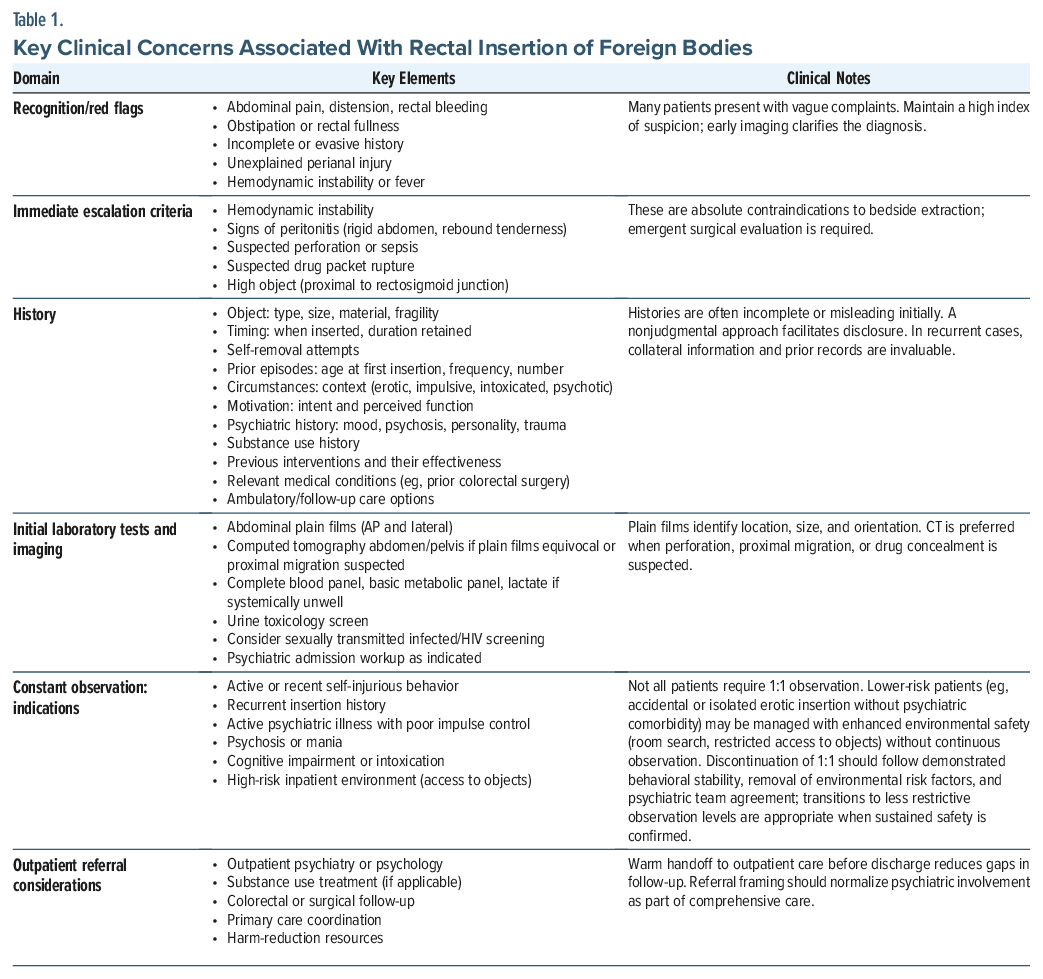
In patients who are clinically stable, the early evaluation should clarify what was inserted, when it was inserted, whether attempts at self-removal were made, whether the object is fragile or sharp, and whether the patient has developed complications (eg, pain, bleeding, constipation, obstipation, fever, or incontinence). Because shame often delays presentation to an ED, clinicians should expect that the history initially provided may be incomplete or misleading. In some cases, patients present with vague abdominal or rectal complaints without disclosing that they have a retained object in their rectum until later in the encounter.2,4
Physical examination should include an abdominal examination, a digital rectal examination, and proctoscopy when feasible. Imaging is also central to safe management. Plain abdominal radiographs should include lateral and anteroposterior views of the chest, abdomen, and pelvis to identify the foreign body’s position; its shape, size, and location; and the possible presence of a pneumoperitoneum.4 Computed tomography scans can help to establish the object’s size, shape, location, and orientation and assess for free air or other complications. Objects that have migrated proximally, especially above the rectosigmoid junction, are less likely to be removed successfully at the bedside and will more likely require endoscopic or operative management.4,8,10
After stabilization and imaging, the next step in management includes transanal or operative techniques of removal, as indicated. For low-lying objects in stable patients, transanal extraction may be attempted in the ED or in an operating room. Techniques used to remove foreign bodies include digital extraction, rigid proctoscopy, flexible sigmoidoscopy, endoscopic snares, and Foley catheter–assisted removal to relieve suction. No single transanal extraction technique has proven superior to others.4 Adequate anesthesia (local, regional, or general) improves success by facilitating sphincter relaxation.4,11,12 Objects that are located more proximally often require endoscopic retrieval or operative management. Overall, transanal extraction is successful in approximately 60%–75% of cases, while operative intervention is required when bedside extraction or endoscopic removal fails or when complications arise.4 Hemodynamically unstable patients require an emergent laparotomy with damage control surgery.4 When bowel resection is necessary, Hartmann’s procedure (resection of the rectosigmoid colon with creation of an end colostomy and closure of the rectal stump) may be performed. Reversal is not always feasible, and some patients require a permanent stoma.8 Special caution is required when drug concealment is suspected. In such cases, maneuvers that could rupture a drug-filled packet may precipitate life-threatening toxicity, and standard extraction strategies may be inappropriate.4 In cases of suspected drug concealment, management is typically conservative, with close monitoring and avoidance of manipulation, reserving interventions for obstruction, rupture, or toxicity.4
How Can Clinicians Learn About the Motivation for Rectal Foreign Body Insertion?
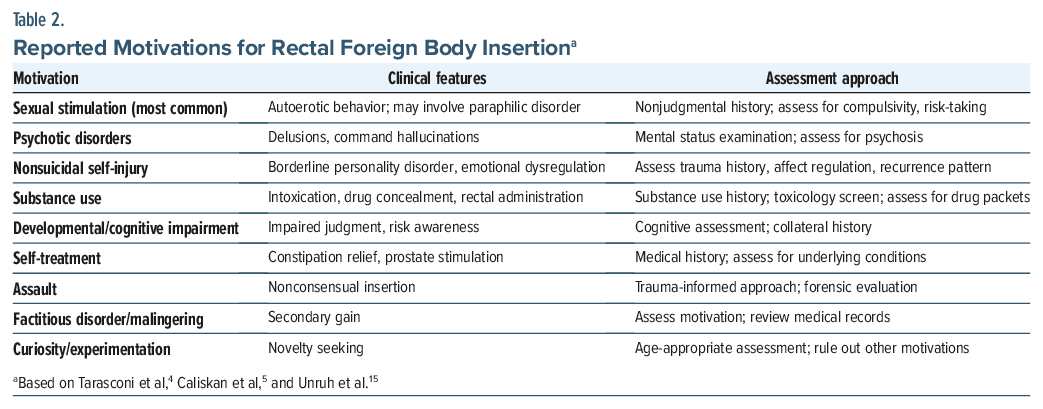
The differential diagnosis for rectal foreign body insertion is broad, and clinicians should resist coming to closure prematurely. The most common driver for foreign body insertion is sexual stimulation, which may reflect nonpathologic autoerotic emotion or, in some cases, a paraphilic disorder.4,5,8,13 In general, paraphilic disorders are distinguishable from nonpathologic sexual behavior by the presence of “clinically significant distress or impairment in social, occupational, or other areas of functioning” for at least 6 months.14 However, even in cases of nonpathologic behavior, clinicians should not assume that foreign body insertion is solely about orgasm or sexual gratification. Even when behavior is sexual, its meaning may extend beyond simple gratification. The act may also serve functions that are related to novelty-seeking, compulsivity, emotional regulation, or symbolic meanings that are not readily apparent from the history alone.15
Other motivations described include psychotic disorders, in which insertion may occur in response to delusions or command hallucinations; nonsuicidal self-injury, particularly in individuals with borderline personality disorder (BPD) or other conditions that are characterized by severe emotional dysregulation; developmental or cognitive disorders that impair judgment or risk awareness; factitious disorders or malingering; curiosity or experimentation; and self-treatment (eg, attempts to relieve constipation or stimulate the prostate for sexual gratification).4,8,15
Clinicians should focus on the function and context of behavior. Therefore, assessment should cover what was inserted, as well as the circumstances, intent, and perceived function of the behavior (eg, whether it was erotic, impulsive, intoxication-related, emotionally regulatory, psychotically driven, attention-seeking, or performed for external gain). This approach is especially important in recurrent or high-risk cases, where the behavior may reflect more than experimentation, as the assessment should guide risk assessment and management (Table 2).4,5,15
What Medical Complications Can Follow Insertion of Foreign Bodies in the Rectum?
Rectal foreign body insertion can produce a myriad of complications, with their severity depending on the nature of the object, the duration of the retention, and the patient’s anatomy. Complications range from minor mucosal injury to life-threatening bowel perforation and sepsis, with the risk of severe complications also influenced by object size, shape, and time to presentation.4,6 Other common complications include rectal bleeding, bowel obstruction, perforation with peritonitis, and perirectal abscesses.4,6,8
With self-inserted rectal foreign bodies, approximately three-fourths (73.6%) of individuals develop no structural injuries, while roughly one-fourth (26.4%) sustain trauma, eg, rectal mucosal ulcers and bleeding (9.2%) and rectal lacerations (8%).6 Approximately one-third of cases involve at least 1 complication.2 The rate of perforation is approximately 15%.4 Perforation represents the most serious complication and may lead to peritonitis, intra-abdominal abscesses, pelvic sepsis, and septic shock.10
Extraction attempts are also associated with the risk of complications. Failure to remove objects (transanally) is more likely with thick, long, hard, or sharp objects, and migration into the sigmoid colon increases the likelihood of an operative intervention by approximately 2.25-fold.4 Among patients who require abdominal surgery after rectal insertion of foreign bodies, complication rates of approximately 27% have been reported.10 Patients who require a bowel resection (including Hartmann’s procedure) may need permanent stomas, as reversal is not always performed.8 Rectal trauma has been associated with rectal or urogenital morbidity (∼8%), gastrointestinal morbidity (∼8%), and septic complications (∼11%).16
In cases of recurrent rectal insertion, repeated trauma produces cumulative structural injuries and escalating medical risk. As illustrated by the case of Mr R, individuals with a history of repeated rectal self-insertions may require operative removal of foreign bodies and prolonged inpatient observation to prevent further injury. These cases highlight the importance of early psychiatric evaluation and behavioral interventions aimed at addressing the underlying drivers of rectal insertion.
When Should Patients Presenting to Outpatient Settings Be Transferred to the ED?
Although rectal foreign body insertion commonly prompts ED presentation, patients may first present to outpatient settings, including urgent care clinics, primary care offices, or outpatient psychiatry practices. Clinicians in these settings should maintain a low threshold for ED transfer or direct admission based on the following considerations. Urgent transfer to an ED is indicated when any of the following are present: hemodynamic instability (tachycardia, hypotension, or fever); signs of peritoneal irritation (abdominal rigidity, rebound tenderness, or guarding); suspected bowel perforation or free air4; inability to perform an adequate physical examination; any concern for drug packet concealment17; or a history suggesting proximal migration of the object (onset more than 24 hours prior, significant abdominal pain, or absence of a palpable or visible object on examination).7 Patients who are intoxicated, psychotic, or otherwise unable to cooperate with evaluation should also be transferred promptly.
Even in the absence of these red flags, patients with a retained rectal foreign body generally cannot be managed definitively in an outpatient setting without imaging and procedural capabilities.10 Most stable patients require, at a minimum, plain abdominal radiographs and surgical or procedural evaluation, which may necessitate ED-level resources or direct surgical admission.7,13 Outpatient clinicians should, therefore, err on the side of transfer when in doubt and should communicate directly with the receiving team regarding the clinical history, suspected object type, and any known psychiatric or substance use history relevant to management.
How Can a Psychiatric Evaluation Inform Management?
Psychiatric consultation can play a pivotal role in the care of patients who have inserted objects into their rectum (Table 3). Psychiatric comorbidity is present in approximately one-third (37%) of these patients, although it is more common with nonsexual and recurrent presentations, and the disorder may not be readily apparent without a formal evaluation.8,15 Conditions such as BPD, posttraumatic stress disorder, psychotic disorders, and substance use disorders (SUDs) are among the most frequently reported conditions altering both the risk and recurrence of the behavior.18,19
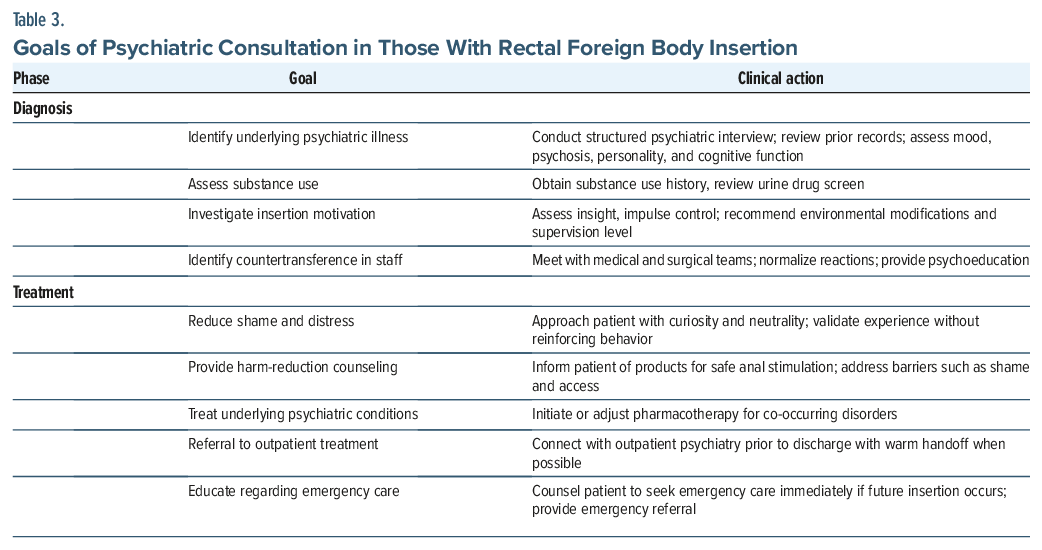
Inpatient management requires an integrated approach that combines medical stabilization, environmental safety, and psychiatric formulation. The initial priority is the prevention of reinjury. Depending on a patient’s risk, this may require removal of insertable objects from the room, 1-to-1 observation, limitation of unsupervised bathroom access, and close communication among nursing, surgical, and psychiatric teams. These interventions should be implemented consistently across disciplines and framed as safety measures rather than punitive restrictions.18–20
Building on the initial assessment, psychiatric consultation helps to clarify the diagnosis, assess risk, and contextualize the behavior within the patient’s broader clinical and psychosocial history. It is particularly valuable when distinguishing among sexually motivated behavior, impulsive or affect-driven self-injury, psychosis-driven insertion, and behaviors associated with substance use or secondary gain.
Beyond immediate safety, management should focus on understanding the drivers and functional role of the behavior, particularly in recurrent cases. In patients with BPD, trauma-related distress, or other forms of emotional dysregulation, insertion behavior may be impulsive, affectively driven, and resistant to simple verbal redirection. The prevalence of BPD among patients with deliberate foreign body behaviors ranges from 23% to 63%,18 underscoring the importance of a trauma-informed and multidisciplinary approach. Therefore, treatment planning should, therefore, attend to behavioral reinforcement patterns, staff countertransference, and the potential iatrogenic effects of prolonged hospitalization.18–20
From a treatment perspective, psychiatric involvement can address the shame and distress that is commonly associated with hospitalization for rectal insertion of foreign objects; provide harm-reduction counseling, including information about safer means of sexual stimulation; facilitate referral to outpatient psychiatric care or substance use treatment; and help recognize and manage countertransference reactions that arise among medical staff.18,19 Dialectical behavior therapy (DBT) is the most extensively studied psychotherapeutic intervention for patients with recurrent foreign body insertion, particularly those with BPD or other cluster B personality pathology. DBT targets emotional dysregulation, distress tolerance, and interpersonal effectiveness and has been shown to reduce attempts at self-harming and improve psychosocial functioning in comparison to treatment as usual, with case reports documenting extended remissions in those with recurrent foreign body behaviors who have been treated on DBT-based units.18,21–26 Other structured psychotherapies, including mentalization-based therapy, have also demonstrated reductions in self-harm and suicide attempt-related outcomes, although evidence that is specific to rectal foreign body insertion remains limited.27
Pharmacologic treatment plays a supportive role; although no medications have been US Food and Drug Administration approved, case reports have described the use of antipsychotics, mood stabilizers, and antidepressants, with some benefit from agents such as naltrexone, although outcomes are variable and psychotherapy remains the cornerstone of treatment. Overwhelmingly, recommendations for psychiatric management for this population are derived largely from case series and extrapolated from the broader self-injury literature, and no interventions have consistently demonstrated long-term resolution of recurrent insertion behavior; relapse remains common.18
Accordingly, expectations during hospitalizations for rectal insertions should focus on risk reduction rather than definitive resolution. The literature emphasizes individualized treatment planning, cautious use of hospitalization with attention to reinforcement dynamics, and early transition to structured outpatient care when feasible.18–20 Therefore, the primary inpatient goals are to reduce imminent risk, clarify the underlying psychopathology and behavioral function, align the multidisciplinary team around a consistent management strategy, and establish a realistic and structured outpatient follow-up plan.
Some clinicians have advocated for psychiatric consultation only when cases involve overt psychiatric illness or unusual presentations. However, given that psychiatric conditions that contribute to insertion behavior may not be apparent without formal evaluation, and that unchecked staff counter-transference can harm patients, a compelling argument can be made for routine psychiatric consultation in all cases of foreign body insertion that result in hospitalization.15 Patients who engage in deliberate foreign body insertion are best managed through a combination of medical, pharmacologic, and cognitive-behavioral interventions.5,19
How Should Clinicians Approach Patients Who Insert Foreign Objects Into Their Rectum?
A respectful, nonjudgmental approach is foundational for preserving the therapeutic alliance, and for obtaining an accurate history and reducing treatment delays. Patients who insert foreign objects often evoke strong reactions (including curiosity, embarrassment, frustration, or revulsion) among clinicians. These responses, if left unrecognized and unaddressed, can interfere with compassionate care and impede the development of a therapeutic alliance.15 Patients with rectal foreign body insertion often experience profound embarrassment and shame, which may lead to incomplete disclosure, delayed presentation, and avoidance of follow-up. Clinicians who approach these encounters with visible surprise, disgust, or moral judgment risk compounding the patient’s distress and impairing both medical and psychiatric assessments.15
In practical terms, this means using neutral, clinical language when discussing the event; obtaining a careful history of the circumstances that preceded insertion; systematically assessing for psychiatric symptoms, substance use, and cognitive impairment; and collaborating closely with surgical colleagues to ensure safe extraction and management of complications.4,5,8 Principal associated factors include mental disorders, drug and alcohol intake, and recent sexual activity.8 Psychiatric consultation, when appropriate, should be framed for the patient as a routine component of comprehensive care rather than as a punitive maneuver.15 In addition to standard medical and surgical management, the literature emphasizes the importance of assessing the patient’s psychological status, particularly in cases of recurrent insertion or unclear motivation.5
Clinicians should also be alert to the phenomenon of social contagion within institutional settings and to the possibility that some presentations involve secondary gain. Nonetheless, the therapeutic default should be curiosity and compassion rather than suspicion.15
How Does Substance Use Contribute to Rectal Foreign Body Insertion?
Substance use can contribute to rectal foreign body insertion in several ways, and each has important clinical consequences. In some patients, alcohol or other substances impair judgment, reduce inhibition, and increase sexual risk-taking, thereby contributing to insertion during erotic activity.8 In others, the object itself may be related to substance use, as in drug concealment or recreational rectal drug administration.8,28 Clinicians should, therefore, avoid making the assumption that all substance-associated cases have the same motivation.1,4,8
Methamphetamine appears to be strongly associated with high-risk rectal insertion behaviors, through direct rectal administration (“plugging”) and its strong association with high-risk sexual practices. Methamphetamine use is disproportionately prevalent among men who have sex with men and is linked to multiple sexual partners, increased receptive anal intercourse, and higher rates of sexually transmitted infections, including HIV infection.29,30 Acute methamphetamine toxicity can cause chest pain, hypertension, palpitations, hyperthermia, impulsivity, delirium, and psychosis, with severe toxicity potentially leading to stroke, kidney injury, myocardial infarction, cardiac arrhythmias, aortic dissection, and suicide.31,32 Long-term methamphetamine use increases the risk of cardiovascular disease, neuropsychiatric conditions (including cognitive impairment, schizophrenia, and Parkinson disease), sexually transmitted infections, poor nutrition, and dental disease.31,32 Of note, many of these sequelae carry the potential for complicating the medical management of rectal insertions, compounding the risk profile associated with insertions in the context of methamphetamine use.
Substance use in sexual contexts is often described as “chemsex,” particularly among men who have sex with men, and involves substances such as methamphetamine, inhaled nitrites (“poppers”), γ-hydroxybutyrate/γ-butyrolactone, ketamine, and cocaine. These substances are associated with prolonged sexual activity, reduced inhibition, and increased risk-taking, which may contribute to foreign body insertion behaviors.29
Substance use also has implications for psychiatric assessment. When intoxication, stimulant use, or polysubstance use is present, it may be difficult to determine whether insertion was primarily erotic, impulsive, self-injurious, or performed for another purpose. Assessment should, therefore, include a substance use history, attention to signs of intoxication or withdrawal, and consideration of referral for substance use treatment when indicated. Given these associations, screening for SUDs should be considered in all patients who present with rectal foreign bodies, with referral to treatment services as appropriate. The combination of stimulant use and sexual activity represents a particularly high-risk context for both foreign body insertion and sexually transmitted infections.
How Does Drug Concealment Affect Assessment and Management of Rectal Foreign Bodies?
A separate and medically important scenario involves drug concealment or rectal drug administration. Patients may use the rectum to hide packets of heroin, cocaine, marijuana, or other substances or to administer drugs recreationally by rectal absorption. Drug trafficking via rectal concealment (“body packing”) is a well-documented cause of rectal foreign bodies and carries risks of obstruction and potentially fatal toxicity if packages rupture.17 In these situations, the retained “foreign body” may pose risks beyond local trauma, including intestinal obstruction, bowel ischemia, systemic toxicity, or sudden poisoning if a packet ruptures. For that reason, clinicians should specifically ask whether the inserted object could contain drugs, explain why this is important for the medical team to know, and exercise caution before attempting extraction. Guidelines emphasize that, when drug concealment is suspected, maneuvers that could disrupt the package should be avoided due to risk of acute toxicity.4
Rectal administration of substances (“plugging,” “booty bumping,” or “keestering”) partially bypasses first-pass metabolism, leading to increased bioavailability, rapid onset, and potentially severe toxicity.33,34 Methamphetamine toxicity after rectal administration can cause rapid-onset hypertension, tachycardia, psychosis, and the need for intensive care.35 In addition to systemic effects, this route may increase the risk of local complications, such as rectal injury or mesenteric ischemia. Given these associations, screening for SUDs should be considered in all patients who present with rectal foreign bodies, with referral to treatment services as appropriate.
What Happened to Mr R?
After plain abdominal radiographs confirmed the presence of a low-lying, smooth glass object without evidence of free air, Mr R was taken for transanal extraction under conscious sedation. Successful bedside removal was accomplished using Foley catheter–assisted extraction to relieve the intrarectal suction effect. Rigid proctoscopy confirmed intact mucosa without lacerations or perforation. He was observed briefly in the ED, hemodynamically remained stable, and was discharged after tolerating clear liquids and passing flatus.
Given the erotic context, absence of psychiatric comorbidity, and isolated nature of the episode, a formal inpatient psychiatric consultation was not required. However, the treating clinician provided brief harm-reduction counseling, including information about purpose-designed products for anal stimulation and instructions to seek emergency care promptly in the event of future retention. Mr R expressed significant embarrassment during the encounter but responded positively to the clinician’s nonjudgmental approach. He was discharged with primary care follow-up and was encouraged to discuss sexual health with his outpatient provider.
CONCLUSION
Rectal foreign body insertion represents a complex clinical presentation at the intersection of surgery, psychiatry, and behavioral medicine. Sexual stimulation is the most commonly reported motivation, but insertion behaviors may arise from a diverse array of psychological, psychiatric, cognitive, and situational contexts.15,36 For clinicians, these cases present challenges to diagnostic and procedural competence as well as to professional equanimity.
Recognizing and managing one’s reactions, and those of the broader clinical team, is as important as mastering the technical aspects of foreign body extraction. Integrating psychiatric evaluation, harm-reduction counseling, and treatment of underlying conditions offers the best opportunity to reduce recurrence of the behavior and prevent the complications that can arise from repeated insertion behaviors.36 Patients with recurrent intentional foreign body behaviors need a nuanced, multidisciplinary management approach to address acute concerns and reduce subsequent episodes.20 However, it should be noted that psychiatric intervention does not always prevent recurrences, particularly in patients with severe psychiatric comorbidities,36 and long-term outcomes remain difficult to predict. The case of Mr R illustrates both the importance of early surgical-psychiatric collaboration and the limits of what acute hospitalization alone can achieve. Translating these lessons into practice will require investment in structured outpatient pathways, trauma-informed care models, and prospective research designed to identify which interventions most effectively interrupt patterns of recurrent self-injury in this population.4
Article Information
Published Online: September 29, 2026. https://doi.org/10.4088/PCC.26f04248
© 2026 Physicians Postgraduate Press, Inc.
Submitted: April 6, 2026; accepted July 15, 2026.
To Cite: Schwartz AC, Robbins-Welty G, Stiles C, et al. Rectal insertion of foreign bodies: motivations, complications, and management. Prim Care Companion CNS Disord 2026;28(5):26f04248.
Author Affiliations: Department of Psychiatry and Behavioral Sciences, Emory University School of Medicine, Atlanta, Georgia (Schwartz, Robbins-Welty, Stiles); Grady Memorial Hospital, Atlanta, Georgia (Schwartz, Robbins-Welty, Stiles); Departments of Family and Preventive Medicine, Division of Palliative Medicine, Emory University School of Medicine, Atlanta, Georgia (Robbins-Welty); Harvard Medical School, Boston, Massachusetts (Stern); Massachusetts General Hospital, Boston, Massachusetts (Stern).
Corresponding Author: Ann C. Schwartz, MD, 12 Executive Parkway, Ste 142, Atlanta, GA 30329 ([email protected]).
Drs Schwartz, Robbins-Welty, and Stiles are co-first authors; Dr Stern is the senior author.
Financial Disclosure: Dr Stern has received royalties from Elsevier for editing textbooks on psychiatry. Drs Schwartz, Robbins-Welty, and Stiles report no conflicts of interest.
Funding/Support: None.
Clinical Points
- Anal erotic stimulation is the most common cause of retained rectal foreign bodies, followed by assaults, accidental insertions, ingestion of objects, psychiatric conditions, and drug trafficking.
- In patients who are hemodynamically stable, the evaluation should clarify what was inserted, when it was inserted, whether attempts at self-removal were made, whether the object is fragile or sharp, and whether the patient has developed complications (eg, pain, bleeding, constipation, obstipation, fever, or incontinence).
- Psychiatric consultation can play a pivotal role in the care of patients who have inserted objects into their rectum. Depending on a patient’s risk, this may require removal of insertable objects from the room, 1-to-1 observation, limitation of unsupervised bathroom access, and close communication among nursing, surgical, and psychiatric teams.
- Psychiatric involvement can address the shame and distress that is commonly associated with hospitalization for rectal insertion of foreign objects, provide harm-reduction counseling (including information about safer means of sexual stimulation), facilitate referral to outpatient psychiatric care or substance use treatment, and help recognize and manage countertransference reactions that arise among medical staff.
References (36)

- Loria A, Marianetti I, Cook CA, et al. Epidemiology and healthcare utilization for rectal foreign bodies in United States adults, 2012-2021. Am J Emerg Med. 2023;69:76–82. PubMed
- Gardetto A, Ploner M, Ploner F, et al. Foreign rectal body: systematic review and meta-analysis. Acta Gastroenterol Belg. 2020;83(1):61–65. PubMed
- Bhasin S, Williams JG. Rectal foreign body removal: increasing incidence and cost to the NHS. Ann R Coll Surg Engl. 2021;103(10):734–737. PubMed
- Tarasconi A, Perrone G, Davies J, et al. Anorectal emergencies: WSES-AAST guidelines. World J Emerg Surg. 2021;16(1):48. PubMed
- Caliskan C, Makay O, Firat O, et al. Foreign bodies in the rectum: an analysis of 30 patients. Surg Today. 2011;41(6):795–800. PubMed CrossRef
- Zhang Y, Han Y, Xu H, et al. A retrospective analysis of transanal surgical management of 291 cases with rectal foreign bodies. Int J Colorectal Dis. 2022;37(10):2167–2172. CrossRef
- Kurer MA, Davey C, Khan S, et al. Colorectal foreign bodies: a systematic review. Colorectal Dis. 2010;12(9):851–861. PubMed
- Rodríguez-Hermosa JI, Codina-Cazador A, Ruiz B, et al. Management of foreign bodies in the rectum. Colorectal Dis. 2007;9(6):543–548. PubMed CrossRef
- Fischer J, Krishnamurthy J, Hansen S, et al. Austere foreign body injuries in children and adolescents: a characterization of penile, rectal, and vaginal injuries presenting to emergency departments in the United States from 2008 to 2017. Pediatr Emerg Care. 2021;37(12):e805–e811. PubMed
- Fritz S, Killguss H, Schaudt A, et al. Proposal of an algorithm for the management of rectally inserted foreign bodies: a surgical single-center experience with review of the literature. Langenbecks Arch Surg. 2022;407(6):2499–2508. PubMed
- Koornstra JJ, Weersma RK. Management of rectal foreign bodies: description of a new technique and clinical practice guidelines. World J Gastroenterol. 2008;14(27):4403–4406. PubMed CrossRef
- Chilakamarry S, Klipfel AA. Novel approach to removal of rectal foreign bodies. Dis Colon Rectum. 2021;64(6):e368–e370. PubMed
- Clarke DL, Buccimazza I, Anderson FA, et al. Colorectal foreign bodies. Colorectal Dis. 2005;7(1):98–103.
- American Psychiatric Association. Diagnostic and Statistical Manual of Mental Disorders. 5th ed., text rev. American Psychiatric Association; 2022.
- Unruh BT, Nejad SH, Stern TW, et al. Insertion of foreign bodies (polyembolokoilamania): underpinnings and management strategies. Prim Care Companion CNS Disord. 2012;14(1):PCC.11f01192. PubMed
- Tan J, Kong V, Ko J, et al. Faecal diversion remains central in the contemporary management of rectal trauma–Experience from a major trauma centre in South Africa. Injury. 2024;55(1):111110. PubMed
- Dunne JW. Drug smuggling by internal bodily concealment. Med J Aust. 1983;2(9):436–439. PubMed
- Ney J, Smoller C, Bower M, et al. Understanding and managing deliberate foreign body ingestion in patients with cluster B personality traits: a scoping review. Gen Hosp Psychiatry. 2026.
- Poynter BA, Hunter JJ, Coverdale JH, et al. Hard to swallow: a systematic review of deliberate foreign body ingestion. Gen Hosp Psychiatry. 2011;33(5):518–524. PubMed CrossRef
- Low Kapalu CM, Ibrahimi N, Mentrikoski JM, et al. Pediatric recurrent intentional foreign body ingestion: case series and review of the literature. J Pediatr Gastroenterol Nutr. 2020;71(2):232–236. PubMed
- Stoffers-Winterling JM, Storebø OJ, Kongerslev MT, et al. Psychotherapies for borderline personality disorder: a focused systematic review and meta-analysis. Br J Psychiatry. 2022;221(3):538–552. PubMed
- Gitlin DF, Caplan JP, Rogers MP, et al. Foreign-body ingestion in patients with personality disorders. Psychosomatics. 2007;48(2):162–166. PubMed
- Knipe D, Padmanathan P, Newton-Howes G, et al. Suicide and self-harm. Lancet. 2022;399(10338):1903–1916. PubMed
- Storebø OJ, Stoffers-Winterling JM, Völlm BA, et al. Psychological therapies for people with borderline personality disorder. Cochrane Database Syst Rev. 2020;5:CD012955. PubMed CrossRef
- McCauley E, Berk MS, Asarnow JR, et al. Efficacy of dialectical behavior therapy for adolescents at high risk for suicide: a randomized clinical trial. JAMA Psychiatry. 2018;75(8):777–785. PubMed
- Witt KG, Hetrick SE, Rajaram G, et al. Psychosocial interventions for self-harm in adults. Cochrane Database Syst Rev. 2021;4:CD013668.
- Bateman A, Fonagy P. Randomized controlled trial of outpatient mentalization-based treatment versus structured clinical management for borderline personality disorder. Am J Psychiatry. 2009;166(12):1355–1364. PubMed CrossRef
- Hsieh A, Hsiehchen D, Layne S, et al. Trends and clinical features of intentional and accidental adult foreign body ingestions in the United States, 2000 to 2017. Gastrointest Endosc. 2020;91(2):350–357. PubMed CrossRef
- Compton WM, Jones CM. Substance use among men who have sex with men. N Engl J Med. 2021;385(4):352–356. PubMed
- Blair CS, Needleman J, Javanbakht M, et al. Examining the relative contributions of methamphetamine use, depression, and sexual risk behavior on rectal gonorrhea/chlamydia among a cohort of men who have sex with men in Los Angeles, California. Sex Transm Dis. 2022;49(3):216–222. PubMed
- Borelli C, Cheng A. What is methamphetamine use disorder?. JAMA. 2025;332(20):1754.
- Leyde S, Tilhou AS, Tsui JI. Methamphetamine use disorder. JAMA. 2025;334(9):784.
- Hua S. Physiological and pharmaceutical considerations for rectal drug formulations. Front Pharmacol. 2019;10:1196. PubMed
- de Boer AG, Moolenaar F, de Leede LG, et al. Rectal drug administration: clinical pharmacokinetic considerations. Clin Pharmacokinet. 1982;7(4):285–311. PubMed
- Farag A, Nordt SP, Perese J. Methamphetamine poisoning after “plugging” intentional recreational rectal use. J Emerg Med. 2024;66(5):e597–e600. PubMed
- Lewis C, Hsu HK, Hoover E. Aspiration of foreign bodies in adults with personality disorders: impact on diagnosis and recurrence. J Natl Med Assoc. 2011;103(7):620–622. PubMed CrossRef
Please sign in or purchase this PDF for $40.