
Amiodarone is an antiarrhythmic drug commonly used to treat cardiac arrhythmias. Due its high iodine content,1,2 1.2%–12% of patients are diagnosed with amiodarone-induced thyrotoxicosis (AIT).1 Independently, hyperthyroidism/thyrotoxicosis has been reported to precipitate mania.3–6 We present the case of a patient diagnosed with AIT who presented with symptoms of mania.
Case Report
The patient is a 66-year-old man who began amiodarone 200 mg 3 times weekly for polymorphic ventricular tachycardia 3 years prior to the current presentation. The patient had a history of stage D nonischemic cardiomyopathy (ejection fraction∼15–20%), status/post-left ventricular assist device insertion and diabetes mellitus.
About 3 months before the current admission, the patient was admitted to the hospital for a heart transplant workup. He was noted to have hyperthyroidism, with thyroid-stimulating hormone (TSH) <0.01 mcU/mL, free thyroxine (fT4) >7.7 ng/dL, and free triiodothyronine (fT3)=10.3 pg/mL. Amiodarone was discontinued due to concern for AIT. He was treated with methimazole 30 mg daily. Twelve days later, with no change in thyroid function tests, methimazole was discontinued, and the patient started prednisone 40 mg daily.
The patient continued prednisone for about 6 weeks before temporarily discontinuing it for a week due to uncontrolled hyperglycemia. After resuming the medication, he remained on prednisone 40 mg daily for about 6 weeks. Two weeks after restarting prednisone, the patient reportedly had the onset of hallucinations. One month later, the patient presented to the emergency department for altered mental status/hallucinations that resulted in the current admission.
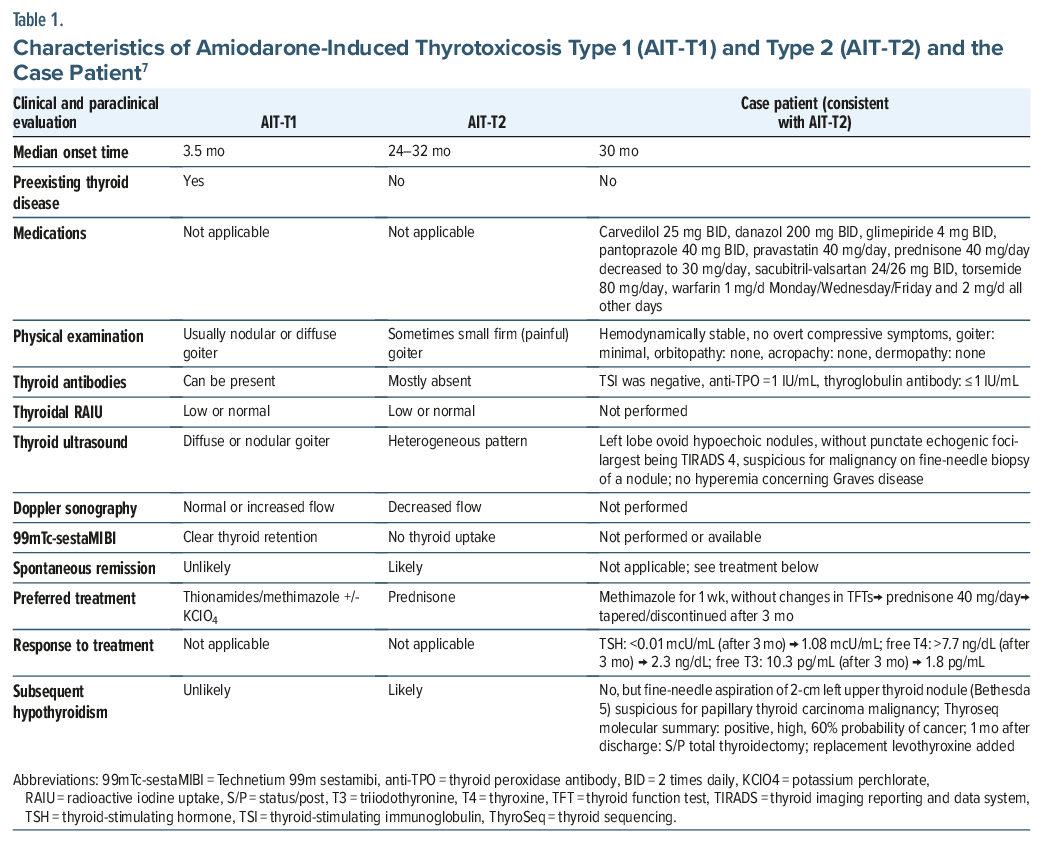
In the emergency department, the patient endorsed heat intolerance, tremors, and diarrhea, with an unremarkable computed tomography scan of the head. His TSH level increased to 1.08 mcU/mL, and fT4 remained elevated but attenuated (2.3 pg/mL), whereas fT3 decreased to 1.8 pg/mL (below the reference range). The remainder of the paraclinical workup was unremarkable, including complete blood count and toxicologic/metabolic, infectious, and autoimmune evaluations. The patient was admitted to the medical floor, where prednisone was decreased to 30 mg/day. Table 1 provides the additional medical history/complete medication list and AIT evaluation.7
The psychiatry consultation team was consulted for “confusion.” On our evaluation, the patient and his family described his confusion as elated mood and increased energy for about 1 month. The patient denied auditory/visual hallucinations, delusions, or lethality. The patient had no psychiatric history or a history of alcohol or illicit/prescription substance misuse. The patient’s Brief Psychiatric Rating Scale-Expanded (BPRS-E) score was 41,8 the Confusion Assessment Method9 was negative, and the Mini-Mental State Examination score was 27.10
As thyrotoxicosis and mania were responding to the decreased prednisone, we opted to not begin pharmacotherapy. The patient was discharged 3 days later to weekly outpatient treatment. After 1 month, the patient’s BPRS-E score was 27. Two weeks after prednisone was discontinued, the patient successfully underwent total thyroidectomy for papillary thyroid carcinoma (PTC). At 6-month follow-up on replacement levothyroxine, he remained medically and psychiatrically stable (BPRS-E score=27).
Discussion
Two types of AIT are recognized, designated type 1 (AIT-T1) and type 2 (AIT-T2), based on whether or not the patient had a preexisting thyroid disorder, respectively.11 Although our patient was diagnosed with PTC, there was no underlying functional autonomy, and he was ultimately diagnosed with AIT-T2.
As in our patient, many AIT patients are asymptomatic. For instance, 3 months prior to the current admission, our patient was admitted for a heart transplant evaluation. Subsequently, incidental hyperthyroidism was discovered. Notably, given that the duration of thyrotoxicosis may last 3–5 months in AIT with underlying cardiac disease, treatment with a prolonged course of tapering systemic oral glucocorticoid therapy is required.12
Nonetheless, unrelated to amiodarone, thyrotoxicosis has been reported to induce mania in about 2%–3% of patients.13 While its pathogenesis is not clear, evidence suggests that modulation of β-adrenergic receptors (B-Ar) by thyroid hormones may accentuate the B-Ar’s response to catecholamines.5,14 While antipsychotics/mood stabilizers can be used adjunctively, propranolol/other beta-blockers are frequently utilized to manage adrenergic symptoms. Additionally, corticosteroids, which were required in our patient, can be administered to lower the peripheral conversion of T4 to T3.13,15
Attribution of the etiology of our patient’s manic phenomenology remains challenging. That is, our patient’s symptoms developed as thyroid indices were normalizing (TSH was within normal limits, and fT4 was mildly elevated). Nonetheless, several studies have investigated the timeline of symptom resolution in hyperthyroidism. For instance, it has been proposed that the effects of hyperthyroidism on the brain return to normal more slowly than other systemic effects. Prospective studies of patients with hyperthyroidism suggest that remission of affective symptoms usually occurs within a few months of patients’ becoming euthyroid. Furthermore, some studies suggest that an episode of hyperthyroidism influences affective modulation in a time frame that exceeds the period of thyroid hormone excess.16
Alternatively, the onset of our patient’s mania following the initiation of prednisone favors the latter in the etiology. Our patient was taking prednisone 40 mg/day for about 6 weeks but discontinued for about 1 week due to developing hyperglycemia. Two weeks after restarting, our patient’s manic symptoms developed, lasting for about 1 month until being admitted for the current hospitalization. One study found that 86% of corticosteroid-induced psychiatric symptoms (CIPS) developed within the first week of starting steroids; two-thirds of patients developed symptoms within 5 days. Additionally, another review of 70 published case reports found a median of 11.5 days from initiation of steroids to the onset of CIPS (range, hours to 210 days).17 Nonetheless, the incidence of CIPS in patients on prednisone ≤40 mg/day was 1.3%.18 Finally, the Naranjo Adverse Drug Reaction Probability Scale score was 5 (probable) for both amiodarone and prednisone.19
In closing, amiodarone is one of the most frequently prescribed specific antiarrhythmic medications. Given the frequency of AIT and the real, but small, potential for precipitating mania, we recommend that psychiatrists become familiarized with amiodarone-induced thyroid manifestations. Just as importantly, corticosteroids, the mainstay of treatment for AIT-T2, can also induce psychiatric symptoms. Thus, both medications need to be considered in the etiology of psychiatric phenomenology.
Article Information
Published Online: July 28, 2026. https://doi.org/10.4088/PCC.26cr04180
© 2026 Physicians Postgraduate Press, Inc.
Prim Care Companion CNS Disord 2026;28(4):26cr04180
Submitted: January 6, 2026; accepted April 15, 2026.
To Cite: Spiegel DR, Billingsley R, Cazzell M, et al. Mania due to amiodarone-induced thyrotoxicosis type 2 or its treatment, prednisone. Prim Care Companion CNS Disord 2026;28(4):26cr04180.
Author Affiliations: Department of Psychiatry and Behavioral Sciences, Eastern Virginia Medical School at Old Dominion University, Norfolk, Virginia.
Corresponding Author: David R. Spiegel, MD, Department of Psychiatry and Behavioral Sciences, Eastern Virginia Medical School at Old Dominion University, 825 Fairfax Ave, Norfolk, Virginia 23507 ([email protected]).
Financial Disclosure: Dr Spiegel is in the Speaker’s Bureau for Allergen, Alkermes, IntraCellular, and Vanda Pharmaceuticals but has no conflicts of interest in preparation of this manuscript. The remainder of the authors have no disclaimers/conflicts of interest to report.
Funding/Support: None.
Patient Consent: Consent was received from the patient’s spouse to publish the case report, and information has been de-identified to protect anonymity.
References (19)

- Guðjónsson P, Jóhannesson AJ, Eyþórsson E, et al. Amiodarone induced thyroid dysfunction: a high cumulative incidence in a nationwide cohort study in Iceland. J Intern Med. 2025;298(3):228–236. PubMed CrossRef
- Huang CJ, Tseng CL, Chu CH, et al. Adherence to guidelines in monitoring amiodarone-induced thyroid dysfunction. J Eval Clin Pract. 2017;23(1):108–113. PubMed CrossRef
- Brownlie BE, Rae AM, Walshe JW, et al. Psychoses associated with thyrotoxicosis - ’thyrotoxic psychosis.’ A report of 18 cases, with statistical analysis of incidence. Eur J Endocrinol. 2000;142(5):438–444. PubMed CrossRef
- Iga J, Taniguchi T, Ohmori T. Mood swing from severe depression to mania following acute alteration of thyroid status. Gen Hosp Psychiatry. 2005;27(6):451–453. PubMed CrossRef
- Spiegel DR, Pilc E, Coleman T, et al. Thyrotoxic psychosis in a patient with Graves’ disease and methimazole nonadherence: the role of antipsychotics in treatment. Prim Care Companion CNS Disord. 2025;27(1):24cr03840. PubMed CrossRef
- Ravishankar J, Shivappa M, Jeevan Y. Thyrotoxicosis masquerading as late onset mania: a case report on treatment of mania in thyroid Storm. J Clin Diagnostic Res. 2024;18(10):VD01–VD03.
- Eskes SA, Wiersinga WM. Amiodarone and thyroid. Best Pract Res Clin Endocrinol Metab. 2009;23(6):735–751. PubMed CrossRef
- Lukoff D, Nuechterlein KH, Ventura J. Manual for the expanded BPRS. Schizophr Bull. 1986;12:594–602.
- Inouye SK, van Dyck CH, Alessi CA, et al. Clarifying confusion: the confusion assessment method. A new method for detection of delirium. Ann Intern Med. 1990;113(12):941–948. PubMed CrossRef
- Folstein MF, Folstein SE, McHugh PR. Mini-mental state. A practical method for grading the cognitive state of patients for the clinician. J Psychiatr Res. 1975;12(3):189–198. PubMed CrossRef
- Cardenas GA, Cabral JM, Leslie CA. Amiodarone induced thyrotoxicosis: diagnostic and therapeutic strategies. Cleve Clin J Med. 2003;70(7):628–631. PubMed CrossRef
- Goundan PN, Lee SL. Thyroid effects of amiodarone: clinical update. Curr Opin Endocrinol Diabetes Obes. 2020;27(5):329–334. PubMed CrossRef
- Taha H, Wahed SA, Berggren V. Psychosis secondary to thyrotoxicosis: an educational review. Health Sci Rev. 2025;16:100237.
- Steardo L Jr, D’Angelo M, Monaco F, et al. Decoding neural circuit dysregulation in bipolar disorder: toward an advanced paradigm for multidimensional cognitive, emotional, and psychomotor treatment. Neurosci Biobehav Rev. 2025;169:106030. PubMed CrossRef
- Kruithoff ML, Gigliotti BJ. Thyroid Emergencies: a Narrative review. Endocr Pract. 2025;31(10):1310–1318. PubMed CrossRef
- Adiba A. Association of thyrotoxicosis with mania. Am J Psychiatry Residents’ J. 2019;14:8–10. CrossRef
- Dubovsky AN, Arvikar S, Stern TA, et al. The neuropsychiatric complications of glucocorticoid use: steroid psychosis revisited. Psychosomatics. 2012;53(2):103–115. PubMed CrossRef
- Boston Collaborative Drug Surveillance Program. Acute adverse reactions to prednisone in relation to dosage. Clin Pharmacol Ther. 1972;13:694–698. PubMed
- Naranjo CA, Busto U, Sellers EM, et al. A method for estimating the probability of adverse drug reactions. Clin Pharacol Ther. 1981;30(2):239–245. PubMed CrossRef
Please sign in or purchase this PDF for $40.