

Lessons Learned at the Interface of Medicine and Psychiatry
The Psychiatric Consultation Service at Massachusetts General Hospital sees medical and surgical inpatients with comorbid psychiatric symptoms and conditions. During their twice-weekly rounds, Dr Stern and other members of the Consultation Service discuss diagnosis and management of hospitalized patients with complex medical or surgical problems who also demonstrate psychiatric symptoms or conditions. These discussions have given rise to rounds reports that will prove useful for clinicians practicing at the interface of medicine and psychiatry.
Prim Care Companion CNS Disord 2026;28(5):26f04236
Author affiliations are listed at the end of this article.
From the Editors

Are you a healthcare provider?
Add your NPI to personalize your JCP experience.
Have you ever noticed that some of your critically ill patients become agitated and confused when their propofol infusions are being tapered or discontinued? Have you suspected that this was due to propofol withdrawal? Have you wondered which strategies could be invoked to mitigate alterations in affect, behavior, and cognition during tapering and discontinuation of propofol infusions? If you have, the following case vignette and discussion could prove useful.
CASE VIGNETTE
Mr A, a 48-year-old man, was admitted to the intensive care unit (ICU) with acute respiratory distress syndrome secondary to severe pneumonia. He required mechanical ventilation with deep sedation to maintain ventilator synchrony. Sedation was achieved primarily with a continuous propofol infusion, titrated up to 50 µg/kg/min, and intermittent opioid analgesia.
After 8 days of continuous propofol infusions, Mr A’s pulmonary status started to improve, and reduction of his sedating regimen was planned in anticipation of extubation. Concurrently, his serum triglyceride levels were rising, which raised concern about propofol-associated hypertriglyceridemia. Given this context, his ICU team abruptly discontinued his propofol infusion.
Within several hours of propofol’s discontinuation, Mr A became markedly agitated, restless, anxious, diaphoretic, tachycardiac, hypertensive, and confused. Given concern for hyperactive delirium, the consultation-liaison (C-L) psychiatry service was consulted to assist with Mr A’s evaluation and management.
DISCUSSION
Why Do Critically Ill Individuals Receive Central Nervous System Depressants in ICUs?
Patients receiving ICU-level care frequently experience distressing symptoms, including pain, anxiety, agitation, fatigue, and dyspnea. Anxiety affects approximately 25% of ICU patients and is among the most distressing symptoms. Pain is also common, affecting nearly 30% of patients despite treatment with analgesics and other central nervous system (CNS) depressants, including benzodiazepines and sedative-hypnotic agents such as propofol.1 These medications are used to promote comfort by reducing pain, anxiety, and agitation. However, ICU sedation practices have evolved substantially over time, with guidelines increasingly favoring agents such as dexmedetomidine and propofol, incorporating melatonin for sleep, and moving away from deep sedation.2
Beyond symptom relief alone, CNS depressants in the ICU serve several interrelated clinical functions, including facilitating mechanical ventilation, enabling invasive procedures, and reducing safety risks associated with severe agitation or confusion. Nearly one-third of critically ill patients require mechanical ventilation,3 and sedative medications are often used in this context to promote comfort, reduce oxygen consumption, and lessen recall of the illness experience.4 These agents may also facilitate procedures such as placement of central venous catheters, chest tubes, and other invasive interventions. In addition, CNS depressants are frequently used to manage agitation and delirium when patients are at risk of self-extubation, removal of lines or catheters, or injury to themselves or health care staff.5,6 Accordingly, decisions about their use in the ICU must balance comfort, procedural necessity, and safety.
Which Classes of Agents Are Used to Manage Anxiety, Agitation, and Pain in Critical Care Settings?
Several complementary strategies are used to manage anxiety, agitation, and pain in the ICU, and treatment should be individualized according to the patient’s symptoms, clinical status, and goals of care. For anxiety, nonpharmacologic interventions are generally recommended as first-line approaches. These interventions include reassurance, reorientation, and other supportive measures aimed at reducing distress without adding medication burden. Such strategies may also be strengthened by optimizing pain control and, when appropriate, involving family members in calming, orienting, and supportive bedside care.7 Sensory and attention-based interventions may provide additional benefit in selected patients. For example, music-based interventions have been associated with lower anxiety scores among critically ill adults,8,9 and small studies suggest that virtual reality and guided breathing exercises may reduce anxiety, pain, and overall discomfort in ICU settings.10
When nonpharmacologic measures are insufficient, pharmacologic treatment may be needed, although the choice of agent depends on whether the primary problem is anxiety, agitation, delirium, or a specific withdrawal syndrome. Benzodiazepines such as lorazepam and midazolam are commonly used for moderate to severe anxiety and agitation, but their overall effect on broader patient outcomes remains uncertain.2 When these agents are considered, clinicians should account for factors that may substantially alter both indication and dosing, including alcohol withdrawal, chronic benzodiazepine exposure, and other causes of physiological dependence. In patients with severe agitation in the setting of hyperactive delirium, antipsychotics such as haloperidol or quetiapine are frequently used despite mixed evidence for efficacy. Clonidine is also used off-label in some settings for agitation, with some data suggesting benefit comparable to haloperidol, although its use may be limited by hypotension and bradycardia.11 Ketamine has likewise been used for refractory agitation, but supporting evidence remains limited, and its use may increase intubation risk or worsen psychotic symptoms in susceptible patients.12
Pain management is a central component of ICU care, particularly for mechanically ventilated patients, and typically relies on opioid-based analgesia tailored to symptom burden and clinical trajectory. Opioids such as morphine and fentanyl are often used as first-line agents, sometimes in combination with acetaminophen, and may be administered either intermittently or by continuous infusion with titration to comfort.13 As patients improve clinically and begin preparation for ventilator liberation, continuous opioid regimens may, when appropriate, be reduced or transitioned to intermittent as-needed dosing. This approach may limit opioid tolerance and opioid-induced hyperalgesia while also supporting lighter sedation, shorter duration of mechanical ventilation, and less psychological distress.14
What Are the Adverse Effects of CNS Depressants?
Critical illness substantially alters the pharmacokinetics and pharmacodynamics of CNS depressants, and adverse effects in the ICU are therefore common, clinically significant, and often shaped by both the choice of agent and the broader context of critical care. Changes in absorption, protein binding, distribution, metabolism, and elimination may modify drug effect and increase the risk of toxicity.15 In addition, ICU patients are frequently exposed to multiple sedative, analgesic, and adjunctive medications, which can compound adverse effects across organ systems.16,17 As summarized in Table 1, the complications of CNS depressants are diverse and vary by drug class, with particularly important effects involving the cardiovascular, respiratory, gastrointestinal, and endocrine systems.
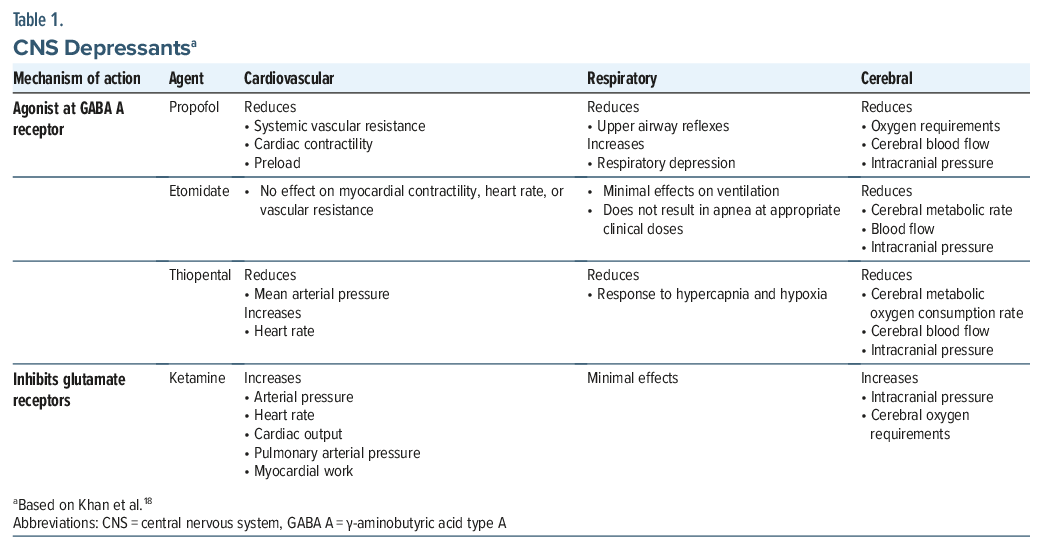
Cardiovascular adverse effects of CNS depressants differ substantially by agent and are especially relevant in critically ill patients with hemodynamic instability. Common cardiovascular effects include hypotension, myocardial depression, conduction abnormalities, and corrected QT interval prolongation. Barbiturates, such as thiopentone, may have limited hemodynamic effects at lower doses, but higher doses can produce severe hypotension and, with infusion or accumulation, myocardial depression.16 Ketamine, by contrast, often increases heart rate, cardiac output, and arterial pressure,
which may be advantageous in selected patients with hypovolemia or shock.18 However, these sympathomimetic effects may be undesirable in patients with coronary artery disease or poorly controlled hypertension.
Respiratory adverse effects are also central to the risk profile of many CNS depressants in ICU practice. Barbiturates can impair upper airway patency and suppress central ventilatory drive. Benzodiazepines likewise depress respiratory drive, reduce inspiratory and expiratory muscle strength, blunt responsiveness to hypercapnia, and promote upper airway obstruction through relaxation of upper airway musculature.19 These respiratory effects are often dose dependent and may be amplified by concurrent opioids, alcohol, or other sedating medications.
Gastrointestinal complications are particularly important with opioid therapy and may contribute meaningfully to morbidity during critical illness. Opioids can cause constipation, postoperative ileus, and, less commonly, complications such as acalculous cholecystitis or pancreatitis.17 These effects may in turn compromise enteral nutrition and impair absorption of orally administered medications, thereby complicating recovery and prolonging ICU care.
Endocrine complications are less common than cardiovascular or respiratory effects but remain clinically important for selected agents. Etomidate is the clearest example, as it inhibits adrenal steroidogenesis and may suppress adrenocortical function for 12–24 hours even after a single bolus dose.17 Although such effects are unusual with routine dosing of most CNS depressants, they may be consequential in critically ill patients with limited physiological reserve.
What Is Propofol, and How Does It Differ From Other Sedating Agents?
Propofol, 2,6-diisopropylphenol, was first developed by Imperial Chemical Industries in the United Kingdom following research into the sedative properties of phenol derivatives in the context of animal models.20 Propofol enhances the inhibitory effects on the CNS by binding to γ-aminobutyric acid (GABA) type A receptors, which increases the duration that the channels remain open and allows an influx of chloride. The postsynaptic neuronal membrane becomes hyperpolarized, which leads to sedation and anesthesia.18,21
Propofol’s rapid onset of action and penetration across the blood-brain barrier are attributed to its high lipid solubility. Propofol is hepatically metabolized via oxidation and glucuronidation and is excreted renally within 24 hours as it is conjugated. Approximately 95% of propofol is protein bound. When administered intravenously, it is completely bioavailable and has an onset of action in less than 1 minute.18
Compared to other anesthetic agents, propofol has many pharmacologic advantages: a short duration of action, rapid effects, few side effects (eg, postoperative nausea), ease of administration, ability to control sedation, and low toxicity.20,22 One of propofol’s primary downsides is its potential for dose-dependent respiratory depression and hypotension.22 Another is its rare complication, propofol infusion syndrome (PRIS).22 The exact mechanism is unknown. Several theories suggest that propofol impairs the balance between energy consumption and energy requirements on molecular and cellular levels, ultimately leading to perivascular and cardiac muscle damage. Propofol, an emulsion, can increase levels of free fatty acids (FFAs), especially when infused at high doses. Propofol also leads to the creation of several short-chain, medium-chain, and long-chain fatty acid metabolites. During times of immense stress, FFAs from adipose tissue lipolysis become the main source of energy to muscle and cardiovascular cells. While propofol increases the overall amount of FFAs, it also impairs oxidative phosphorylation, obstructing the electron flow in the electron transport chain and leading to a reduced ability to break down the FFAs to use as fuel.23 FFAs and triglycerides accumulate in the tissues, leading to a “fat overload syndrome.”23 Triacylglycerols are collected in the blood and absorbed through the reticuloendothelial system, leading to a variety of clinical presentations including splenomegaly, hepatomegaly, coagulation disorders, and jaundice.23 Significant cardiorespiratory depression along with metabolic acidosis also occurs.23
PRIS often presents with significant cardiorespiratory depression along with metabolic acidosis.23 PRIS often affects elderly critically ill individuals, young children, and those with systemic inflammatory stress, severe infection, or neurological diseases. The risk of PRIS increases with extended use and high doses, coadministered with glucocorticoids or catecholamines, underlying medical conditions, and consumption of carbohydrates. It involves rhabdomyolysis, hyperkalemia, severe metabolic acidosis, and cardiovascular compromise.21 PRIS is often fatal, and it usually occurs in the context of prolonged and high-dose infusions in children.24 The first step in management of PRIS is discontinuing the propofol infusion and replacing it with another sedating agent.25 Lactic and metabolic acidosis can be managed with sodium bicarbonate, hemofiltration, and hemodialysis. Both hemofiltration and hemodialysis assist in ridding the body of excess lipids in the blood.26 Cardiac complications can be managed with inotropes, vasopressors, and cardiac pacing, which help improve contractility and mitigate cardiogenic shock.27 Extracorporeal membrane oxygenation can also be used to assist with metabolic acidosis and improve circulation.28
What Are the Manifestations of Propofol Withdrawal, and Why Does It Develop?
Although propofol is generally valued for its rapid onset, short duration of action, and ease of titration, prolonged or high-dose administration may lead to a clinically significant withdrawal syndrome after abrupt discontinuation. This phenomenon appears to resemble withdrawal from other GABAergic agents, such as benzodiazepines or ethanol, and is thought to emerge most often in patients exposed to extended infusions in critical care settings.29,30 Reported manifestations include tachycardia, hypertension, tachypnea, hyperthermia, marked agitation, tremors, and, in severe cases, myoclonus or seizures.29,30 These findings suggest a state of autonomic and neurological hyperexcitability following withdrawal of sustained inhibitory signaling.
The mechanisms underlying propofol withdrawal have not been fully established, but the syndrome is thought to reflect disruption of the balance between inhibitory and excitatory neurotransmission after prolonged GABAergic exposure.31 As with other agents that enhance GABA-mediated signaling, chronic exposure may promote compensatory downregulation of GABA receptors together with upregulation of excitatory glutamatergic pathways, including N-methyl-D-aspartate receptor activity.31 When propofol is stopped abruptly, this adaptive balance may be lost, leaving reduced inhibitory tone unopposed by heightened excitatory signaling. The result is a withdrawal state characterized by autonomic activation and neuroexcitation, which likely accounts for the agitation, tremor, vital sign instability, and seizure-like phenomena that have been described.31
Who Is Prone to Develop Propofol Withdrawal, and When Do the Signs and Symptoms Appear?
Several risk factors contribute to the development of propofol withdrawal, including its abrupt discontinuation, high cumulative propofol doses, prolonged propofol infusions (several days or more),32 concurrent use of other sedatives (eg, benzodiazepines),33 and genetic polymorphisms that may alter propofol’s pharmacokinetic and pharmacodynamic properties.34 Prolonged propofol infusions lead to significant accumulation of propofol in body tissues, as its distribution is not constant over time. After an initial IV bolus, rapid equilibration occurs between plasma and the brain, which is followed by a steep decline in plasma concentrations. However, as propofol levels in peripheral tissues equilibrate more slowly, continued administration at the same rate results in progressive tissue accumulation of propofol.32
This extended exposure enhances GABAergic activity, and its abrupt tapering or sudden cessation can trigger excitatory rebound effects, which involve the characteristic clinical manifestations of propofol withdrawal. Animal studies have demonstrated that within 2–4 hours of propofol’s discontinuation, there are notable increases in excitatory neuronal activity, consistent with the loss of GABAergic inhibition.35 These rebound effects can emerge rapidly due to propofol’s short half-life, which often necessitates either the reinstitution of propofol or the use of other agents having similar pharmacologic profiles to mitigate the withdrawal symptoms.
How Can Propofol Withdrawal Be Managed?
Management of propofol withdrawal is aimed at preventing abrupt loss of inhibitory GABAergic signaling while treating the autonomic and neuropsychiatric manifestations of withdrawal. One direct strategy is to restart the propofol infusion or increase the dose if withdrawal is suspected, followed by a gradual taper with supportive care for agitation, autonomic instability, and other withdrawal symptoms. This approach is consistent with US Food and Drug Administration labeling, which specifically warns against abrupt discontinuation of propofol before weaning or daily sedation evaluation because it may result in rapid awakening with anxiety, agitation, and resistance to mechanical ventilation.32 Rather, a light level of sedation should be maintained throughout the weaning process until shortly before extubation, at which point the infusion can be discontinued.32
Prevention and careful dose reduction are therefore central to the management of patients receiving prolonged propofol infusions. In patients exposed to extended infusions, daily titration to the minimum effective dose and avoidance of unnecessarily deep sedation may reduce the risk of withdrawal and other complications.32 More broadly, maintaining light sedation targets throughout the ICU stay, using daily sedation interruption or daily sedation evaluation when appropriate, and optimizing respiratory status before ventilator weaning may reduce the likelihood of iatrogenic withdrawal syndromes in high-risk critically ill patients. 36,37 In addition, because tissue redistribution becomes increasingly important after prolonged administration, substantial dose reductions may be required over time to maintain stable plasma concentrations during continued sedation.32
When continued propofol use is limited by toxicity or tapering alone is insufficient, alternative agents may be used to facilitate withdrawal management by targeting the same underlying neurochemical disturbances. This is particularly relevant when prolonged propofol exposure has been accompanied by adverse effects such as cardiovascular compromise, hypertriglyceridemia, or PRIS. In such cases, benzodiazepines and barbiturates may be used to support withdrawal management, with phenobarbital having been used most often after prolonged propofol administration.29 In one reported case, phenobarbital administration was followed by a reduction in propofol requirements within hours of the first dose, with intermittent dosing continued over the subsequent 36 hours until propofol was discontinued. 24 Alternative weaning strategies described in the critical care literature include gradual reduction of the infusion, transition to longer-acting enteral or parenteral agents from the same class, or substitution with other agents selected to mitigate withdrawal symptoms through a multidisciplinary approach.37
Adjunctive non-benzodiazepine strategies may also be considered when the goal is to blunt the excitatory and adrenergic features of propofol withdrawal while limiting further sedative burden. Analogous to some ethanol withdrawal protocols, non-benzodiazepine, barbiturate-sparing approaches may be used because they target the same underlying pharmacologic disturbances implicated in propofol withdrawal. These include gabapentinoids such as gabapentin or pregabalin to mitigate glutamatergic excess, antiepileptics such as valproic acid to enhance GABAergic neurotransmission while reducing glutamatergic activity, and α2 adrenergic receptor agonists including dexmedetomidine, clonidine, and guanfacine to attenuate noradrenergic hyperactivity and its downstream facilitation of glutamate release.38
What Happened to Mr A?
The C-L psychiatrist recommended a pharmacologic adjustment for suspected propofol withdrawal, manifested by autonomic instability and severe behavioral symptoms. Because Mr A had hypertriglyceridemia thought to be related to propofol, restarting the infusion was not considered a viable option. Dexmedetomidine was initiated for sedation and sympatholysis, and valproic acid was added to address the neuroexcitatory effects of abrupt cessation of prolonged GABAergic sedation. Over the ensuing days, his symptoms diminished, and his attention gradually improved. As his condition stabilized, dexmedetomidine was tapered slowly, and guanfacine was introduced to facilitate weaning.
Mr A was extubated without recurrence of withdrawal symptoms. Guanfacine and valproic acid were subsequently tapered and discontinued without complication, and he was transferred out of the ICU in stable condition.
CONCLUSION
Propofol withdrawal is an underrecognized but clinically significant syndrome that may occur after prolonged or high-dose infusion in critically ill patients. It should enter the differential diagnosis when autonomic and neuropsychiatric symptoms develop during rapid tapering or abrupt discontinuation of propofol, particularly in patients with extended exposure or concurrent sedative use. Although its pathophysiology has not been fully established, available evidence suggests that it reflects a GABAergic withdrawal state with compensatory excitatory and adrenergic overactivity. Early recognition, thoughtful differential diagnosis, and management strategies that emphasize prevention, gradual weaning, and targeted pharmacologic support may reduce morbidity and facilitate safe ICU recovery.
Article Information
Published Online: October 27, 2026. https://doi.org/10.4088/PCC.26f04236
© 2026 Physicians Postgraduate Press, Inc.
Submitted: March 21, 2026; accepted June 16, 2026.
To Cite: Braford MB, Robbins-Welty GA, Adler SM, et al. Manifestations and management of propofol withdrawal. Prim Care Companion CNS Disord 2026;28(5):26f04236.
Author Affiliations: Department of Psychiatry, Lewis Gale Medical Center, Salem, Virginia (Braford); Departments of Family and Preventive Medicine, Psychiatry and Behavioral Sciences, and Medicine, Emory University School of Medicine and Grady Memorial Hospital, Atlanta, Georgia (Robbins-Welty); Department of Psychiatry and Behavioral Sciences, Stanford University School of Medicine, Stanford, California (Adler, Gunther); Department of Psychiatry, Virginia Commonwealth University School of Medicine, Richmond, Virginia (Arents, Williams); Harvard Medical School, Boston, Massachusetts (Stern); Massachusetts General Hospital, Boston, Massachusetts (Stern).
Corresponding Author: Michalla B. Braford, MD, 1900 Electric Rd, Salem, VA 24153 ([email protected]).
Braford, Robbins-Welty, Adler, Gunther, Arents, and Williams are co-first authors; Stern is the senior author.
Financial Disclosure: Dr Stern has received royalties from Elsevier for editing textbooks on psychiatry. The other authors have no disclosures or conflicts of interest.
Funding/Support: None.
Clinical Points
- Propofol is an intravenously administered hypnotic agent often used to induce and maintain general anesthesia for short-term invasive procedures, to sedate mechanically ventilated patients, and to manage refractory status epilepticus and delirium tremens.
- Propofol’s rapid onset of action (within 40 seconds) is attributed to its high lipophilicity, while its short duration of action (typically 3–8 minutes) results from its rapid distribution and clearance.
- Extended exposure to propofol enhances GABAergic activity, and its abrupt tapering or sudden cessation can trigger excitatory rebound effects, which involve the characteristic clinical manifestations of autonomic arousal and mental status changes.
- Management often involves restarting the propofol infusion or raising the propofol dose, followed by a gradual taper, while providing supportive care for autonomic and neuropsychiatric withdrawal symptoms.
References (38)

- Saltnes-Lillegård C, Rustøen T, Beitland S, et al. Self-reported symptoms experienced by intensive care unit patients: a prospective observational multicenter study. Intensive Care Med. 2023;49(11):1370–1382. PubMed CrossRef
- Lewis K, Balas MC, Stollings JL, et al. A focused update to the clinical practice guidelines for the prevention and management of pain, anxiety, agitation/sedation, delirium, immobility, and sleep disruption in adult patients in the ICU. Crit Care Med. 2025;53(3). CrossRef
- Wunsch H, Wagner J, Herlim M, et al. ICU occupancy and mechanical ventilator use in the United States. Crit Care Med. 2013;41(12):2712–2719. PubMed CrossRef
- Gitti N, Renzi S, Marchesi M, et al. Seeking the light in intensive care unit sedation: the optimal sedation strategy for critically ill patients. Front Med (Lausanne). 2022;9:901343. PubMed CrossRef
- Jaber S, Chanques G, Altairac C, et al. A prospective study of agitation in a medical-surgical ICU: incidence, risk factors, and outcomes. Chest. 2005;128(4):2749–2757. PubMed CrossRef
- Berger S, Grzonka P, Frei AI, et al. Violence against healthcare professionals in intensive care units: a systematic review and meta-analysis of frequency, risk factors, interventions, and preventive measures. Crit Care. 2024;28(1):61. PubMed CrossRef
- Pun BT, Balas MC, Barnes-Daly MA, et al. Caring for critically ill patients with the ABCDEF bundle: results of the ICU liberation collaborative in over 15,000 adults. Crit Care Med. 2019;47(1):3–14. PubMed CrossRef
- Chlan L, Weinert C, Heiderscheit A, et al. Effects of patient-directed music intervention on anxiety and sedative exposure in critically ill patients receiving mechanical ventilatory support. JAMA. 2013;309(22):2335–2344. PubMed CrossRef
- Dalli OE, Bozkurt C, Yildirim Y. The effectiveness of music interventions on stress response in intensive care patients: a systematic review and meta-analysis. J Clin Nurs. 2022;32(11-12):2827–2845.
- Merliot-Gailhoustet L, Raimbert C, Garnier O, et al. Discomfort improvement for critically ill patients using electronic relaxation devices: results of the cross-over randomized controlled trial E-CHOISIR (Electronic-CHOIce of a System for Intensive care Relaxation). Crit Care. 2022;26(1):263. PubMed CrossRef
- Smit L, van der Jagt M, Dijkstra-Kersten SMA, et al. Agitation control with clonidine and haloperidol in critically ill patients: a retrospective analysis. J Crit Care. 2025;89:155135. PubMed CrossRef
- Evanoff AB, Baig M, Taylor JB, et al. Ketamine: a practical review for the consultation-liaison psychiatrist. J Acad Consult Liaison Psychiatry. 2023;64(6):521–532. PubMed CrossRef
- Shahu A, Banna S, Applefeld W, et al. Liberation from mechanical ventilation in the cardiac intensive care unit. JACC Adv. 2023;2(1):100173. PubMed CrossRef
- Martyn JA, Mao J, Bittner E. Opioid tolerance in critical illness. N Engl J Med. 2019;380(4):365–378. PubMed CrossRef
- John LJ, Devi P, John J, et al. Utilization patterns of central nervous system drugs: a cross-sectional study among the critically ill patients. J Neurosci Rural Pract. 2011;02(02):119–123. PubMed CrossRef
- Paul SB, Paul G. Sedation in neurological intensive care unit. Ann Indian Acad Neurol. 2013;16(2):194–202. PubMed CrossRef
- Devlin WJ, Mallow-Corbett S, Riker RR. Adverse drug events associated with the use of analgesics, sedatives, and antipsychotics in the intensive care unit. Crit Care Med. 2010;38(6 Suppl):S231–S243. PubMed CrossRef
- Khan KS, Hayes I, Buggy DJ. Pharmacology of anaesthetic agents I: intravenous anaesthetic agents. Continuing Education Anaesth Crit Care Pain. 2014;14(3):100–105. CrossRef
- Webster LR, Karan S. The physiology and maintenance of respiration: a narrative review. Pain Ther. 2020;9(2):467–486. PubMed CrossRef
- Thompson KA, Goodale DB. The recent development of propofol (DIPRIVAN). Intensive Care Med. 2000;26(Suppl 4):S400–S404. PubMed CrossRef
- Zhang X, Wei K-Y, Huang D. Effect of propofol in the cardiovascular system and its related mechanism research progress. Niger J Clin Pract. 2024;27(8):938–944. PubMed CrossRef
- Chidambaran V, Costandi A, D’Mello A. Propofol: a review of its role in pediatric anesthesia and sedation. CNS Drugs. 2015;29(7):543–563. PubMed CrossRef
- Singh A, Anjankar PA. Propofol-related infusion syndrome: a clinical review. Cureus. 2022;14(10):e30383. PubMed CrossRef
- Sahinovic MM, Struys FRMM, Absalom RA. Clinical pharmacokinetics and pharmacodynamics of propofol. Clin Pharmacokin. 2018;57(12):1539–1558. CrossRef
- Uzbay T, Shahzadi A. A comprehensive analysis of propofol abuse, addiction and neuropharmacological aspects: an updated review. Korean J Anesthesiol. 2025;78(2):91–104. PubMed CrossRef
- Marinella MA. Propofol for sedation in the intensive care unit: essentials for the clinician. Respir Med. 1997;91(9):505–510. PubMed CrossRef
- Folino TB, Muco E, Safadi AO, et al, Propofol. [Updated 2023 Jul 24]. In: StatPearls [Internet]. Treasure Island (FL): StatPearls Publishing; 2025. Available from: https://www.ncbi.nlm.nih.gov/books/NBK430884/.
- Xiong M, Shiwalkar N, Reddy K, et al. Neurobiology of propofol addiction and supportive evidence: what is the new development?. Brain Sci. 2018;8(2):36. PubMed
- Feeney ME, Steiling K. Successful management of suspected propofol dependence with phenobarbital in an adult patient with COVID-19. Am J Health-System Pharmacy: AJHP Official J Am Soc Health-System Pharm. 2023;80(19):1309–1314. CrossRef
- Cawley MJ, Guse TM, Laroia A, et al. Propofol withdrawal syndrome in an adult patient with thermal injury. Pharmacotherapy. 2003;23(7):933–939. PubMed CrossRef
- Nehring SM, Chen RJ, Freeman AM. Alcohol use disorder: screening, evaluation, and management. In: StatPearls. StatPearls Publishing; 2024.
- Diprivan (propofol) injectable emulsion. Package insert. Fresenius Kabi; 2022. Accessed March 20, 2026. https://www.accessdata.fda.gov/drugsatfda_docs/label/2022/019627s069lbl.pdf
- Fernández Hernández O, Torres A, Palacios S. Propofol as a risk factor to develop withdrawal syndrome in critically ill children. Pediatr Crit Care Med. 2021;22(Suppl 1):65–66.
- Budic I, Jevtovic Stoimenov T, Pavlovic D, et al. Clinical importance of potential genetic determinants affecting propofol pharmacokinetics and pharmacodynamics. Front Med. 2022;9:809393. PubMed CrossRef
- Hasan ZA, Woolley DE. The short-acting anesthetic propofol produces biphasic effects-depression and withdrawal rebound overshoot-on some (but not all) limbic evoked potentials in the behaving rat. Brain Res. 1999;818(1):51–64. PubMed CrossRef
- Jain RP, Gosek K, Johnston M. Reduction of iatrogenic withdrawal syndrome in high-risk critically ill patients with acute respiratory distress syndrome. Anaesth Intensive Care. 2025;53(4):272–281. PubMed CrossRef
- Reade MC, Finfer S. Sedation and delirium in the intensive care unit. N Engl J Med. 2014;370(5):444–454. PubMed CrossRef
- Maldonado JR. Acute brain failure: pathophysiology, diagnosis, management and sequelae of delirium. Crit Care Clin. 2017;33(3):461–519. PubMed CrossRef
Please sign in or purchase this PDF for $40.