
Lessons Learned at the Interface of Medicine and Psychiatry
The Psychiatric Consultation Service at Massachusetts General Hospital sees medical and surgical inpatients with comorbid psychiatric symptoms and conditions. During their twice-weekly rounds, Dr Stern and other members of the Consultation Service discuss diagnosis and management of hospitalized patients with complex medical or surgical problems who also demonstrate psychiatric symptoms or conditions. These discussions have given rise to rounds reports that will prove useful for clinicians practicing at the interface of medicine and psychiatry.
Prim Care Companion CNS Disord 2026;28(5):26f04216
Author affiliations are listed at the end of this article
From the Editors

Are you a healthcare provider?
Add your NPI to personalize your JCP experience.
Have you ever made an error that resulted in the unnecessary discomfort or disability of a patient? Have you wondered whether you should tell the patient what happened and why it occurred? Have you thought about how offering an apology might affect your relationship with the patient, their family members, or your medical colleagues? If you have, the following case vignette and discussion should prove helpful.
CASE VIGNETTE 1
Ms B, a 68-year-old woman with coronary artery disease, diabetes mellitus, hypertension, and peripheral vascular disease, developed severe bilateral ischemic injuries to her lower extremities. Surgical amputation of her right foot was deemed necessary due to chronic nonhealing wounds and gangrene. Unfortunately, although both limbs had comparable wounds, her left foot was removed in error, not the right foot that was scheduled to be removed.
CASE VIGNETTE 2
D, a 40-year-old patient with type 1 diabetes and chronic kidney disease (diagnosed 1 year earlier) due to diabetic nephropathy, presented to the emergency department in urgent need of dialysis, but the estimated glomerular filtration rate (eGFR) did not qualify for placement on the transplant list.1 When evaluated, D was not asked about gender identity, sex assigned at birth, preferred pronouns, identified sexual orientation, or relationship status during the medical history inquiry and physical examination. During dialysis, D revealed to the medical staff that they had been living as a man for 2 decades, but the sex assigned at birth was female. Had the female cutoff for eGFR been used, D would have been qualified for a transplant 1 year ago. However, D was registered as a man in medical records, and health care staff used the male cutoff for the eGFR level.
DISCUSSION
What Types of Errors Can Lead to Disfigurement or the Loss of Function?
The Institute of Medicine defines medical errors as failure to complete planned action as intended or the use of an improper plan to achieve an aim.2 Fortunately, medical errors do not always result in harm to patients; however, epidemiologic estimates have suggested that medical errors contribute to preventable harm in approximately 400,000 hospitalized patients each year.3 The “Swiss cheese model” of human error and accidental causation describes how errors are not typically the fault of one individual.4 Rather, errors are often systemic in nature and occur when multiple failures align, allowing a hazardous scenario to contribute to patient harm.
Medical errors that contribute to permanent injuries can be categorized into 4 broad categories. The first type involves a surgical or procedural error. Although it is considered a “never event,” wrong-site surgery occurs in 0.09–4.5 cases per 10,000 surgeries.5 Other types of surgical errors occur more often, although estimates of their incidence vary widely. These can be due to equipment malfunction, complex patient anatomy, inadequate operating room staffing, and human error, among other factors. One case-controlled study of patients who experienced postoperative morbidity or mortality found that more than half of cases identified at least 1 surgical error.6 The type of injury sustained can often indicate the degree of disfigurement or the loss of function. For example, an iatrogenic injury to the brachial plexus during shoulder surgery can lead to permanent loss of motor function in the affected arm, whereas a nerve compression injury may only result in transient loss of function.
A second, but related, category of harm that can lead to long-term injury is errors in postsurgical care. Patients may experience complications in the perioperative period, such as surgical site infection or falls. Even after a patient has been discharged in a stable condition, complications (such as improper wound care or inadequate use of antibiotics) can arise.
Errors in diagnosis and treatment (including misdiagnosis, delayed diagnosis, and failure to act on abnormal laboratory or imaging results) comprise a third category of error that can lead to serious harm. In primary care, approximately 5% of patient visits have been found to result in at least 1 missed or delayed diagnosis.7 Although many of these errors may not lead to direct patient harm, misdiagnosis can contribute to inappropriate treatment choices that can lead to harm. Alternatively, when a correct treatment has been chosen, the patient may not be adequately monitored for adverse side effects. One rare but serious example is the development of Stevens-Johnson syndrome from medications (eg, lamotrigine or sulfamethoxazole/trimethoprim), which can cause permanent dermatologic damage.
A fourth category involves errors in systems and communication. These errors often occur in tandem with other errors, including poor verbal or written communication between clinical team members about patient care, such as unclear postoperative instructions between a surgeon and primary care physician regarding postoperative wound management.
When, How, and Why Should Health Care Providers Reveal That Their Error Resulted in Disfigurement or Loss of Function?
Medical and ethical guidelines clearly assert that health care providers have an obligation to disclose medical errors.8 Apologies reduce blame and anger, improve trust and relationships, have the potential to reduce the likelihood of lawsuits, and facilitate settlements.9 Hospitalized patients have indicated that they want and expect an apology and an explanation if an error occurs.10 Similarly, more than three-fourths of physicians agree that physicians should be required to disclose errors to a patient or their family.11 This is not always the case in clinical practice. Retrospective self-report surveys have suggested that less than a quarter of physicians disclose medical mistakes.12
Multiple professional organizations including the American Academy of Family Physicians and the National Quality Forum have provided guidelines and recommendations outlining key elements for disclosing errors and apologizing to patients.13,14,15 While every disclosure should be tailored to the specific patient and error that occurred, there are common elements that can contribute to a more effective apology (Table 1).
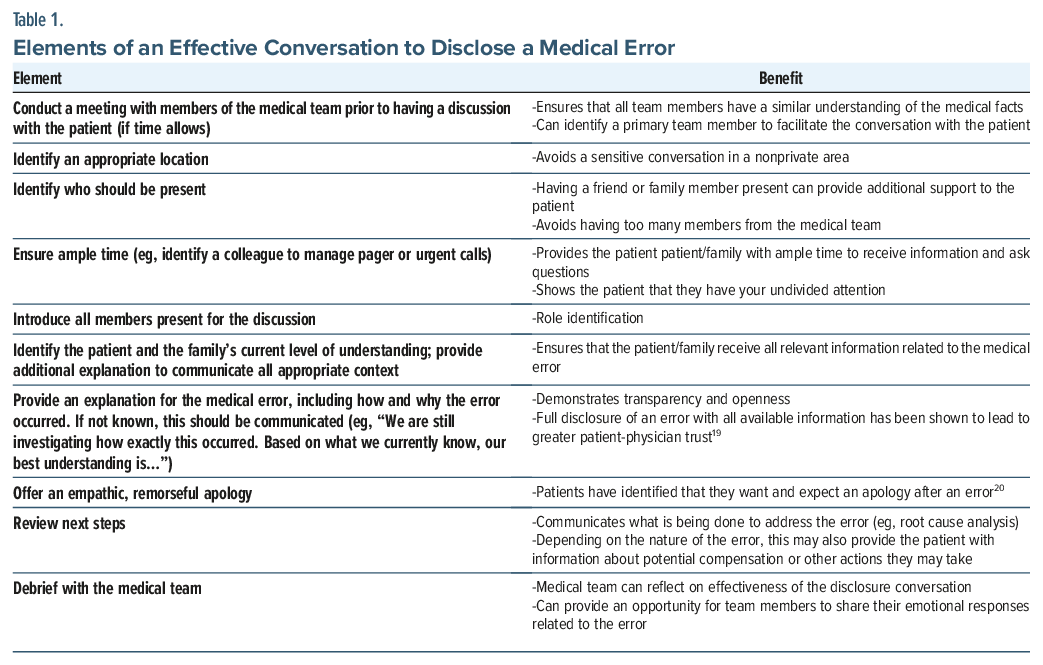
In addition to the content of disclosing medical errors, the way it is delivered can have a significant impact on the patient and family. A study by Wu et al16 found that individuals who perceived that a clinician provided a full apology and accepted responsibility were more likely to rate the clinician more favorably. Even during scenarios where a clinician did not provide a full apology, the patient’s perception of an apology was associated with favorable ratings. This finding suggests that elements such as tone and nonverbal communication play an important role in conveying a disclosure and apology to a patient after an error has occurred. Clinicians need to allow ample time to discuss an error with a patient so that all questions can be answered. Information may have to be repeated multiple times or explained in alternate ways to ensure patient understanding.
How Might Patients Who Have Been the Victim of a Surgical Error or Complication React to Hearing About or Seeing What Has Happened to Them?
Several factors (such as the degree of harm, the likelihood of complications prior to the procedure, and the way this information is delivered to the patient) can impact how a patient reacts when learning that a surgical complication occurred. For example, a patient may react differently when learning about an error that causes a minor cosmetic scar compared to a complication that causes a life-altering injury, such as permanent motor damage.
Many patients become psychologically distressed after learning that they have experienced a surgical complication.17 This might manifest as intense anxiety about the long-term impact of the complication on their health. If a patient was not adequately informed preoperatively about potential risks and complications related to surgery, they may be in denial when first learning of the error. Alternatively, a patient may become angry and blame their doctors for causing the error (even if the complication was not the direct result of human error) or themselves for consenting to surgery. One narrative review of patients’ well-being after surgical complications suggested that these untoward emotional reactions can continue to adversely impact their quality of life for a year or more after surgery.18
The way in which a patient learns about a complication can also affect how a patient responds. Several studies have found that patients who believed their doctors provided full disclosure and were transparent had more favorable views on their treating team and lower rates of depressive symptoms.19,21 Thus, a patient’s reactions following a medical error are impacted by both the “what” and the “how” when delivering information about complications. Given the wide range of emotional responses that patients may manifest when learning about a complication or error, it is important for clinicians to deliver this news to allow time for a patient to express their emotions.
What Is the Impact of An Apology on Patients, Family Members, and Health Care Providers?
Apologies after a medical error can have beneficial effects on trust, emotional recovery, and the durability of the patient-clinician relationship. Patients tend to interpret an apology as evidence that the clinician is taking responsibility for harm and is willing to engage honestly rather than retreat into silence or defensiveness. Apologies are often experienced as part of a morally meaningful response to an injury, which helps a patient make sense of what happened and to decide whether the clinician and institution remain trustworthy. 22,23
For patients, the impact is revealed in stated preferences and measurable downstream attitudes. Offering a full apology increased a patient’s willingness to recommend the hospital compared with receiving a limited apology or no apology at all (34.1% vs 22.3% vs 13.6%).24 Longer-term outcomes suggest that apologies and open communication can reduce the “emotional footprint” of a medical injury, even if they do not restore global trust in health care. Years after an error, many patients and family members report ongoing sadness, depression, and feelings of abandonment or betrayal, and many of them avoid the clinicians or the facilities that were involved in their injury.21 Open communications are associated with having lower odds for developing persisting sadness, depression, and feelings of abandonment or betrayal and with less avoidance of the involved clinicians and facility.21
For patients and families, apologies can facilitate reconciliation and continued engagement with the institution. Families often describe a need to be heard and to feel that the institution has taken the injury seriously, which an apology can signal.25 At the same time, apologies alone are often insufficient to obtain closure. Families frequently want to know what will change to prevent a recurrence of injuries, and the absence of credible follow-through on safety improvement can limit reconciliation, even when apologies and disclosures are otherwise experienced positively.25
For health care providers, apologies contribute to professional well-being in the setting of distress after a medical error. Clinicians commonly feel guilty, anxious, ashamed, and afraid about their reputation and legal consequences, and these reactions can become chronic in the absence of support.26,27 Apologies can function as a tool for moral repair by aligning clinicians’ behavior with professional values and preserving their therapeutic identity as a trustworthy caregiver, but this benefit is shaped by whether a clinician feels supported, rather than isolated, by their organization.22,27
For physicians, disclosing an error often involves additional steps beyond the conversation with the patient or family. Physicians practicing within a larger institution may need to consult with their legal or risk management departments, while those in private practice may need to discuss with their malpractice insurance provider. In addition, the Institute for Healthcare Improvement recommends conducting a root cause analysis following medical errors to better understand why errors occur and to prevent future occurrences.28
The fear of malpractice litigation and subsequent impact on medical licensure have historically been major barriers to disclosures and apologies, shaping clinicians’ behaviors and institutional policies.13,29 Liability outcomes are mixed and depend far more on the broader institutional response than on an apology given in isolation. Programs that integrate communication with patients and families, institutional review, and, when appropriate, proactive resolutions are associated with improved liability trends in some settings and do not appear to worsen liability exposure overall.30 One survey of nearly 40 state medical boards found that boards tend to hold favorable views toward physicians who have disclosed an error and apologized directly to the patient.31 “Apology laws,” or state statutes that limit whether certain statements made during an apology can be used as evidence in malpractice litigation, have not reliably reduced malpractice risk and may increase risk for some clinician groups.29 Consistent with that, text-based apologies appear to have little effect on a patient’s intention to sue, while perceived physical and emotional harm is a primary driver of litigation intent.30
What Happened to Ms B?
The operation was completed without complications. However, when her family saw her in the recovery room, they were aghast when they saw that Ms B’s left foot had been removed. They confronted the surgeon, who said, “It’s not a big deal, as we were planning on removing the other foot later this week, anyway.” The family was furious. They felt that the surgeon did not believe that his actions were consequential and that he did not appreciate their outrage and horror. Were it possible for them to arrange for an immediate transfer to another facility, they would have done so. Driven by their anger, they contacted an attorney to help them make the seemingly indifferent surgeon “pay” for his error.
What Happened to D?
Because D was not asked about gender identity, sex assigned at birth, preferred pronouns, identified sexual orientation, or relationship status during the medical history inquiry and physical examination, D was identified and treated as a biological male. This decision to use the male cutoff eGFR level delayed his transplant surgery by more than a year, and it nearly cost him his life. Once D’s medical team was aware of this error, the transplant nephrology team met with D to fully explain the error and communicate a sincere apology. D was tearful and upset at the implication that they were erroneously deemed unable to qualify for a kidney transplant. After being given time to emotionally process this information, the team discussed next steps with regard to revisiting a transplant evaluation. Ample time was provided for D to ask questions. Although it took some time to fully move past the initial error, D remained amenable to working with their transplant team.
CONCLUSION
Medical errors are those in which the planned action was not completed as intended or the wrong plan was used to achieve an aim. Unfortunately, medical errors are common, and they contribute to preventable harm in approximately 400,000 hospitalized patients each year. Errors can involve surgery or procedures (eg, wrong-side or wrong-site surgery); involve equipment malfunction, inadequate staffing, and human error (eg, with errors of omission or commission); develop even after hospital discharge (eg, related to improper wound care or inadequate use of antibiotics); involve treatment (including misdiagnosis, delayed diagnosis, and failure to act on abnormal laboratory or imaging results); or involve poor verbal or written communication among clinical team members about patient care.
The “Swiss cheese model” highlights how seemingly small systemic flaws can contribute to a future error. For example, if in the case of D, there had been certain questions on intake and screening forms (eg, asking about preferred pronouns/gender at birth), this life-threatening situation could have been avoided.
When discussing medical errors with a patient or their family, the facts about what occurred should be delivered promptly. Given the wide range of emotional responses that patients may manifest when learning about a complication or error, it is important for clinicians to allow time for a patient to express their emotions. Apologies reduce blame and anger, improve trust and relationships, have the potential to reduce the likelihood of lawsuits, and facilitate settlements.
For patients and their families, apologies can facilitate reconciliation and continued engagement with the institution. For physicians, the fear of malpractice litigation has historically been a central barrier to disclosures and apologies, which shapes clinicians’ behaviors and institutional policies.
Article Information
Published Online: September 8, 2026. https://doi.org/10.4088/PCC.26f04216
© 2026 Physicians Postgraduate Press, Inc.
Submitted: February 20, 2026; accepted May 18, 2026.
To Cite: Powell D, Wilkerson D, Robbins-Welty G, et al. Reactions to, and coping with, the sequelae of medical errors that lead to disfigurement and loss of function. Prim Care Companion CNS Disord 2026;28(5):26f04216.
Author Affiliations: Department of Psychiatry, MedStar Georgetown University Hospital, Washington, DC (Powell); Department of Family and Preventive Medicine, Emory University School of Medicine, Atlanta, Georgia (Wilkerson, Robbins-Welty); Departments of Medicine and Psychiatry and Behavioral Sciences, Emory University School of Medicine and Grady Memorial Hospital, Atlanta, Georgia (Robbins-Welty); Department of Psychiatry Geisel School of Medicine at Dartmouth, Lebanon, New Hampshire (Rustad); Department of Psychiatry, Larner College of Medicine at the University of Vermont, Burlington, Vermont (Rustad); White River Junction VA Medical Center, White River Junction, Vermont (Rustad); Department of Psychiatry, Massachusetts General Hospital/Harvard Medical School, Boston, Massachusetts (Stern).
Corresponding Author: Daniel Powell, MD, 2115 Wisconsin Ave NW, Suite 200, Washington, DC ([email protected]).
Drs Powell, Wilkerson, Robbins-Welty, and Rustad are co-first authors; Dr Stern is the senior author.
Financial Disclosure: Dr Rustad is employed by the United States Department of Veterans Affairs, but the opinions expressed in this presentation do not reflect those of the Department of Veterans Affairs. Dr Stern has received royalties from Elsevier for editing textbooks on Psychiatry. Drs Powell, Wilkerson, and Robbins-Welty report no conflicts of interest.
Funding/Support: None.
Clinical Points
- Although medical and ethical guidelines assert that health care providers are obliged to disclose medical errors, this practice is not always followed.
- When providing the facts about an adverse event, practitioners should express regret for the outcome and provide an apology (whether the error was due to an individual’s error or a system failure).
- Elements of disclosures and apologies (eg, tone and nonverbal communication) play an important role after an error has occurred. Moreover, clinicians should allow ample time to discuss the error and the reaction to it with a patient so that all questions can be answered. Offering an apology recognizes an error, admits to being responsible for it, and communicates remorse for having caused harm.
References (31)

- Gorvett Z. Why transgender people are ignored by modern medicine. BBC Future August. 2020;16. https://www.bbc.com/future/article/20200814-why-our-medical-systems-are-ignoring-transgender-people
- Committee on Quality of Health Care in America; Institute of Medicine. To Err Is Human: Building a Safer Health System. National Academies Press; 2000.
- James JT. A new, evidence-based estimate of patient harms associated with hospital care. J Patient Saf. 2013;9(3):122–128. PubMed CrossRef
- Wiegmann DA, Wood LJ, Cohen TN, et al. Understanding the “swiss cheese model” and its application to patient safety. J Patient Saf. 2022;18(2):119–123. PubMed CrossRef
- Zil-E-Ali A, Laubscher L, Kourampi I, et al. Is surgery on the right track? The burden of wrong-site surgery. Proc Bayl Univ Med Cent. 2023;36(5):657–660. PubMed CrossRef
- Marsh KM, Turrentine FE, Schenk WG Jr, et al. Errors in surgery: a case-control study. Ann Surg. 2022;276(5):e347–e352. PubMed CrossRef
- Singh H, Meyer AND, Thomas EJ. The frequency of diagnostic errors in outpatient care: estimations from three large observational studies involving US adult populations. BMJ Qual Saf. 2014;23(9):727–731. PubMed CrossRef
- American Medical Association. Opinion 8.6: promoting patient safety. In: AMA Code of Medical Ethics. American Medical Association; 2026. https://code-medical-ethics.ama-assn.org/ethics-opinions/promoting-patient-safety
- Robbennolt JK. Apologies and medical error. Clin Orthop Relat Res. 2009;467(2):376–382. PubMed CrossRef
- Witman AB, Park DM, Hardin SB. How do patients want physicians to handle mistakes? A survey of internal medicine patients in an academic setting. Arch Intern Med. 1996;156(22):2565–2569. PubMed
- Blendon RJ, DesRoches CM, Brodie M, et al. Views of practicing physicians and the public on medical errors. N Engl J Med. 2002;347(24):1933–1940. PubMed CrossRef
- Allman J. Bearing the burden or baring the soul: physicians’ self-disclosure and boundary management regarding medical mistakes. Health Commun. 1998;10(2):175–197. PubMed CrossRef
- Roberts RG. The art of apology: when and how to seek forgiveness. Fam Pract Manag. 2007;14(7):44–49. PubMed
- Gallagher TH, Studdert D, Levinson W. Disclosing harmful medical errors to patients. N Engl J Med. 2007;356(26):2713–2719. PubMed CrossRef
- Mazor KM, Reed GW, Yood RA, et al. Disclosure of medical errors: what factors influence how patients respond? J Gen Intern Med. 2006;21(7):704–710. PubMed CrossRef
- Vincent CA, Pincus T, Scurr JH. Patients’ experience of surgical accidents. BMJ Qual Saf. 1993;2(2):77–82. PubMed CrossRef
- Pinto A, Faiz O, Davis R, et al. Surgical complications and their impact on patients’ psychosocial well-being: a systematic review and meta-analysis. BMJ Open. 2016;6(2):e007224. PubMed CrossRef
- Prentice JC, Bell SK, Thomas EJ, et al. Association of open communication and the emotional and behavioural impact of medical error on patients and families: state-wide cross-sectional survey. BMJ Qual Saf. 2020;29(11):883–894. PubMed CrossRef
- Kachalia A, Kaufman SR, Boothman R, et al. Liability claims and costs before and after implementation of a medical error disclosure program. Ann Intern Med. 2010;153(4):213–221. PubMed CrossRef
- Wu A, Huang IC, Stokes S, et al. Disclosing medical errors to patients: it’s not what you say, it’s what they hear. J Gen Intern Med. 2009;24(9):1012–1017. PubMed CrossRef
- Robbennolt JK. Apologies and legal settlement. Mich Law Rev. 2003;102:460–516.
- Gallagher TH, Waterman AD, Ebers AG, et al. Patients’ and physicians’ attitudes regarding the disclosure of medical errors. JAMA. 2003;289(8):1001–1007. PubMed CrossRef
- Fisher KA, Gallagher TH, Smith KM, et al. Communicating with patients about breakdowns in care: a national randomized vignette-based survey. BMJ Qual Saf. 2020;29(4):313–319. PubMed CrossRef
- Moore J, Bismark M, Mello MM. Patients’ experiences with communication-and-resolution programs after medical injury. JAMA Intern Med. 2017;177(11):1595–1603. PubMed CrossRef
- Wu AW. Medical error: the second victim. The doctor who makes the mistake needs help too. BMJ. 2000;320(7237):726–727. PubMed CrossRef
- Schwappach DLB. In the aftermath of medical error: caring for patients, family, and the healthcare workers involved. Bundesgesundheitsblatt Gesundheitsforsch Gesundheitsschutz. 2015;58(1):80–86. PubMed CrossRef
- Charles R, Hood B, Derosier JM, et al. Ho to perform a root cause analysis for workup and future prevention of medical errors: a review. Patient Saf Surg. 2016;10(1):20. PubMed CrossRef
- Kachalia A, Sands K, Van Niel M, et al. Effects of a communication-and-resolution program on hospitals’ malpractice claims and costs. Health Aff (Millwood). 2018;37(11):1836–1844. PubMed CrossRef
- McMichael BJ, Van Horn RL, Viscusi WK. “Sorry” is never enough: how state apology laws fail to reduce medical malpractice liability risk. Stanf Law Rev. 2019;71(2):341–409. PubMed
- Arbel-Groissman N, Dorfman E, Yom-Tov E, et al. On the influence of apologies on the likelihood of lawsuits in cases of perceived medical negligence: analysis of archival and experimental data. J Med Internet Res. 2025;27:e77493. PubMed CrossRef
- Wojcisak D. How will state medical boards handle cases involving disclosure and apology for medical errors?. J Patient Saf Risk Manage. 2022;27(1):15–20.
Please sign in or purchase this PDF for $40.