
Amyotrophic lateral sclerosis (ALS) is a progressive neurodegenerative disorder marked by functional decline, communication impairment, and limited disease-modifying therapies. Given prognostic uncertainty and risk of rapid loss of decisional capacity, early and iterative goals-of-care discussions are essential. Patients with complex social needs may be at particular risk for delayed advance care planning and inequitable access to supportive care. This case illustrates how early collaboration with an inpatient palliative care interdisciplinary team can promote patient-centered, goal-concordant care in the acute hospital setting.
Case Report
A 36-year-old Swahili-speaking Congolese man was admitted to the hospital after 5 months of progressive upper and lower extremity weakness resulting in dependence for activities of daily living. Prior outpatient evaluation included cervical, thoracic, and lumbar spine magnetic resonance imaging (MRI) showing degenerative changes and electromyography (EMG) concerning for neuromuscular disease; a prednisone trial was ineffective. On admission, the examination demonstrated diffuse weakness, muscle atrophy, multifocal fasciculations, and hyperreflexia. Laboratory testing revealed elevated creatine kinase (726 U/L). Brain MRI showed T2-weighted fluid-attenuated inversion recovery hyperintensity along the bilateral internal capsules. Repeat EMG demonstrated active denervation with chronic reinnervation consistent with motor neuron disease. Negative inspiratory force was −10 cm H2O. The patient was diagnosed with ALS.
The patient had immigrated alone to the United States as a refugee in December 2023 and had no local family or surrogate decision-maker. His history included significant psychological trauma associated with the persecution he experienced. Given the new diagnosis and complex psychosocial context, inpatient palliative care was consulted early. The interdisciplinary team collaborated with neurology to address symptom management and provided social work and chaplain support for emotional and spiritual distress, which can be incorporated outside of the palliative team.1 The team also assisted with efforts toward family reunification, as the patient’s family remained in a refugee camp in Eastern Africa.
Goals-of-care discussions were facilitated using the Serious Illness Conversation Guide (SICG) with a medical interpreter. This structured approach supported the exploration of the patient’s understanding of illness, values, and preferences and enabled him to establish limits of care aligned with his beliefs. Moreover, trauma-and grief-informed care, which included permission seeking and therapeutic support to address the patient’s multiple losses and sources of trauma and to ensure physical and emotional safety, was used to build trust and avoid re-traumatization.
Discussion
Advance care planning is particularly important in ALS due to prognostic variability and the risk of rapid functional and communicative decline.2 Proactive elicitation of patient values supports goal-concordant care when patients may later lose the ability to communicate their wishes.3,4 Multidisciplinary ALS care, including palliative care involvement, has been associated with improved quality of life and outcomes.5 The SICG provides a practical framework to guide discussions about prognosis, goals, and preferences and has been shown to improve patient-reported outcomes in other serious illness populations, with recent updates to address more diverse patient populations (Figure 1).6
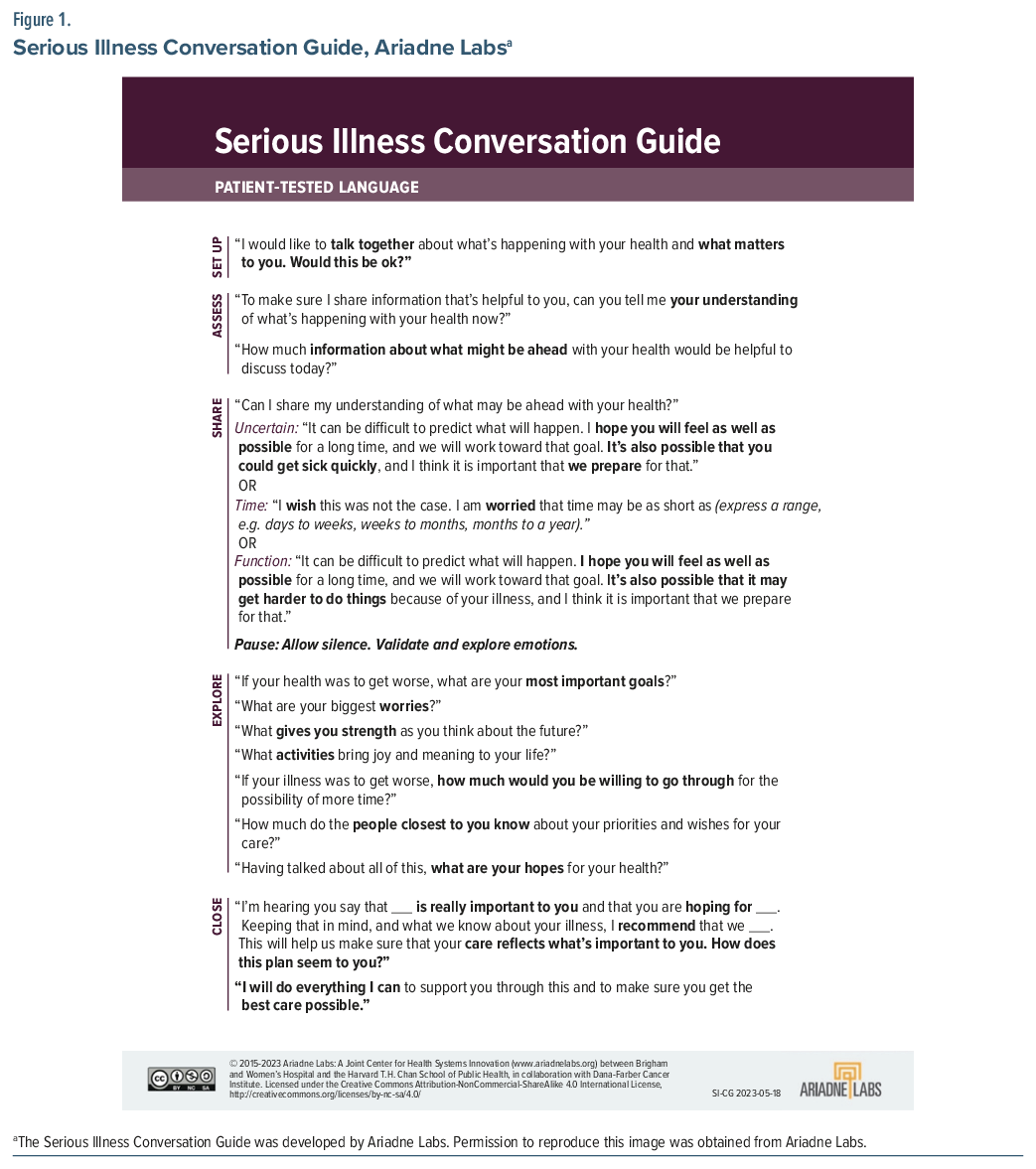
In the outpatient oncology setting, studies have shown significant reductions in anxiety and depression among patients whose providers utilized the SICG as part of a communication quality improvement intervention.7 We hypothesize that similar improvements could be seen through routine implementation of this model to guide advance care planning conversations in a multidisciplinary ALS clinic setting, in situations where expert palliative care consultation is not available. Thus, the SICG serves as a valuable tool in facilitating discussions for neurologists who may encounter ALS patients in a community or hospital-based setting.
In this case, use of the SICG was especially valuable given the language barriers, trauma history, and absence of informal caregivers. The PC team utilized it as a vehicle to deliver grief-and trauma-informed care, which is essential for optimizing patient coping and outcomes such as improved symptom management.8,9 Members of the interdisciplinary team explored the patient’s values and wishes and sought permission to discuss his disease trajectory, all while assessing for traumatic distress, providing psychoeducation regarding the impact of past trauma on his illness experience, and offering psychotherapeutic and spiritual support centered on meaning-making to minimize grief intensity. The palliative care team also advocated for other clinical teams to similarly adopt practices that were sensitive to the patient’s significant losses and trauma.
While specialty palliative care services are not universally available, structured communication tools and training in primary palliative care skills may allow neurologists and hospitalists to initiate earlier, higher-quality advance care planning conversations.10 This approach is particularly critical for socially isolated patients and those with notable histories of trauma, grief, and loss.
Conclusion
Early interdisciplinary palliative care and structured grief-and trauma-informed serious illness communication can facilitate meaningful advance care planning for patients with ALS, even during acute hospitalization. Broader training in such communication and care may help promote equitable, patient-centered care for particularly vulnerable populations with neurodegenerative diseases.
Article Information
Published Online: October 6, 2026. https://doi.org/10.4088/PCC.26cr04223
© 2026 Physicians Postgraduate Press, Inc.
Prim Care Companion CNS Disord 2026;28(5):26cr04223
Submitted: March 4, 2026; accepted June 16, 2026.
To Cite: Rankin J, Oltmann C, Pinto Taylor E, et al. Early palliative care and structured serious illness communication in a refugee patient with amyotrophic lateral sclerosis. Prim Care Companion CNS Disord 2026; 28(5):26cr04223.
Author Affiliations: Emory University School of Medicine, Atlanta, Georgia (Rankin); Department of Population Health Sciences, University of Miami, Miami, Florida (Oltmann); Division of Health Research, Lancaster University, Bailrigg, United Kingdom (Oltmann); Division of Hospice and Palliative Medicine, Department of Family and Preventive Medicine, Emory University School of Medicine, Atlanta, Georgia (Pinto Taylor, Lal); Division of General Internal Medicine, Department of Medicine, Emory University School of Medicine, Atlanta, Georgia (Pinto Taylor); Department of Neurology, Emory University School of Medicine, Atlanta, Georgia (Schachter).
Corresponding Author: Emily Pinto Taylor, MD, 49 Jesse Hill Jr Dr SE, Faculty Office Building, 4th Floor, Atlanta GA 30303 ([email protected]).
Financial Disclosure: None.
Funding/Support: None.
Patient Consent: Consent was received from the patient to publish the case report, and information has been de-identified to protect patient anonymity.
References (10)

- Bangerter LR, Griffin JM, Eagan A, et al. Recommendations from the Salzburg Global Seminar on Rethinking Care Toward the End of Life. Int J Qual Health Care. 2018;30(5):408–413. PubMed CrossRef
- Ding JL, Ritchie CS, Vranceanu AM, et al. Palliative care interventions for persons with neurodegenerative disease: a scoping review of clinical trial study design features. J Palliat Med. 2024;27(7):939–950. PubMed CrossRef
- Seeber AA, Pols AJ, Hijdra A, et al. Advance care planning in progressive neurological diseases: lessons from ALS. BMC Palliat Care. 2019;18(1):50. PubMed CrossRef
- Sudore RL, Lum HD, You JJ, et al. Defining advance care planning for adults: a consensus definition from a multidisciplinary Delphi Panel. J Pain Symptom Manage. 2017;53(5):821–832.e1. PubMed CrossRef
- Shoesmith C. Palliative care principles in ALS. Handb Clin Neurol. 2023;191:139–155. PubMed CrossRef
- Ariadne Labs. Serious Illness Conversation Guide. Accessed August 9, 2024. https://www.ariadnelabs.org/resources/downloads/serious-illness-conversation-guide/
- Bernacki R, Paladino J, Neville BA, et al. Effect of the serious illness care program in outpatient oncology: a cluster randomized clinical trial. JAMA Intern Med. 2019;179(6):751–759. PubMed CrossRef
- Ho JJ, Brown CK, Bemis H, et al. Top ten tips palliative care clinicians should know about trauma-informed care. J Palliat Med. 2025.
- de Groot JM, Fehon DC, Calman L, et al. Trauma-informed palliative care is needed: a call for implementation and research. Palliat Med. 2023;37(10):1470–1473. PubMed CrossRef
- Jacobsen J, Bernacki R, Paladino J. Shifting to serious illness communication. JAMA. 2022;327(4):321–322. PubMed CrossRef
Please sign in or purchase this PDF for $40.