
Schizophrenia is widely conceptualized as a neurodevelopmental disorder where genetic and environmental factors during early brain development contribute to symptoms.1–3 Minor physical anomalies (MPAs) observed in affected individuals provide a clue to these disturbances occurring during embryogenesis, reflecting multisystem developmental involvement.3,4 Similarly, congenital urinary tract anomalies like unilateral renal agenesis (URA) also arise from disruptions in nephrogenesis during embryonic development and may occur either in isolation or in association with abnormalities affecting other organ systems.5 We report a case of treatment-resistant schizophrenia with URA and MPAs, highlighting this rare association and its potential development as well as treatment implications.
Case Report
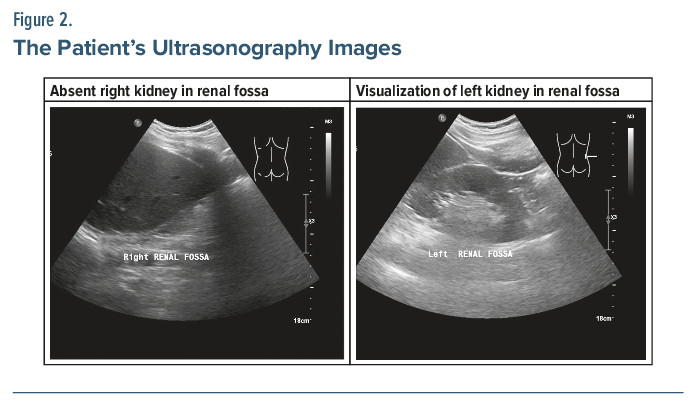
A 36-year-old unmarried, unemployed man, educated up to 11th grade, presented to the psychiatry clinic with an acute-onset continuous illness for the past 10 years, meeting International Classification of Diseases, Eleventh Revision6 criteria for schizophrenia, characterized by suspiciousness, auditory hallucinations, and self-absorbed behavior. Despite adequate trials of risperidone (up to 16 mg for 3 years), amisulpride (800 mg for 1 year), and trifluoperazine (15 mg for 6 months) and a brief clozapine trial (up to 100 mg for 2 weeks, discontinued due to constipation and postural drop), only partial response was seen with risperidone (8–16 mg), with no response to the other medications, indicating treatment resistance. His birth and premorbid history were unremarkable. There was a family history of alcohol dependence in his father. He had a medical history of recurrent urinary tract infection, with phimosis and circumcision for the same 2 years ago, during which a solitary functioning left kidney with absent right kidney was revealed on ultrasonography incidentally.
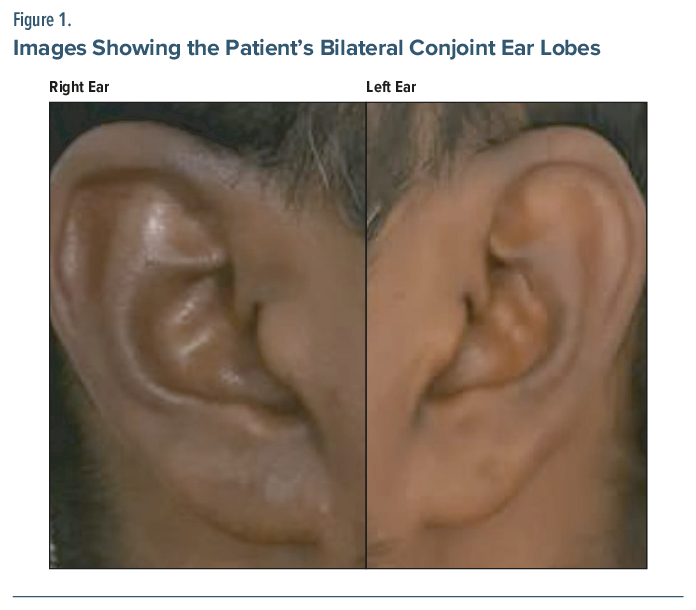
On mental state examination, he had constricted affect and second-person auditory hallucinations. Insight was grade II. The patient was admitted to the hospital. His Positive and Negative Syndrome Scale (PANSS)7 score at admission was 60. The physical examination revealed dysmorphic facial features, including elongated face, increased intercanthal distance, and adherent earlobes (Figure 1). The Waldrop Minor Congenital Anomaly Scale score was 6.8 Magnetic resonance imaging of the brain showed nonspecific white matter changes in the right frontal lobe and left corona radiata and a calcified parietal granuloma. Repeat ultrasonography confirmed a solitary left kidney with nonvisualization of the right kidney (Figure 2).
Before the current admission, he was taking risperidone 8 mg and trifluoperazine 10 mg. Trifluoperazine was tapered and stopped, and risperidone was reduced to 4 mg. Tablet olanzapine 10 mg/day was started, as he was not tolerating clozapine. Clinical improvement was noted, with his PANSS score decreasing from 60 to 54 within 2 weeks of medication change. The patient was discharged, and at the recent follow-up 3 months later, his PANSS score was 50. Olanzapine was increased to 20 mg, with a plan to initiate clozapine if no further response was observed during the follow-up.
Discussion
This case is notable for the coexistence of schizophrenia, URA, and MPAs, suggesting the possibility of a shared developmental vulnerability. URA results from disturbances in embryologic development. Over 200 syndromes are associated with URA, of which many are commonly associated with MPAs, supporting that those common developmental insults may cause both URA and MPAs.5,9
Similarly, the association between schizophrenia and MPAs has been well established, and the presence of MPAs is the strongest clinical support for the neurodevelopmental conceptualization of schizophrenia.1,4,10 Emerging evidence supports that the presence of MPAs and other markers of aberrant embryological development is associated with greater illness severity and treatment resistance, as seen in our patient.11–13
Despite the established association between URA and MPAs, and the association between schizophrenia and MPAs, reports describing the coexistence of URA and schizophrenia remain exceedingly rare in the literature. No prior case reports, to the best of our knowledge, document the simultaneous presence of URA, MPAs, and treatment-resistant schizophrenia in the same individual. Certain genetic syndromes, such as 17q12 recurrent deletion syndrome14 and 22q11.2 deletion (DiGeorge syndrome),15 are known to present with renal anomalies, facial dysmorphism, and increased vulnerability to schizophrenia, indicating the possibility of an underlying genetic syndrome in our patient. Although further genetic testing would have been clinically informative, it could not be done due to financial constraints.
This case highlights the importance of assessing MPAs at the primary care level, as individuals with such markers may warrant closer monitoring for major physical anomalies and the onset of conditions like schizophrenia. In patients with schizophrenia, systematic evaluation for MPAs and major anomalies such as URA may help predict treatment resistance and assist in prognostication. Recognition of these markers provides important clues to underlying genetic and neurodevelopmental vulnerabilities in schizophrenia.
Article Information
Published Online: August 18, 2026. https://doi.org/10.4088/PCC.26cr04230
© 2026 Physicians Postgraduate Press, Inc.
Prim Care Companion CNS Disord 2026;28(4):26cr04230
Submitted: February 16, 2026; accepted May 4, 2026.
To Cite: Bakam A, Birdi R, Dhiman K, et al. Treatment-resistant schizophrenia in a patient with unilateral renal agenesis and dysmorphic facial features: A case report.
Prim Care Companion CNS Disord. 2026;28(4): 26cr04230.
Author Affiliations: Department of Psychiatry, All India Institute of Medical Sciences, Bibinagar, Hyderabad, India (Bakam, Birdi, Spoorthy); Department of Radiology, All India Institute of Medical Sciences, Bibinagar, Hyderabad, India (Dhiman).
Corresponding Author: Anirudh Bakam, MD, PDF, All India Institute of Medical Sciences, Bibinagar, Hyderabad, Telangana, India ([email protected]).
Financial Disclosure: None.
Funding/Support: None.
Patient Consent: Consent was obtained from the patient and caregiver for publication of this case report and images, and information has been de-identified to protect patient anonymity.
ORCID: Anirudh Bakam: https://orcid.org/0009-0009-7738-3082
References (15)

- Fatemi SH, Folsom TD. The neurodevelopmental hypothesis of schizophrenia, revisited. Schizophr Bull. 2009;35(3):528–548. PubMed CrossRef
- Murray RM, Lewis SW. Is schizophrenia a neurodevelopmental disorder?. Br Med J Clin Res Ed. 1987;295(6600):681–682. PubMed CrossRef
- Gupta S, Kulhara P. What is schizophrenia: a neurodevelopmental or neurodegenerative disorder or a combination of both? A critical analysis. Indian J Psychiatry. 2010;52(1):21–27. PubMed CrossRef
- Weinberg SM, Jenkins EA, Marazita ML, et al. Minor physical anomalies in schizophrenia: a meta-analysis. Schizophr Res. 2007;89(1-3):72–85. PubMed CrossRef
- Mahmoud AH, Talaat IM, Tlili A, et al. Congenital anomalies of the kidney and urinary tract. Front Med. 2024;11:1384676. doi:10.3389/fmed.2024.1384676. PubMed CrossRef
- Schizophrenia in ICD-11: Comparison of ICD-10 and DSM-5. Rev Psiquiatr Salud Ment English Ed. 2020;13(2):95-104.
- Kay SR, Fiszbein A, Opler LA. The Positive and Negative Syndrome Scale (PANSS) for schizophrenia. Schizophr Bull. 1987;13(2):261–276. PubMed CrossRef
- Waldrop MF, Pedersen FA, Bell RQ. Minor physical anomalies and behavior in preschool children. Child Dev. 1968;39(2):391–400. PubMed
- Kolvenbach CM, Shril S, Hildebrandt F. The genetics and pathogenesis of CAKUT. Nat Rev Nephrol. 2023;19(11):709–720. PubMed CrossRef
- Green MF, Satz P, Christenson C. Minor physical anomalies in schizophrenia patients, bipolar patients, and their siblings. Schizophr Bull. 1994;20(3):433–440. PubMed CrossRef
- Iftimovici A, Krebs E, Dalfin W, et al. Neurodevelopmental predictors of treatment response in schizophrenia and bipolar disorder. Psychol Med. 2024;54(13):1–12. PubMed CrossRef
- John JP, Arunachalam V, Ratnam B, et al. Expanding the schizophrenia phenotype: a composite evaluation of neurodevelopmental markers. Compr Psychiatry. 2008;49(1):78–86. PubMed CrossRef
- Uğurpala C, Berberoğlu E, Özkan U, et al. Minor physical anomalies may be related to treatment resistance in patients with schizophrenia. Asian J Psychiatr. 2023;88:103729. PubMed CrossRef
- Mitchel MW, Moreno-De-Luca D, Myers SM, et al. 17q12 Recurrent Deletion Syndrome. In: Adam MP, Bick S, Mirzaa GM, et al, eds. GeneReviews. University of Washington, Seattle; 1993. Accessed February 23, 2026. http://www.ncbi.nlm.nih.gov/books/NBK401562/
- Bassett AS, Chow EWC. Schizophrenia and 22q11.2 deletion syndrome. Curr Psychiatry Rep. 2008;10(2):148–157. PubMed CrossRef
Please sign in or purchase this PDF for $40.