
Lessons Learned at the Interface of Medicine and Psychiatry
The Psychiatric Consultation Service at Massachusetts General Hospital sees medical and surgical inpatients with comorbid psychiatric symptoms and conditions. During their twice-weekly rounds, Dr Stern and other members of the Consultation Service discuss diagnosis and management of hospitalized patients with complex medical or surgical problems who also demonstrate psychiatric symptoms or conditions. These discussions have given rise to rounds reports that will prove useful for clinicians practicing at the interface of medicine and psychiatry.
Prim Care Companion CNS Disord 2026;28(5):26f04265
Author affiliations are listed at the end of this article.
From the Editors

Are you a healthcare provider?
Add your NPI to personalize your JCP experience.
Have you ever wondered whether depression that develops in the context of a medical illness is understandable and not pathological? Have you been unsure about whether (and when) you should initiate treatment (eg, pharmacologic or nonpharmacologic) in your patients who have lost the will to live? Have you considered whether suicide can be a rational act that need not be prevented? If you have, the following case vignette and discussion should prove useful.
CASE VIGNETTE
Mr A, a 74-year-old man with end-stage nonischemic cardiomyopathy who was being supported by a left ventricular assist device (LVAD), developed chest pain and shortness of breath after disconnecting his LVAD driveline to end his life. His son, who discovered what had occurred, called emergency medical services. Mr A agreed to reconnect his LVAD and to be transported to the hospital for evaluation.
In the emergency department, Mr A described having been connected to the LVAD 18 months earlier as a “mistake,” as he had anxiety, insomnia, anhedonia, guilt, irritability, low levels of energy and motivation, impaired concentration, and hopelessness since he had the procedure. He believed that he should have “said his goodbyes” to his family and died of heart failure, rather than proceeding with the LVAD implantation. Although Mr A was frustrated by his failure to commit suicide, he said that he would not disconnect or deactivate the LVAD while hospitalized, noting that staff would quickly intervene.
Mr A also reported progressive dysphagia, nausea, vomiting, poor appetite, and weight loss. An upper gastrointestinal (GI) endoscopy revealed a large, partially obstructing, fungating, and friable mass at the gastroesophageal junction, and a biopsy confirmed that he had a high-grade esophageal adenocarcinoma. Although the oncology team discussed potential treatment options with him, the presence of the LVAD substantially limited his therapeutic options. As his medical condition stabilized, Mr A declined to pursue further life-prolonging interventions. He refused anticoagulation (that was required for his LVAD management), chronic use of antibiotics (for a known methicillin-sensitive Staphylococcus aureus driveline infection), and psychotropics (to address his depressive symptoms). While he denied having plans to disconnect his LVAD in the hospital, he requested a change in code status (to do not resuscitate and do not intubate) and repeatedly told his treatment team that he hoped his death would occur “as soon as possible to give my family peace.”
Multidisciplinary discussions (involving palliative care, psychiatry, social work, ethics, risk management, and the LVAD team) focused on the clinical, ethical, and logistical challenges that arose while caring for Mr A, given his recent suicide attempt, severe medical illness, and change of his code status while he declined to pursue recommended treatments. Options for psychiatric hospitalization and hospice care were explored; however, his medical complexity limited his treatment options on a psychiatric unit, and hospice programs were unable to manage his LVAD or his ongoing wish for death.
How Often (and Why) Does Depression Arise in Those With Medical Illness?
Depression is common among patients with medical illnesses, although the incidence of depressive symptoms varies widely depending on the clinical setting, the type of medical illness, and how depression is measured. In general hospital settings, roughly 12% of inpatients meet criteria for major depressive disorder (MDD), with a wide range of frequencies that reflect differences in acuity and patient populations.1 The course of illness also impacts when and how depression develops. Acute medical events often provoke distress, fear, or grief, but these reactions may improve as the underlying condition stabilizes, the patient adapts to this distress, or the patient develops new or preexisting coping skills. Patients may experience a range of psychosocial distress with certain patients exhibiting mild distress, others experiencing a brief period of adjustment or grief reaction, and other patients experiencing demoralization in the setting of medical stressors. This contributes to variability in inpatient prevalence estimates of depressive disorders.1 Rates are often higher in those with chronic diseases, particularly in conditions that are associated with persistent physical symptoms or a functional decline. In chronic illnesses, patients must contend with ongoing symptoms, uncertainty, and the daily work of managing their condition. Because of these factors, depression may be more likely to develop, or to recur, later in the patient’s illness course. Importantly, while a proportion of patients experience persistent depressive symptoms, particularly when illness is accompanied by pain, fatigue, or sustained treatment demands, many patients adapt over time. Depression among patients with medical illnesses is not universal across all populations, and the presence of these symptoms varies over time for individual patients.2 Examining the patient’s source of distress, how the onset of symptoms correlates in time with medical stressors, and an understanding of a patient’s coping skills and sources of support can be helpful in providing diagnostic clarity and creating a treatment plan.
Certain medical conditions have been consistently associated with higher rates of depression. Patients with advanced heart disease, especially heart failure, frequently experience depression, with 41.9% of these patients experiencing depression (of any severity) and 28.1% of patients experiencing moderate to severe depressive symptoms.3 Patients with cancer also have elevated rates of depression. Estimates vary by tumor type, cancer stage, and treatment phase, but in general the range is from 8% to 24%.4 Chronic kidney disease (CKD), particularly among those who are being dialyzed, carries a substantial burden, with pooled prevalence rates around 26.5%.5 Depression is also common in type 2 diabetes (T2DM), with 23% of males and 34% of females with T2DM having depression.6 Depression is also frequent following a cerebrovascular accident, and it is associated with negative outcomes.7
The intensity of medical treatment also increases the risk of developing depression. In CKD, depression is more common among patients receiving hemodialysis than among patients who are awaiting dialysis, suggesting that treatment burden and severity of illness play an important role.5 In those with cancer, depressive symptoms often fluctuate over the treatment course, reflecting side effects, fatigue, and uncertainty about outcomes.4 In those with advanced heart disease, the association between depression and treatment interventions is more nuanced. Depression is common before advanced therapies, such as LVAD placement or heart transplantation. Some patients improve after undergoing these treatments, potentially due to improvement in functional capacity, symptoms of acute heart failure, and quality of life.8 Unfortunately, many transplant recipients continue to experience depression, which reflects ongoing medical complexity and psychosocial stress.9
Several frameworks help to explain why depression arises in the setting of medical illnesses, with most suggesting a combination of biological, psychological, and social factors. Biological models focus on shared pathways, particularly low-grade inflammation and metabolic changes, which appear to be linked to specific depressive symptoms (such as fatigue, anhedonia, and changes in sleep or appetite).10 Psychological models emphasize the impact of persistent symptoms, uncertainty, and loss that may lead to demoralization, difficulty coping, and shrinking patient self-efficacy.2,11 Social and functional perspectives highlight the effects of reductions in independence, role disruption, and the ongoing demands of managing illness.2,12 In practice, these explanations often overlap. For most patients, depression reflects the combined influence of biological vulnerability, symptom burden, functional limitations, and the lived experience of significant medical illness. Importantly, a bidirectional relationship between depressive symptoms and medical symptoms is also common, with depressive symptoms impacting aspects of medical care including increased risk of medication noncompliance, medical readmissions, and worsened outcomes.
Does Depression in the Medically Ill Differ From Depression in Otherwise Healthy Adults?
Overall, features of depression in those with medical illness overlap significantly with depression in otherwise healthy adults. Core features (such as low mood, anhedonia, and impaired concentration) remain central across both groups.13 In medically ill populations, neurovegetative and somatic symptoms (such as fatigue, sleep disturbance, and appetite changes) are often prominent.14,15 These symptoms may be driven by the underlying medical condition or its treatment, rather than depression itself. This overlap can complicate diagnosis and may lead to under-recognition of depression and overattribution of physical symptoms as being caused by depression, rather than an underlying medical precipitant.13
In patients with a medical illness, depressive symptoms may be impacted by concurrent medical processes, treatment-related effects, and physical symptoms. Such patients are often coping with pain, functional limitations, uncertainty about prognosis, and changes in their identity or independence. As a result, depressive symptoms may be intertwined with demoralization, adjustment difficulties, and existential distress.16,17 While these constructs are distinct, they frequently coexist in clinical practice,18 which requires careful assessment to clarify whether a patient is experiencing a major depressive episode, a situational response, or both.
Which Medical Conditions and Their Treatments Can Cause (or Look Like) Depression?
Depressive symptoms in those with a medical illness do not always indicate the presence of a primary mood disorder. A range of medical conditions and treatments can precipitate depressive syndromes or produce symptom profiles that closely resemble primary mood disorders. Please see Table 1 for selected medical conditions and treatments that resemble depressive disorders. For clinicians, the key challenge is distinguishing a true depressive disorder from depressive symptoms that are better attributed to an underlying disease process, treatment effect, or overlapping physiological changes.
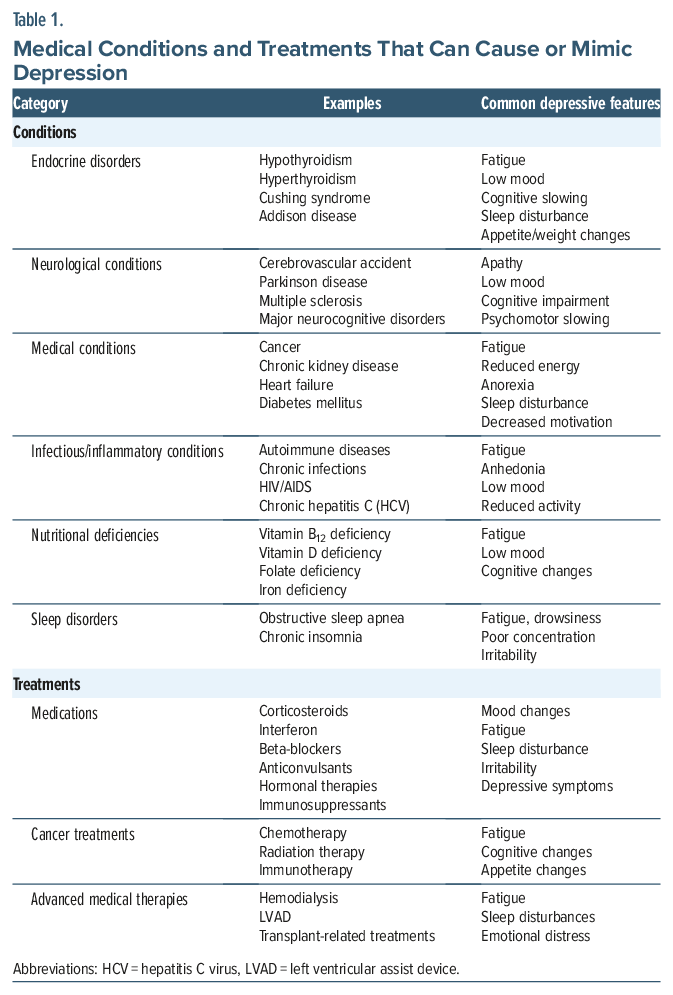
Several medical illnesses are known to cause or to contribute to depression through direct biological mechanisms. Endocrine disorders are among the most classic examples. Hypothyroidism can present with low mood, fatigue, cognitive slowing, and weight gain, often closely mimicking MDD.19 In contrast, hyperthyroidism may present with anxiety, irritability, and sleep disturbances.19 Adrenal disorders, such as Cushing syndrome, are also strongly associated with depression, potentially due to sustained glucocorticoid exposure on brain function.20 Chronic systemic illnesses can also produce depressive symptoms through a combination of inflammation, metabolic disruption, and symptom burden. Several conditions (such as cancer, CKD, and heart failure) are frequently associated with fatigue, anorexia, sleep disturbance, and reduced energy, each of which overlaps with criteria for depression.3,5
Medications and medical treatments are often under-recognized sources of depressive symptoms. Corticosteroids are among the most well-established medications that cause psychiatric effects (including depression, anxiety, and mood lability), especially when higher doses are used, or they are used for a prolonged period.21 Interferon-based therapies are strongly associated with depressive syndromes, with 25% and 28% of patients experiencing depression at 1 and 2 years, respectively.22 Other medications that may contribute to depressive symptoms include beta-blockers, certain anticonvulsants, and some hormonal therapies, although the strength of these associations varies. Cancer treatments, including chemotherapy and radiation therapy, can also produce fatigue, cognitive changes, and reduced motivation, which may resemble or coexist with depression.
For many patients, symptoms may be driven by both processes simultaneously, with depression emerging from the interaction between biological vulnerability and psychosocial distress related to living with significant medical illness. The distinction between primary and secondary depression is often less clear in practice than it appears conceptually. For example, a patient who is undergoing cancer treatment may have biologically mediated fatigue or chemotherapy-induced cognitive impairment alongside existential distress and role disruption. In these cases, a comprehensive assessment that considers medical, psychiatric, and functional factors is essential. From a clinical standpoint, several features help guide the evaluation. The presence of prominent symptoms such as hopelessness, guilt, or thoughts of suicide may point more strongly toward a depressive disorder, whereas isolated somatic symptoms in the absence of psychological distress suggest a medical or treatment-related etiology. That said, overlap is common, and clinicians should be cautious about attributing symptoms to one domain alone. The most effective approach involves treating medical contributors and the depressive syndrome concurrently, when clinically indicated.
How Can Depression in Medically Ill Individuals Be Treated?
Although depression in the medically ill is treated like depression in otherwise healthy adults, collaborative care models, which incorporate case management, systematic symptom monitoring, and enhanced communication between primary care and mental health clinicians, have led to improved outcomes in medically ill populations.13 In addition, managing multiple related or comorbid conditions together (eg, patients with concurrent diabetes mellitus, heart disease, and MDD) has shown improved control of chronic conditions, even without changes in medication adherence rates.23 Certain care models include the use of care managers who oversee each patient’s care plan and ensure all conditions and medications are appropriately monitored.24 The 2009 National Institute for Health and Care Excellence guidelines for depression in those with chronic physical health concerns recommended a stepwise, comprehensive approach in which treatment intensity was matched to symptom severity, chronicity, comorbidity, and patient preference.25 Effective treatment of depression in the medically ill requires an individualized and integrated approach that combines psychosocial interventions, pharmacotherapy, and potentially neuromodulatory techniques, while addressing the complex interplay between physical and mental health.
Management for those with depression or suspected depression should begin with a comprehensive assessment that evaluates depressive symptom burden, the duration of the episode, the degree of functional impairment, the psychiatric and treatment history, social supports, and the risk of self-injurious behaviors and suicide, followed by psychoeducation, monitoring, and referral for further assessment or interventions as needed.25 Screening tools, such as the Patient Health Questionnaire-9 or the Hospital Anxiety and Depression Scale (HADS), may help in detecting symptoms and tracking worsening in severity or improvements in symptoms with treatment over time.26,27 The HADS may be especially helpful in patients with comorbid medical illnesses given that it minimizes the influence of physical symptoms on score reporting.
For individuals with mild to moderate depression or persistently subthreshold depressive symptoms, low-intensity psychosocial or psychological interventions are first-line treatments. These interventions include peer support, group physical activity, and patient-guided self-help based on the principles of cognitive-behavioral therapy (CBT).25 In particular, exercise is effective for reducing depressive symptoms and potentially as effective as antidepressants.28 Behavioral activation also shows promise, although the data are less robust.29 Such approaches are particularly valuable in the medically ill, as they can be adapted to physical limitations (in the case of physical activity), customized to certain physical health problems (in the case of peer support), and delivered to groups of patients with a shared health problem.25
Although psychotropics are not typically recommended for those with mild depression, those agents can be considered based on patient preference and functional impairment, which may severely impact quality of life. In patients whose medical treatment necessitates long-term treatment with medications that are known to precipitate depressive symptoms (eg, interferon, corticosteroids), clinicians should consider starting, or restarting, treatment with nonpharmacologic treatments or psychotropic agents.
For individuals with persistent subthreshold depressive symptoms, mild to moderate depression that has not responded to initial interventions, or those with moderate to severe depression, high-intensity psychological interventions, including individual CBT or interpersonal therapy, are recommended and can address illness-related distress, role transitions, and challenges with adherence.25 Dignity therapy has also been implemented in palliative care settings to decrease psychological distress in patients at the end of life.30 Meaning-centered psychotherapy has also decreased psychological distress in terminally ill individuals.31
When moderate to severe depression develops or when psychological interventions alone have been insufficient to remit symptoms, pharmacotherapy is indicated.25 Selective serotonin reuptake inhibitors (SSRIs) are typically viewed as first-line agents due to their tolerability and relatively benign side effect profile, although medication selection should be individualized and based on comorbid conditions, their side effect profile, and the risk of interactions given the complex medical needs of these patients. Earlier or more frequent follow-up is advised to monitor for treatment response, adverse effects, and emergent suicidality. In cases of nonresponse, guidelines recommend that treatment adherence and diagnosis be reassessed, followed by dose optimization, switching antidepressants, or considering augmentation strategies.25
For those with severe, complex, treatment-resistant, or life-threatening depression (eg, involving thoughts of suicide or severe self-neglect), referral to a specialist should be considered. Neuromodulatory interventions, such as electroconvulsive therapy (ECT), should be considered, especially when depression is accompanied by the acute risk of suicide, psychotic symptoms, or failure of at least 1 medication trial.32 Other available interventional treatments for depression include repetitive transcranial magnetic stimulation,33 ketamine-based therapies,34 or vagus nerve stimulation,35 which may be helpful for selected patients.
What Should Health Care Providers Consider Before Prescribing Psychotropic Medications?
Before prescribing psychotropic medications for medically complex patients, clinicians should weigh the potential benefits against the risks in the context of their comorbid illness, concurrent medical treatments, disease status, quality of life, and overall goals of depression treatment. Nonpharmacologic interventions (such as psychotherapeutic modalities, exercise, and behavioral activation) should be recommended if not already initiated, given their low risk of harm and potential benefits.25,28,29 Next, the duration of the expected medical illness should be considered, given that antidepressants may take up to 12 weeks for their full effect to appear. In patients who are nearing the end of life, the initiation of a stimulant or a steroid should be considered to improve mood in the short term. For patients experiencing comorbid physical symptoms, such as insomnia and physical pain, efforts should be made to address these symptoms directly, especially if these comorbid symptoms are further exacerbating the patient’s depressive symptoms.
When considering which antidepressant to prescribe, co-occurring physical symptoms (such as nausea, pain, or insomnia) should be considered. For nausea, serotonergic medications may increase GI distress and may not be tolerated by all patients; mirtazapine or bupropion are usually better tolerated by patients with nausea. Use of adjunctive antipsychotics (acting as antiemetics) might be particularly useful in this population. In those with comorbid pain and depression, duloxetine, amitriptyline, or nortriptyline should be considered. Patients with comorbid insomnia might benefit from mirtazapine, nortriptyline, or a low dose of a sedating antipsychotic.
Physiological changes associated with medical illness can significantly alter pharmacokinetics and pharmacodynamics, which increases the risks of developing adverse effects, drug interactions, and treatment intolerance.36 Table 2 provided selected considerations. Many psychotropics are metabolized via cytochrome P450 (CYP) enzymes and interact with commonly prescribed medications, eg, opioids, antiemetics, antibiotics, and corticosteroids. For example, SSRIs, such as fluoxetine and paroxetine, inhibit CYP2D6 and may reduce the conversion of prodrugs into their active metabolites. When prescribing in the setting of polypharmacy, medications (eg, escitalopram, citalopram, desvenlafaxine, and sertraline) with multiple elimination pathways and a wide safety margin should be considered.36 Clinical tools that check for drug-drug interactions (eg, Lexicomp, Epocrates, Medscape) are widely available and can assist in the evaluation of a patient’s medication regimen.
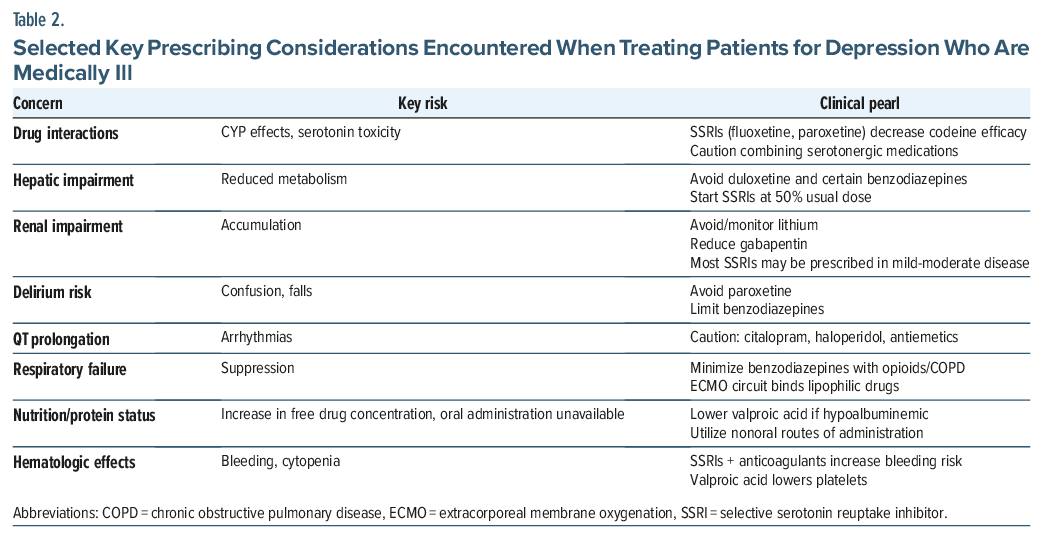
Hepatic and renal function are also critical determinants of medication selection and dosing, as organ dysfunction is common in advanced illness and dose adjustments or use of alternative agents may be necessary. Hepatic impairment can slow the metabolism of medications, such as duloxetine, tricyclic antidepressants, or certain antipsychotics, which increases the risk of drug accumulation and adverse side effects. The initial dose of SSRIs should be lowered by 50% and should aim for lower target doses.36 Calculation of Child-Pugh scores can assist in the evaluation of the extent of liver disease and guide dose reduction. Evaluating the extent of renal dysfunction through determination of the creatinine clearance and estimated glomerular filtration rate is particularly important when prescribing agents such as bupropion, which may require a downward dose adjustment, change in formulation, or avoidance due to reduced renal clearance.
Cognitive vulnerability, including baseline cognitive impairment or delirium, is highly prevalent in medically ill patients, and it should influence prescribing practices. Medications with anticholinergic or sedating properties can worsen confusion, precipitate delirium, and increase the risk of falls. For this reason, paroxetine is typically avoided in older or medically ill individuals due to its anticholinergic potency. Benzodiazepines, while sometimes necessary to manage severe anxiety, may exacerbate delirium and should be used with caution. When antipsychotics are used to mitigate symptoms of delirium, lower doses and careful monitoring are prudent. First-generation antipsychotics are generally more likely to contribute to anticholinergic burden and extrapyramidal symptoms, although several second-generation antipsychotics are also highly anticholinergic.37 Patients with neurocognitive disorders are often sensitive to medication side effects; prevention of polypharmacy and use of rational polypharmacy can maximize functional status.36
Cardiac and respiratory status further shape medication selection. Venlafaxine and bupropion may increase blood pressure.36 Many antipsychotics (including chlorpromazine, haloperidol, clozapine, risperidone, quetiapine, and olanzapine) contribute to orthostatic hypotension.37 QT prolongation is a relevant concern in patients with electrolyte abnormalities, structural heart disease, or use of concomitant QT-prolonging medications, each of which is common in those with underlying significant medical illnesses. Obtaining a baseline electrocardiogram (ECG) is reasonable before initiating many psychotropics, with ongoing monitoring guided by individual risk factors.38 Several factors can influence the QT measurement on the ECG. The interplay of tachycardia, bundle branch blocks, and implantable cardiac devices can influence the measurement of repolarization duration. Repolarization arrhythmias (eg, torsades de pointes) are rare, and this risk should be weighed against the risk of untreated or undertreated MDD.
Sedating medications, including benzodiazepines and some antipsychotics, may suppress respiratory drive, particularly in patients with advanced pulmonary disease or those receiving high-dose opioids, although most antidepressants have little effect on respiratory drive.36 Patients receiving extracorporeal membrane oxygenation (ECMO) present additional challenges, as lipophilic medications (including many psychotropics) may be sequestered in the ECMO circuit, potentially requiring higher than expected doses.39
GI function and nutritional status may affect medication absorption and distribution. Malabsorption, reduced oral intake, or prior GI surgery can impair oral bioavailability. Hypoalbuminemia, common in advanced illness, increases the free fraction of highly protein-bound medications, potentially increasing toxicity even at standard doses. Patients with prior GI surgery or malabsorptive conditions may benefit from immediate-release or liquid formulations.40 Alternative formulations may improve feasibility: Several antidepressants (ie, fluoxetine, fluvoxamine, escitalopram, trazodone, and tricyclics) and antipsychotics (ie, haloperidol, chlorpromazine, aripiprazole, clozapine, risperidone, and quetiapine) are available in liquid formulations.41
Medication administration can be challenging in those who are unable to take oral medications. Notably, there are no parenteral antidepressants available in the United States. Selegiline is available as a transdermal patch, although its use is limited by a required washout period due to its monoamine oxidase inhibitor properties.36 Several antipsychotics are available in short-acting parenteral formulations, and long-acting injectables may be considered in patients previously stabilized on oral agents. Asenapine is the only antipsychotic with sublingual absorption, and loxapine is the only antipsychotic with intranasal absorption, although this is only for acute agitation.
Finally, hematologic and oncologic considerations are relevant when selecting certain agents. Inhibitors of CYP3A4 (eg, fluoxetine) may reduce the metabolism of several oncologic medications and increase the likelihood of side effects, and inhibitors of CYP2D6 (eg, fluoxetine, bupropion, duloxetine, and paroxetine) may reduce the bioactivation of prodrug tamoxifen.36 SSRIs may increase bleeding risk, especially in patients taking anticoagulants or with an underlying coagulopathy. This risk appears most significant with warfarin and with certain agents, including citalopram, fluoxetine, paroxetine, mirtazapine, and amitriptyline, whereas venlafaxine, sertraline, or escitalopram may carry comparatively lower risk.42 In higher-risk patients, consideration of gastroprotection may be appropriate, as GI bleeding is the most common manifestation. Temporary discontinuation of antidepressants may also be warranted in select high-risk scenarios (eg, recent intracranial hemorrhage, severe thrombocytopenia, active bleeding, or high-risk surgical procedures), particularly when the risk of bleeding outweighs the risk of psychiatric relapse.42
How Are Decisions About the Management of Suicide Risk Altered By Being Near the End of Life?
Decisions about managing suicide risk near the end of life are shaped by overlapping medical, psychiatric, ethical, and practical considerations that differ from those encountered in the general adult population. Clinicians must distinguish between declining further life-prolonging care in accordance with a patient’s longstanding values, a desire for a hastened death in the setting of unmet needs (eg, pain control, decreased quality of life), and a wish to end one’s life independent of these values secondary to a primary psychiatric illness. Initial evaluation regarding an expressed wish to end one’s life should focus on understanding the reasons behind the desire and obtaining any previously documented information about the patient’s values (eg, an advance directive or living will). Advance directives, when available, can provide important insight into a patient’s wishes and help determine whether a newly expressed wish to end their life or withdraw care is consistent with prior preferences, thereby informing both diagnosis and management.
In evaluating psychiatric symptoms near the end of life, one major challenge is diagnostic uncertainty. While not all patients will experience depression at the end of life, the differential diagnosis for those who do is broad and includes adjustment disorder, MDD, delirium/encephalopathy, grief, and demoralization.43 Several symptoms used to diagnose depression (eg, fatigue, poor appetite, disturbed sleep, impaired concentration) are also common at the end of life, making it challenging to distinguish primary psychiatric pathology from an underlying medical condition. In addition, medications frequently used in serious illness (eg, glucocorticoids, opioids, antiemetics, antibiotics, cardiovascular agents, antiparkinsonians, antivirals, antiepileptics) can contribute to alterations in mood and cognition.44 The HADS, which minimizes the influence of physical symptoms, may be particularly useful in patients with serious medical illnesses.27 In addition, patients with serious illness often have delirium, which may limit their ability to participate fully in a psychiatric interview, and lack the capacity to refuse or consent to certain interventions offered by the primary team.
Management decisions are further complicated by practical limitations of mental health law. Although severe psychiatric decompensation may prompt consideration of involuntary hospitalization or treatment over objection, these interventions are often difficult to implement in medically complex patients. Many individuals with serious medical illnesses cannot be managed safely on inpatient psychiatric units, which typically lack the resources to provide comprehensive medical care (eg, intravenous therapies, enteral feeding, complex pain management, catheter care, personal nursing care). Safety and reimbursement constraints may prevent access to transportation to outpatient appointments while admitted to inpatient psychiatry services. The lack of parenteral antidepressant medications limits the ability to treat over objection, and neuromodulatory treatments over objection (eg, ECT) require legal involvement and a court order. Environmental features of psychiatric units, including ligature precautions and restricted visiting hours, may further conflict with the goals of end-of-life care, particularly the emphasis on comfort and family presence.
Disposition planning is similarly challenging in the context of active suicidality at the end of life. Efforts to mitigate suicide risk must be balanced against quality-of-life considerations. Hospice programs are often unable to accept patients with ongoing suicide risk, in part due to limited access to psychiatric support. For patients receiving home hospice care, suicide risk places a significant emotional and caregiving burden on family members who are typically closely involved in day-to-day care. When suicidality is driven by poorly controlled physical symptoms, more aggressive symptom management may be effective but can result in sedation that limits a patient’s ability to interact meaningfully with loved ones.
Access to rapidly acting psychiatric treatments remains limited in both inpatient psychiatric and inpatient medical settings. For example, ketamine is not widely available in hospital practice despite emerging evidence,34 and psilocybin remains restricted to use in clinical trials.45 Finally, the growing availability of medical aid in dying or physician-assisted suicide in some jurisdictions for patients nearing the end of life adds complexity that underscores the need for a careful, nuanced, and interdisciplinary evaluation.
What Happened to Mr A?
Over time, Mr A informed his palliative care and LVAD teams that he wished to retain the LVAD and “let the cancer take its course.” As his condition evolved and his care goals were revisited, Mr A’s care shifted toward a comfort-focused approach that was consistent with his stated preferences. When his health deteriorated, his LVAD was deactivated, and he became eligible for hospice care. Approximately 3 months after his suicide attempt, Mr A was transferred to hospice care, and he died 1 week later.
CONCLUSION
Although acute medical events often provoke distress, fear, or grief, these reactions typically resolve as the underlying condition stabilizes and do not morph into MDD. However, in the context of significant medical conditions, depression is more likely to develop, or to recur, later in the illness course. Often, a combination of biological, psychological, and social factors coalesces to precipitate demoralization, difficulty coping, shrinking self-efficacy, and depression. The HADS, which minimizes the influence of physical symptoms, may be a particularly useful tool to screen for patients with serious medical illnesses. Effective treatment of depression in individuals with significant medical illnesses requires a personalized and integrated approach that combines psychosocial interventions, pharmacotherapy, and potentially neuromodulatory techniques, while addressing the complex interplay between physical and mental health. Unfortunately, many individuals with significant medical illnesses cannot be managed safely on inpatient psychiatric units, which typically lack the resources to provide comprehensive medical care, while hospice care may be ill-prepared to manage those with life-saving medical devices.
Article Information
Published Online: October 29, 2026. https://doi.org/10.4088/PCC.26f04265
© 2026 Physicians Postgraduate Press, Inc.
Submitted: May 1, 2026; accepted July 6, 2026.
To Cite: Miran DM, Ramirez KJ, DeSimone AC, et al. Depression in the context of medical illness: evaluation, management, and the risk of suicide. Prim Care Companion CNS Disord 2026;28(5):26f04265.
Author Affiliations: Department of Supportive Oncology, Dana-Farber Cancer Institute, Boston, Massachusetts (Miran); Harvard Medical School, Boston, Massachusetts (Miran, Ramirez, Stern); Department of Psychiatry, Beth Israel Deaconess Medical Center, Boston, Massachusetts (Ramirez); Department of Psychiatry, Bayhealth Medical Center, Dover, Delaware (DeSimone); Department of Psychiatry, Massachusetts General Hospital, Boston, Massachusetts (Stern).
Corresponding Author: Damien M. Miran, MD, Dana-Farber Cancer Institute, Boston, Massachusetts ([email protected]).
Miran, Ramirez, and DeSimone are co-first authors; Stern is the senior author.
Financial Disclosure: None.
Funding/Support: None.
References (45)

- Walker J, Burke K, Wanat M, et al. The prevalence of depression in general hospital inpatients: a systematic review and meta-analysis of interview-based studies. Psychol Med. 2018;48(14):2285–2298. PubMed CrossRef
- Scott AJ, Correa AB, Bisby MA, et al. Depression and anxiety trajectories in chronic disease: a systematic review and meta-analysis. Psychother Psychosom. 2023;92(4):227–242. CrossRef
- Moradi M, Doostkami M, Behnamfar N, et al. Global prevalence of depression among heart failure patients: a systematic review and meta-analysis. Curr Probl Cardiol. 2022;47(6):100848. CrossRef
- Krebber AM, Buffart LM, Kleijn G, et al. Prevalence of depression in cancer patients: a meta-analysis of diagnostic interviews and self-report instruments. Psychooncology. 2014;23(2):121–130. PubMed CrossRef
- Adejumo OA, Edeki IR, Sunday Oyedepo D, et al. Global prevalence of depression in chronic kidney disease: a systematic review and meta-analysis. J Nephrol. 2024;37(9):2455–2472. CrossRef
- Khaledi M, Haghighatdoost F, Feizi A, et al. The prevalence of comorbid depression in patients with type 2 diabetes: an updated systematic review and meta-analysis on huge number of observational studies. Acta Diabetol. 2019;56(6):631–650. PubMed CrossRef
- Medeiros GC, Roy D, Kontos N, et al. Post-stroke depression: a 2020 updated review. Gen Hosp Psychiatry. 2020;66:70–80.
- Yost G, Bhat G, Mahoney E, et al. Reduced anxiety and depression in patients with advanced heart failure after left ventricular assist device implantation. Psychosomatics. 2017;58(4):406–414. CrossRef
- Loh AZH, Tan JSY, Tam JKC, et al. Postoperative psychological disorders among heart transplant recipients: a meta-analysis and meta-regression. Psychosom Med. 2020;82(7):689–698. CrossRef
- Milaneschi Y, Kappelmann N, Ye Z, et al. Association of inflammation with depression and anxiety: evidence for symptom-specificity and potential causality from UK Biobank and NESDA cohorts. Mol Psychiatry. 2021;26(12):7393–7402. CrossRef
- Katon W, Lin EH, Kroenke K. The association of depression and anxiety with medical symptom burden in patients with chronic medical illness. Gen Hosp Psychiatry. 2007;29(2):147–155. PubMed CrossRef
- Yang J, Song G, Zhang M, et al. Changes in daily living dependency and incident depressive symptoms among older individuals: findings from four prospective cohort studies. BMJ Ment Health. 2025;28(1):e301749. CrossRef
- Rosenblat JD, Kurdyak P, Cosci F, et al. Depression in the medically ill. Aust N Z J Psychiatry. 2020;54(4):346–366.
- Saracino RM, Rosenfeld B, Nelson CJ. Performance of four diagnostic approaches to depression in adults with cancer. Gen Hosp Psychiatry. 2018;51:90–95.
- Thombs BD, Ziegelstein RC, Pilote L, et al. Somatic symptom overlap in Beck Depression Inventory-II scores following myocardial infarction. Br J Psychiatry. 2010;197(1):61–66. PubMed CrossRef
- Kissane DW, Clarke DM, Street AF. Demoralization syndrome-a relevant psychiatric diagnosis for palliative care. J Palliat Care. 2001;17(1):12–21.
- Fava M, Sorg E, Jacobs JM, et al. Distinguishing and treating demoralization syndrome in cancer: a review. Gen Hosp Psychiatry. 2023;85:185–190.
- Fava GA, Guidi J, Porcelli P, et al. A cluster analysis-derived classification of psychological distress and illness behavior in the medically ill. Psychol Med. 2012;42(2):401–407. PubMed CrossRef
- Hage MP, Azar ST. The link between thyroid function and depression. J Thyroid Res. 2012;2012:590648. PubMed
- Sonino N, Fava GA. Psychiatric disorders associated with Cushing’s syndrome. Epidemiology, pathophysiology and treatment. CNS Drugs. 2001;15(5):361–373. PubMed CrossRef
- Fardet L, Petersen I, Nazareth I. Suicidal behavior and severe neuropsychiatric disorders following glucocorticoid therapy in primary care. Am J Psychiatry. 2012;169(5):491–497. PubMed CrossRef
- Udina M, Castellví P, Moreno-España J, et al. Interferon-induced depression in chronic hepatitis C: a systematic review and meta-analysis. J Clin Psychiatry. 2012;73(8):1128–1138. PubMed
- Lin EH, Von Korff M, Ciechanowski P, et al. Treatment adjustment and medication adherence for complex patients with diabetes, heart disease, and depression: a randomized controlled trial. Ann Fam Med. 2012;10(1):6–14. PubMed CrossRef
- Katon WJ, Lin EH, Von Korff M, et al. Collaborative care for patients with depression and chronic illnesses. N Engl J Med. 2010;363(27):2611–2620. PubMed
- NICE. Overview | Depression in Adults With a Chronic Physical Health Problem: Recognition and Management | Guidance. 2024.
- Kroenke K, Spitzer RL, Williams JB. The PHQ-9: validity of a brief depression severity measure. J Gen Intern Med. 2001;16(9):606–613. PubMed
- Zigmond AS, Snaith RP. The Hospital Anxiety and Depression Scale. Acta Psychiatr Scand. 1983;67(6):361–370. PubMed
- Clegg AJ, Hill JE, Mullin DS, et al. Exercise for depression. Cochrane Database Syst Rev. 2026;1(1):CD004366. Published 2026 Jan 8. PubMed
- Uphoff E, Ekers D, Robertson L, et al. Behavioural activation therapy for depression in adults. Cochrane Database Syst Rev. 2020;7(7):CD013305. PubMed
- Martínez M, Arantzamendi M, Belar A, et al. ’Dignity therapy’, a promising intervention in palliative care: a comprehensive systematic literature review. Palliat Med. 2017;31(6):492–509. PubMed CrossRef
- Breitbart W, Pessin H, Rosenfeld B, et al. Individual meaning-centered psychotherapy for the treatment of psychological and existential distress: a randomized controlled trial in patients with advanced cancer. Cancer. 2018;124(15):3231–3239. PubMed CrossRef
- Thirthalli J, Sinha P, Sreeraj VS. Clinical practice guidelines for the use of electroconvulsive therapy. Indian J Psychiatry. 2023;65(2):258–269. PubMed
- Chen L, Fukuda AM, Jiang S, et al. Treating depression with repetitive transcranial magnetic stimulation: a clinician’s guide. Am J Psychiatry. 2025;182(6):525–541. PubMed
- Huang C, Hu L, Liu W, et al. Efficacy and safety of esketamine on major depression, postpartum depression and perioperative depression: a systematic review and meta-analysis. Mol Psychiatry. 2026;31(1):545–558. PubMed
- Austelle CW, O’Leary GH, Thompson S, et al. A comprehensive review of vagus nerve stimulation for depression. Neuromodulation J Int Neuromodulation Soc. 2022;25(3):309–315.
- Levenson JL, Ferrando SJ. Clinical Manual of Psychopharmacology in the Medically Ill. 3rd ed. American Psychiatric Publishing; 2023.
- Solmi M, Murru A, Pacchiarotti I, et al. Safety, tolerability, and risks associated with first-and second-generation antipsychotics: a state-of-the-art clinical review. Ther Clin Risk Management. 2017;13:757–777. PubMed CrossRef
- Beach SR, Gross AF, Hartney KE, et al. Intravenous haloperidol: a systematic review of side effects and recommendations for clinical use. Gen Hosp Psychiatry. 2020;67:42–50. PubMed CrossRef
- Rocha-Romero A, Chaverri-Fernandez JM, Chaves-Fernández F, et al. Optimizing drug therapy in ECMO-supported critically ill adults: a narrative review and clinical guide. Pharm Basel, Switz. 2025;13(6):151. CrossRef
- Coughlin JW, Steffen KJ, Sockalingam S, et al. Psychotropic medications in metabolic and bariatric surgery: research updates and clinical considerations. Curr Psychiatry Rep. 2022;24(1):89–98. PubMed
- Papazisis G, Siafis S. The added value of liquid antipsychotics: the case of quetiapine. Curr Clin Pharmacol. 2019;14(2):101–107. PubMed
- McFarland D, Merchant D, Khandai A, et al. Selective serotonin reuptake inhibitor (SSRI) bleeding risk: considerations for the consult-liaison psychiatrist. Curr Psychiatry Rep. 2023;25(3):113–124. PubMed
- Calagua-Bedoya EA, Ernst C, Shalev D, et al. Consultation-liaison case conference: suicidal ideation in a patient at the end-of-life. J Acad Consultation-Liaison Psychiatry. 2023;64(4):371–382.
- Turjanski N, Lloyd GG. Psychiatric side-effects of medications: recent developments. Adv Psychiatric Treat. 2005;11(1):58–70.
- Griffiths RR, Johnson MW, Carducci MA, et al. Psilocybin produces substantial and sustained decreases in depression and anxiety in patients with life-threatening cancer: a randomized double-blind trial. J Psychopharmacol Oxf Engl. 2016;30(12):1181–1197. PubMed CrossRef
Please sign in or purchase this PDF for $40.