
Lessons Learned at the Interface of Medicine and Psychiatry
The Psychiatric Consultation Service at Massachusetts General Hospital sees medical and surgical inpatients with comorbid psychiatric symptoms and conditions. During their twice-weekly rounds, Dr Stern and other members of the Consultation Service discuss diagnosis and management of hospitalized patients with complex medical or surgical problems who also demonstrate psychiatric symptoms or conditions. These discussions have given rise to rounds reports that will prove useful for clinicians practicing at the interface of medicine and psychiatry.
Prim Care Companion CNS Disord 2026;28(4):26f04213
Author affiliations are listed at the end of this article.
From the Editors
Are you a healthcare provider?
Add your NPI to personalize your JCP experience.
Have you been uncertain about whether spirituality and religious beliefs have a beneficial effect on health and mental health? Have you ever wondered how facilitating spirituality and religious beliefs, or practices, might influence the cardiovascular and immune systems? Have you considered whether you should take a spiritual and religious history from your patients? If you have, the following case vignette and discussion should prove useful.
CASE VIGNETTE
Mr A, a 48-year-old retired US Army special operations forces veteran who served for more than 20 years (including multiple combat deployments to Iraq and Afghanistan), presented 4 years after retirement with worsening irritability, insomnia, emotional withdrawal, increased alcohol use, and a growing sense of purposelessness.
During deployment, he sustained repeated blast exposures and experienced multiple combat losses. One event remained particularly distressing for him: He had switched positions inside a mine-resistant ambush-protected vehicle shortly before it was struck by an explosive device. A teammate in his original position was killed. He said repeatedly, “It should have been me.”
In the years that followed, several former teammates died by suicide. He described persistent guilt, shame, and belief that he had failed to protect his men. He endorsed intrusive memories, hypervigilance, anger outbursts, and emotional numbing. Although he denied active suicidal intent, he admitted to thinking that he wished he would not wake from sleep.
Raised as a Catholic, he once relied on religion for grounding. However, over time, he described having a spiritual struggle that centered on justice, forgiveness, and moral responsibility. He felt disconnected from both faith and his identity. His presentation was consistent with posttraumatic stress disorder (PTSD) symptoms that were complicated by moral injury, survivor’s guilt, and loss of meaning following his transition from military service.
With psychiatric treatment and psychotherapy, he was started on sertraline (titrated up to 150 mg daily for PTSD) and prazosin (titrated up to 5 mg at night for trauma-related nightmares). He participated in individual cognitive processing therapy, and he was referred to the Home Base 2-week intensive clinical program (ICP) for massed, multidisciplinary treatment. Although his PTSD Checklist-5 score decreased from 65 to 50 and his sleep improved, he continued to be hypervigilant and to feel anxious and guilty.1
DISCUSSION
What Is Meant By Spirituality and Religious Practices?
Spirituality and religious practices represent distinct yet often overlapping dimensions of human experience that influence health behaviors, coping mechanisms, and patient care preferences. While these terms are frequently used interchangeably in both clinical and academic contexts, they encompass fundamentally different—although related—constructs that health care professionals must understand to provide culturally competent, patient-centered care.
Spirituality refers to an individual’s search for meaning, purpose, and connection that transcends the material aspects of existence. It encompasses a broad spectrum of beliefs, values, and practices through which individuals seek to understand their place in the universe and their relationship with something greater than themselves.2 Spirituality represents a deeply personal and subjective experience that may be expressed through organized religious frameworks. Contemporary definitions emphasize spirituality as multidimensional, incorporating existential questions about life’s meaning, connectedness to others and nature, transcendence, and the pursuit of peace and harmony.3 Importantly, spirituality exists on a continuum, and it may be entirely secular for some individuals, manifested through connections with nature, art, humanity, or personal values rather than through any conception of the divine.
The concept of spirituality in health care contexts has evolved considerably over recent decades. Historically marginalized in medical education and practice due to scientific medicine’s emphasis on empirical evidence and biological mechanisms, spirituality has gained recognition as an essential component of holistic patient care.2 Health care organizations increasingly acknowledge that spiritual well-being influences physical health outcomes, psychological resilience, and quality of life, particularly among individuals facing serious illness, chronic conditions, or end-of-life circumstances. This recognition has prompted the integration of spiritual assessment tools and interventions into clinical practice guidelines across multiple specialties.
Religious practices, in contrast, represent the formal, organized expression of faith traditions characterized by specific belief systems, rituals, texts, moral codes, and community structures. Religion provides institutional frameworks through which individuals express and cultivate their spirituality, although having a religious affiliation does not necessarily indicate active spiritual engagement, and conversely, deeply spiritual individuals may not identify with any religious tradition.3 Religious practices encompass observable behaviors (such as prayer, meditation, worship service attendance, scripture reading, dietary observances, and participation in faith-based community activities). These practices often serve multiple functions: reinforcing belief systems, providing social support networks, establishing moral guidelines, and creating structured approaches to life’s existential questions.
The relationship between spirituality and religion is a complex, dynamic interaction rather than a simple dichotomy. While all religions contain spiritual elements, not all spirituality is religious. Some scholars conceptualize religion as the institutional container for spiritual expression, providing the language, symbols, rituals, and community through which individuals explore transcendent experiences.3 Others view spirituality as the broader construct, with religion representing one potential pathway, among many, for spiritual development and expression.
Contemporary health care literature increasingly distinguishes between these constructs to avoid conflating organized religious participation with personal spiritual well-being. This distinction carries clinical implications, as patients who reject organized religion may still possess rich spiritual lives that influence their health care decisions, coping strategies, and treatment preferences.4 Conversely, individuals who regularly engage in religious practices may do so primarily for social or cultural reasons, rather than from deeply held spiritual convictions. Therefore, health care professionals must assess both dimensions independently, while remaining attentive to how they interact within individual patients’ lives.
Spiritual distress, characterized by a disrupted sense of meaning, a disconnection from sources of strength, and an inability to experience hope or peace, represents a legitimate nursing diagnosis and clinical concern that requires assessment and intervention.2 Patients who experience spiritual distress may exhibit poorer treatment adherence, increased symptom burden, reduced quality of life, and complicated grief processes. Health care professionals trained in spiritual assessment can identify such distress and provide appropriate interventions, including compassionate presence, referral to chaplaincy services, support for religious practices, or facilitation of conversations about meaning and purpose.
How Many of Your Patients Believe in Spirituality and Religiosity and Engage in Spiritual or Religious Practices?
Lack of consensus on a definition of spirituality makes it hard to measure and establish its prevalence; however, the Pew Research Center has found that religiousness has been fairly stable in the United States since 2020: 71% of Americans identify with a religion, 48% pray daily, 45% said that religion is very important in their lives, and 33% attend services at least twice a month.5 In a 2010 study of 75 randomly selected cancer patients receiving palliative radiation at 4 Boston centers,6 81% were at least slightly religious (58% were moderately to very religious), 93% were at least slightly spiritual (74% were moderately to very spiritual), and 78% said that religion and/or spirituality was “important to their advanced cancer experience.”
Commonly reported religious themes in patients with advanced cancer include spiritual/religious coping, practices, beliefs, transformation, and community. However, the importance to patients of spiritual/religious practices is frequently underappreciated. In a study of 50 consecutive cancer patients seen in psychiatric consultation, roughly two-thirds (64%) were concerned with religious issues, and one-fourth (26%) of them mentioned religion spontaneously, and more than one-third (36%) were actively struggling with several forms of religious problems, but only 18% appeared to have discussed these concerns with other members of the hospital staff.7 Also, in an interview study of 100 patients with advanced lung cancer and their caregivers, 257 medical oncologists were asked to rank the importance to patients of several factors in treatment decision-making: Patients ranked faith in God as second, while oncologists rated it only seventh.8 These and other findings have contributed to an emerging consensus that clinicians need to incorporate spiritual care into care for patients with serious illness.9 Several screening tools can help to identify the importance of spiritual/religious practices to a given patient, arguably none better than simply asking, “Have you been a spiritual or religious person?”
How Might Spirituality and Religious Practices Affect Your Cardiovascular and Immune System?
Spiritual/religious practices improve health among those with cardiovascular and immune-mediated diseases. While the mechanisms are incompletely understood, several explanations for improving health outcomes (eg, reducing morbidity and mortality, improving quality of life, and reducing symptom burden) have been offered.10 Individuals who engage in religious practices have greater access to support systems within the community and are more socially engaged and connected.10,11 Religious attendance has been correlated with a higher likelihood (odds ratio [95% CI]) of achieving intermediate or ideal levels of physical activity (1.16 [1.06–1.26]), smoking behaviors (1.50 [1.34–1.68]), and dietary (1.0 [1.01–1.20]) and blood pressure control (1.12 [1.01–1.24]).12 More frequent church attendance, along with higher spiritual well-being and intrinsic religiousness, has been associated with emotional well-being among those with cardiovascular conditions.13,14 Moreover, daily spiritual practices are linearly associated with a reduction in functional limitations that are secondary to heart failure.15
Religion may also mediate inflammation. Respondents from the Health and Retirement Study (n = 2,385) from 2006 to 2014 who reported having stronger religious beliefs and values had lower levels of C-reactive protein.10 In addition, spiritual well-being had an inverse relationship with endothelial dysfunction, whereas higher levels of spiritual well-being were associated with lower levels of endothelial dysfunction.16 In some autoimmune conditions, eg, Sjogren syndrome, those who engaged in regular prayer or meditation had lower levels of autoantibodies that were specific for primary Sjogren syndrome as well as lower scores of disease activity.17
What Is the Evidence That Supports Spiritual and Religious Practices’ Enhancing Medical and Mental Health Outcomes?
In the last few decades, several developments have challenged the commonly accepted dichotomization between medical health and spiritual/religious health. Research has burgeoned on the interface of medicine and spirituality, including research related to how spirituality positively affects physical and mental health outcomes.18 Analysis of systematic reviews, along with expert consensus, has identified consistent findings in the literature, particularly highlighting the role of community. Spiritual/religious practice has been associated with an overall lower mortality risk in a dose-response relationship, as well as with less substance use, less depressive symptoms, and better overall quality of life.9 For example, in mental health outcomes research, a longitudinal study of nearly 90,000 women who were followed from 1996 through 2010 showed a fivefold reduction in suicide rates among women with increased attendance at religious services.19 While some evidence suggests that there are maladaptive manifestations of spiritual/religious experiences,20 positive engagement in spiritual/religious practices, particularly with community involvement, has consistently been demonstrated to improve both mental and physical health outcomes in diverse patient populations.
In response to these recent empirical findings, several specialties have integrated spiritual care into regular practices. For example, palliative medicine has been on the forefront of integrating spirituality and medicine, including spiritual care as a goal of treatment. Specifically, the National Consensus Project for Quality Palliative Care emphasized key components of spiritual, religious, and existential aspects of care (eg, assessing and addressing spiritual concerns, recognizing and respecting spiritual beliefs, providing spiritual support, and allowing the patient’s spiritual community to play a role in their care when appropriate).21 Spiritual considerations are also central to discussions of advance directives and end-of-life decision-making, where patients’ values, beliefs, and sources of meaning often guide preferences for care. Consistent with this, the Joint Commission highlights the importance of incorporating spiritual assessments into patient-centered care, particularly in serious illness and end-of-life contexts and in the treatment of substance use disorders, where standards highlight the role of patients’ beliefs and recovery context in clinical assessment and treatment planning.22,23
The American Psychological Association’s Division 36 and The Royal College of Psychiatrists’ Spirituality Interest Group have been active in this realm, and the American Psychiatric Association (APA) created a Mental Health and Faith Community Partnership. A variety of psychotherapeutic treatment approaches (eg, mindfulness) for the once dichotomized physical and spiritual domains of personhood have started to integrate these practices in an evidence-based manner.24 In sum, during the last 2 decades, research at the intersection of spiritual/religious health and physical/mental health has suggested positive effects with the integration, collaboration, and implementation of community supports and individual spiritual/religious practices.
How Can You Ask Your Patients About (and Rate) Their Spiritual Beliefs and Religious Practices?
Despite recent research that has suggested the benefits of incorporating spiritual care into medical practices, physicians often fail to provide spiritual care. Roughly two-thirds (68%) of patients mentioned in the previous inpatient survey said that their physician had never discussed religious beliefs with them, even though they welcomed and desired such engagement.25 The reasons for this neglect were complex and may have included a lack of consensus on the definition of spiritual/religious care, inexperience or lack of training in providing spiritual care, physicians’ unresolved personal spiritual concerns, lack of time, boundary concerns, and general role confusion surrounding what place physicians have in the intimate lives of their patients.
The primary aim of taking a spiritual history is to help clinicians make informed assessments about the role of spirituality in the lives and illnesses of their patients.26 Such assessments provide a valuable window through which to view their patients’ core values, culture, relationships, trauma histories, resources, practices, and support systems. Eliciting a spiritual history entails listening, asking, and actively exploring. It requires listening for what is valued, sacred, or deeply troubling. For example, a patient’s use of terms (eg, courage, despair, comfort, suffering, and peace) often functions as the “tip of the iceberg” of deeper underlying distress. Focusing on specific language helps physicians ask better questions. During the clinical encounter, patients should be screened for their spiritual/religious background by asking open-ended questions, eg, “What is the most important aspect of your background or identity? Have you been a spiritual or religious person? If so, in what way?” In addition, depending on the answers to the screening questions, physicians may explore further by asking questions about spiritual/religious practices, relationships with God, and ongoing spiritual struggles. To explore the patient’s practices one might ask, “What helps you to replenish yourself spiritually?” If a patient mentions God, one can ask “How do you envision God during this time of stress?” Such questions may reveal spiritual struggles (such as guilt, disappointment, or doubt), as well as opportunities for resiliency, hope, and reliance on their community for strength. Questions asked during this exploratory phase are guided by the information gathered while listening and by the answers to screening questions.
An additional tool to facilitate taking a spiritual history as it pertains to a patient’s mental health is the Diagnostic and Statistical Manual of Mental Disorders, Fifth Edition, Text Revision (DSM-5-TR) Cultural Formulation Interview (CFI) Supplementary Module on Spiritual, Religious, or Moral Traditions. This appendix to the DSM-5-TR provides a structured, yet flexible, framework for eliciting aspects of a patient’s existential life that may reflect strengths that can be leveraged in treatment planning, such as spiritual practices that promote meaning-making, forgiveness, or communal support.27 For example, the module encourages clinicians to ask whether spiritual/religious beliefs help patients to understand their suffering or to guide decisions about coping and healing—information that may reveal protective resources that can be incorporated into psychotherapy or recovery-oriented care.
The module was also designed to identify areas of vulnerability, including spiritual struggles or moral conflicts that may exacerbate distress. For instance, clinicians are prompted to explore whether a patient’s religious community holds stigmatizing views about mental illness or psychiatric treatment and whether symptoms are interpreted as moral failure or spiritual punishment.28 Such responses signal the need for a patient-centered, culturally informed dialog that addresses these beliefs respectfully, while clarifying the potential benefits of psychiatric diagnosis and treatment. In this way, the CFI Supplementary Module supports clinicians when navigating spiritual/religious beliefs and moral frameworks as sources of resilience and as clinically relevant contexts in which moral distress, shame, or conflict may arise.
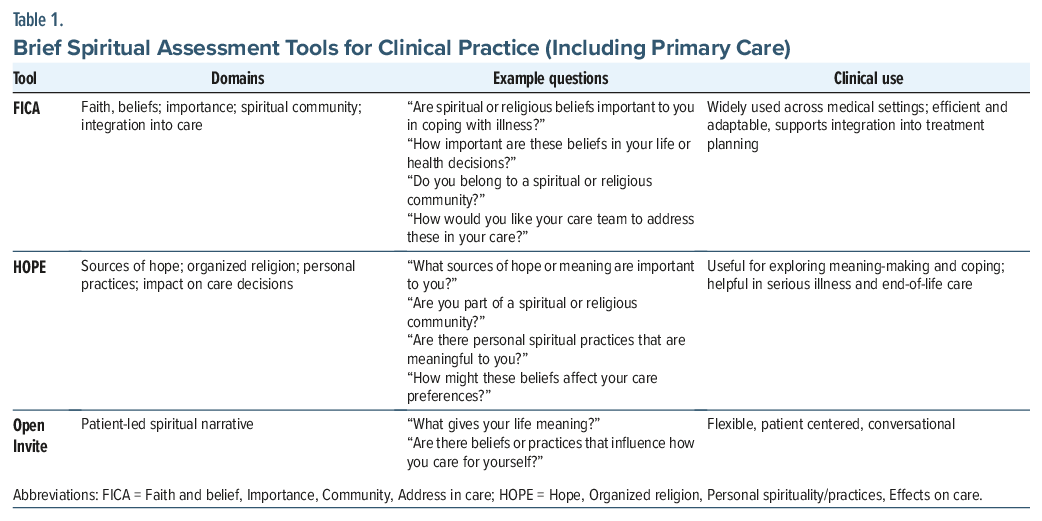
In addition to open-ended inquiry, several brief, structured tools have been developed to support clinicians in efficiently assessing spirituality in primary care settings. Commonly used frameworks include the FICA spiritual assessment tool Faith and belief, Importance, Community, Address in care;29 the HOPE mnemonic sources of Hope, Organized religion, Personal spirituality/practices, Effects on care;30 and the Open Invite model, which emphasizes patient-led discussion of spiritual concerns (Table 1).31 These tools are particularly useful in time-limited clinical environments and can help standardize the assessment while preserving a patient-centered approach.
How Often (and at What Times of the Day) Should One Engage in Religious Practices or Meditation to Obtain the Greatest Effect?
Daily religious and spiritual practices have been associated with a variety of health benefits, including lower mortality rates and greater emotional well-being. According to the Nurse’s Health Study, attendance at religious services once per week or more was linked with a fivefold lower rate of suicide compared to individuals who never attended religious services (hazard ratio = 0.16; 95% CI, 0.06–0.46).19 Individuals with chronic illnesses who prayed on a daily basis were more likely to survive more than 6 years (hazard ratio = 1.48; 95% CI, 1.08–2.03) compared to individuals who prayed less often.32 Overall mental and physical well-being also improved with daily religious practices. Among those with cardiovascular conditions, the frequency of church attendance, intrinsic religiosity, and greater spiritual well-being were associated with emotional well-being.13,14 Religious individuals who observed the Sabbath exhibited earlier chronotypes, less jetlag, and more sleep on weekends.33
Where Can One Learn More About Spirituality and Religious Practices?
Learning about spirituality and religious practices can be done through local, in-person, and online resources (eg, local libraries, temples, monasteries, and university departments). Key online references such as the APA resource document and the World Psychiatric Association position statement, as well as the National Alliance on Mental Illness Faith and Spirituality, are included in Table 2.34-38
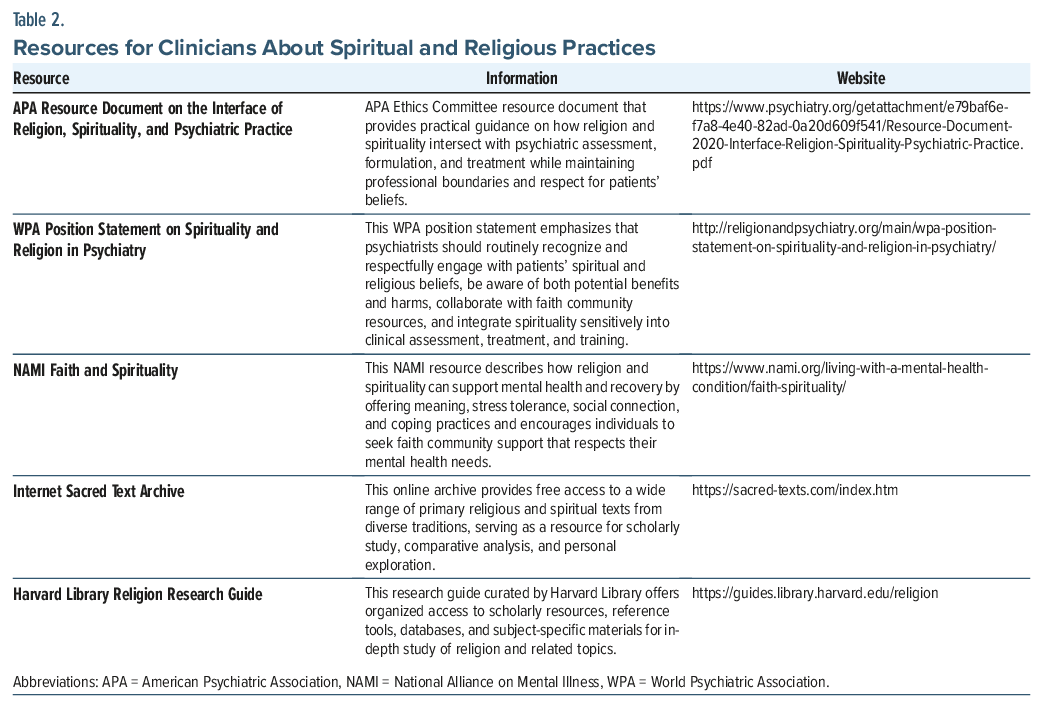
In-person exploration can include visits to local churches, mosques, synagogues, or meditation centers to attend study groups. Academic and educational resources include the Harvard Library Research Guides for religion for in-depth, scholarly, or concise introductory material. Spiritual classics and religious texts are often available for free on the internet through the Internet Sacred Text Archive, Project Gutenberg, and other free web resources.
Clinicians seeking to incorporate spirituality into assessment or treatment planning may find the following validated instruments helpful for identifying spiritual strengths, resources, and areas of distress (Table 3).39–43 These measures, which are generally more comprehensive and suited for in-depth clinical or research use, complement the brief, structured tools used in time-limited settings such as primary care that were discussed above (see Table 1). These instruments were among the most frequently used tools identified in a recent scoping review examining spirituality and combat-related PTSD in military and veteran populations.44
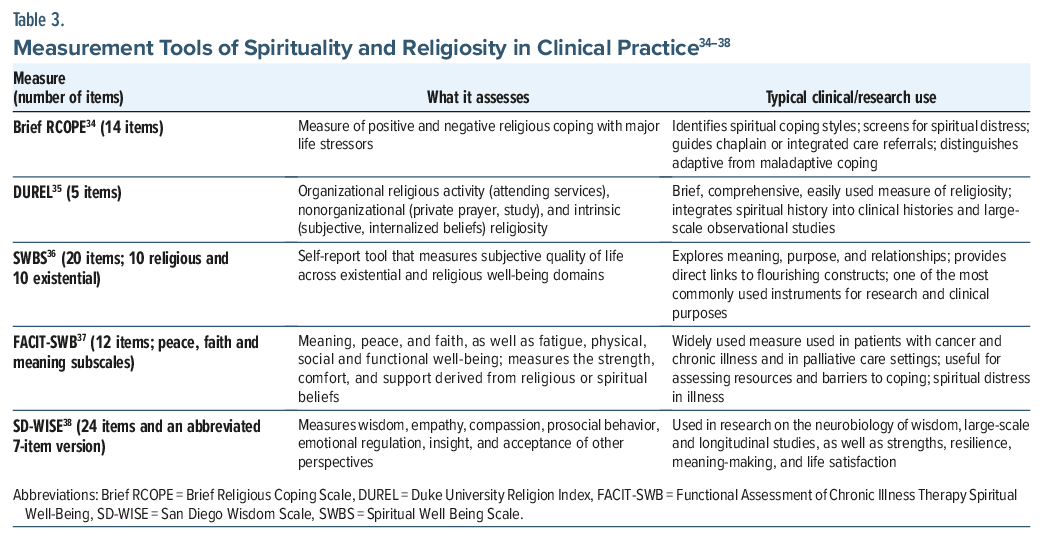
Emerging research also highlights spirituality as a component of wisdom, a multidimensional construct consistently associated with lower loneliness and greater overall well-being. The San Diego Wisdom Scale reflects this broader framework, encompassing prosocial behaviors, emotional regulation, insight, and tolerance for uncertainty. This may be particularly relevant considering the growing recognition of the loneliness pandemic as a major public health concern of this century.45
Digital Platforms for Spirituality and Religious Engagement
In addition to in-person and academic resources, digital platforms now offer accessible pathways for exploring spirituality and religious practices. Industry reports suggest that millions of individuals worldwide engage with spiritual or faith-based applications, and the number of available platforms continues to expand. Mobile applications and web-based tools provide guided prayer, meditation, contemplative exercise, scripture study, gratitude practices, and online community engagement. These platforms span multiple traditions and secular approaches to meaning-making.
Commonly used examples include Hallow, which focuses on prayer and contemplative practice; Virtual Hope Box, which incorporates evidence-based coping and grounding tools; and broader spiritual well-being platforms such as Skylight. In addition, numerous mindfulness and meditation applications incorporate spiritual or mindfulness-based elements. These platforms provide low-barrier, portable options for individuals that may serve as adjunctive supports within treatment plans, reinforcing daily practice and facilitating ongoing engagement between sessions. The rapid growth of this digital ecosystem reflects an important and increasingly normalized pathway for integrating spirituality into contemporary mental health care.
What Happened to Mr A?
Mr A completed the Home Base ICP, which included massed therapy with 70 hours of individual and group therapy with other special operations forces active-duty service members and veterans, exercise, nutrition, yoga, and acupuncture and spiritually integrated care with a local church. Over time, his PTSD symptoms abated, his alcohol use decreased, and his sleep improved. More importantly, he began reconstructing a coherent moral narrative of his service. Engagement with his peers reduced isolation and fostered accountability and belonging. He gradually re-engaged with his faith community, not with certainty, but with curiosity. Rather than defining himself solely by trauma and loss, he began to identify a renewed purpose in mentoring younger veterans. Mr A became less symptomatic, and he demonstrated elements of posttraumatic growth (including resilience, restored meaning, and strengthened connection).
CONCLUSION
Spirituality refers to a broad spectrum of beliefs, values, and practices through which individuals seek to understand their place in the universe and their relationship with something greater than themselves. However, religious practices represent the formal, organized expression of faith traditions, characterized by specific belief systems, rituals, texts, moral codes, and community structures.
Individuals who engage in religious practices tend to have greater access to support systems within the community; this is associated with an overall lower mortality risk. In addition to in-person and academic resources, digital platforms offer accessible pathways for exploring spirituality and religious practices; these platforms provide low-barrier, portable options for individuals that serve as adjunctive supports to treatment plans.
Article Information
Published Online: August 4, 2026. https://doi.org/10.4088/PCC.26f04213
© 2026 Physicians Postgraduate Press, Inc.
Submitted: February 13, 2026; accepted April 13, 2026.
To Cite: Matta SE, Mattson S, Braford MB, et al. The impact of spirituality and religious practices on health and mental health. Prim Care Companion CNS Disord 2026;28(4):26f04213.
Author Affiliations: Department of Psychiatry, Harvard Medical School, Boston, Massachusetts (Matta, Mattson, Stern); Department of Psychiatry, Massachusetts General Hospital, Boston, Massachusetts (Matta, Mattson, Stern); Dartmouth Hitchcock Medical Center, Lebanon, New Hampshire (Braford); Dana-Farber Cancer Institute and Brigham and Women’s Hospital, Boston, Massachusetts (Peteet); Sacred Heart University, Fairfield, Connecticut (Schieffler).
Matta, Mattson, Braford, Peteet, and Schieffler are co-first authors; Stern is the corresponding author.
Corresponding Author: Sofia E. Matta, MD, Department of Psychiatry, Harvard Medical School/Massachusetts General Hospital, Boston, Massachusetts ([email protected]).
Financial Disclosure: Dr Stern has received royalties from Elsevier for editing textbooks on psychiatry. The other authors report no disclosures or conflicts of interest.
Funding/Support: None.
Clinical Points
- Although most Americans value their religious beliefs and spiritual practices, the importance of patients’ spiritual/religious practices is frequently underappreciated by health care providers.
- The primary aim of taking a spiritual history is to help clinicians make informed assessments about the role of spirituality in the lives and illnesses of their patients.
- Several screening tools can help to identify the importance of spiritual/religious practices to patients, but none is better than asking “Have you been a spiritual or religious person?”
- An additional tool to facilitate taking a spiritual history is the Diagnostic and Statistical Manual of Mental Disorders, Fifth Edition, Text Revision, Cultural Formulation Interview Supplementary Module on Spiritual, Religious, or Moral Traditions, which was also designed to identify areas of vulnerability, including spiritual struggles or moral conflicts that may exacerbate distress.
References (45)

- Weathers FW, Litz BT, Keane TM, et al. The PTSD Checklist for DSM-5 (PCL-5)–Standard [measurement instrument]. U.S. Department of Veterans Affairs; 2013. https://www.ptsd.va.gov/. Accessed March 18, 2026
- Puchalski CM, Vitillo R, Hull SK, et al. Improving the spiritual dimension of whole person care: reaching national and international consensus. J Palliat Med. 2014;17(6):642–656. PubMed CrossRef
- Koenig HG. Religion, spirituality, and health: the research and clinical implications. ISRN Psychiatry. 2012;2012:278730. PubMed CrossRef
- Balboni TA, Vanderwerker LC, Block SD, et al. Religiousness and spiritual support among advanced cancer patients and associations with end-of-life treatment preferences and quality of life. J Clin Oncol. 2007;25(5):555–560.
- Smith GA. Religion holds steady in America. Pew Research Center; 2025. https://www.pewresearch.org/religion/2025/12/08/religion-holds-steady-in-america/pr_2025-12-08_religion-holds-steady_0-03/. Accessed January 20, 2026
- Alcorn SR, Balboni MJ, Prigerson HG, et al. If God wanted me yesterday, I wouldn’t be here today: religious and spiritual themes in patients’ experiences of advanced cancer. J Palliat Med. 2010;13(5):581–588. PubMed CrossRef
- Peteet JR. Religious issues presented by cancer patients seen in psychiatric consultation. J Psychosoc Oncol. 1985;3(1):53–66. CrossRef
- Silvestri GA, Knittig S, Zoller JS, et al. Importance of faith on medical decisions regarding cancer care. J Clin Oncol. 2003;21(7):1379–1382. PubMed CrossRef
- Balboni TA, VanderWeele TJ, Doan-Soares SD, et al. Spirituality in serious illness and health. JAMA. 2022;328(2):184–197. CrossRef
- Britt CK, Boateng COA, Sebu J, et al. The association between religious beliefs and values with inflammation among middle-age and older adults. Aging Ment Health. 2024;28(10):1343–1350. CrossRef
- Lee ES. The impact of social and spiritual connectedness on the psychological well-being among older Americans. J Religion, Spirituality Aging. 2014;26(4):300–319. CrossRef
- Brewer CL, Bowie J, Slusser PJ, et al. Religiosity/spirituality and cardiovascular health: the American heart association life’s simple 7 in African Americans of the Jackson heart study. J Am Heart Assoc. 2022;11(17):e024974. CrossRef
- Abu HO, Ulbricht C, Ding E, et al. Association of religiosity and spirituality with quality of life in patients with cardiovascular disease: a systematic review. Qual Life Res. 2018;27(11):2777–2797. PubMed CrossRef
- Cilona L, Veronese N, Lalicata D, et al. Spirituality and heart failure: a systematic review. Aging Clin Exper Res. 2023;35(11):2355–2361. CrossRef
- Park CL, Lim H, Newlon M, et al. Dimensions of religiousness and spirituality as predictors of well-being in advanced chronic heart failure patients. J Relig Health. 2014;53(2):579–590. PubMed CrossRef
- Casarsa A, Medeiros DBP, Tolentino CJ, et al. Spiritual well-being as a protective factor for endothelial dysfunction in clinically healthy adults. PLOS One. 2025;20(12):e0339676. CrossRef
- Módis VL, Aradi Z, Horváth FI, et al. Spirituality is associated with immune parameters and disease activity in primary Sjögren’s syndrome: a cross-sectional study. Sci Rep. 2024;14(1):12473. CrossRef
- Koenig HG, VanderWeele TJ, Peteet JR. Handbook of Religion and Health. Oxford University Press; 2024.
- VanderWeele TJ, Li S, Tsai AC, et al. Association between religious service attendance and lower suicide rates among US women. JAMA Psychiatry. 2016;73(8):845–851. PubMed CrossRef
- Cowden RG, Pargament KI, Wilkinson R. Divine struggles and whole person functioning: a 9-year longitudinal study of middle-aged US adults. Psychol Health. 2025;40(7):1225–1242. CrossRef
- National Consensus Project. Clinical practice guidelines for quality palliative care. 2018. https://www.nationalcoalitionhpc.org/wp-content/uploads/2020/07/NCHPC-NCPGuidelines_4thED_web_FINAL.pdf. Accessed January 29, 2026
- The Joint Commission. Evaluating a patient’s spiritual needs. Stand FAQs. 2026. https://www.jointcommission.org/en-us/knowledge-library/support-center/standards-interpretation/standards-faqs/000001669. Accessed April 5, 2026 CrossRef
- The Joint Commission. R3 Report Issue 25: Enhanced substance use disorders standards for behavioral health organizations. 2019. https://www.jointcommission.org/en-us/standards/r3-report/r3-report-25. Accessed April 5, 2026
- Peteet JR. A fourth wave of psychotherapies: Moving beyond recovery toward well-being. Harv Rev Psychiatry. 2018;26(2):90–95. CrossRef
- King DE, Bushwick B. Beliefs and attitudes of hospital inpatients about faith healing and prayer. J Fam Pract. 1994;39(4):349–352. PubMed
- The Joint Commission. Does the Joint Commission specify what needs to be included in a spiritual assessment? 2016. https://www.jointcommission.org/standards/standard-faqs/critical-access-hospital/provision-of-care-treatment-and-services-pc/000001669/. Accessed February 13, 2026
- American Psychiatric Association (APA). Supplementary modules to the Cultural Formulation Interview (CFI). American Psychiatric Association Publishing; 2013. https://www.psychiatry.org/File%20Library/Psychiatrists/Practice/DSM/APA_DSM5_Cultural-Formulation-Interview-Supplementary-Modules.pdf. Accessed February 13, 2026
- American Psychiatric Association (APA). Diagnostic and Statistical Manual of Mental Disorders (DSM-5-TR). American Psychiatric Association Publishing; 2022.
- Puchalski CM, Romer AL. Taking a spiritual history allows clinicians to understand patients more fully. J Palliat Med. 2000;3(1):129–137. PubMed CrossRef
- Anandarajah G, Hight E. Spirituality and medical practice: using the HOPE questions as a practical tool for spiritual assessment. Am Fam Physician. 2001;63(1):81–89. PubMed
- Kuckel DP, Jones AL, Smith DK. The spiritual assessment. Am Fam Physician. 2022;106(4):415–419.
- Ironson G, Ahmad SS. Frequency of private prayer predicts survival over 6 years in a nationwide U.S. sample of individuals with a chronic illness. J Religion Health. 2024;63(4):2910–2923.
- Zarina D, Berger A, Fishbein P, et al. Living by the clock of the book: religious observance enhances circadian stability and reduces social jetlag in older adults, a cross-sectional study. BMC Public Health. 2025;25(1):2607.
- American Psychiatric Association. Resource document on the interface of religion, spirituality, and psychiatric practice. https://www.psychiatry.org/getattachment/e79baf6e-f7a8-4e40-82ad-0a20d609f541/Resource-Document-2020-Interface-Religion-Spirituality-Psychiatric-Practice.pdf. Accessed February 12, 2026
- Moreira-Almeida A, Sharma A, van Rensburg BJ, et al. WPA position statement on spirituality and religion in psychiatry. World Psychiatry. 2016;15(1):87–88. CrossRef
- National Alliance on Mental Illness. Faith & Spirituality. NAMI. https://www.nami.org/living-with-a-mental-health-condition/faith-spirituality/. Accessed February 12, 2026
- Internet sacred text Archive. https://sacred-texts.com/. Accessed February 12, 2026.
- Harvard Library. Religion Research Guide. Harvard University. https://guides.library.harvard.edu/religion. Accessed February 12, 2026
- Pargament KI, Smith BW, Koenig HG, et al. Brief RCOPE. APA PsycTests; 1998.
- Koenig HG, Büssing A. The Duke University Religion Index (DUREL): a five-item measure for use in epidemiological studies. Religions. 2010;1(1):78–85. CrossRef
- Paloutzian RF, Ellison CW. Spiritual Well-Being Scale (SWBS) [Database record]; 1982. PsycTESTS.
- Peterman AH, Fitchett G, Brady MJ, et al. Measuring spiritual well-being in people with cancer: the Functional Assessment of Chronic Illness Therapy—Spiritual Well-being Scale (FACIT-Sp). Ann Behav Med. 2002;24(1):49–58. PubMed CrossRef
- Thomas ML, Bangen KJ, Palmer BW, et al. A new scale for assessing wisdom based on common domains and a neurobiological model: the San Diego Wisdom Scale (SD-WISE). J Psychiatr Res. 2017;92:148–156.
- Matta SE, Schieffler FDA Jr, Braford MB, et al. Warriors’ healing: examining the interconnectivity of spirituality and combat posttraumatic stress disorder: a scoping review. Mil Med. 2025.
- Jeste DV, Thomas ML, Liu J, et al. Is spirituality a component of wisdom? Study of 1,786 adults using expanded San Diego Wisdom Scale (Jeste-Thomas Wisdom Index). J Psychiatr Res. 2021;132:174–181. PubMed CrossRef
Please sign in or purchase this PDF for $40.