
Intentional self-inflicted injuries resulting in major limb loss present complex medical, psychiatric, ethical, and legal challenges. Such injuries are rare outside the context of psychosis or other significant psychiatric illness, but they often occur in the context of body integrity dysphoria (BID) (formerly known as body integrity identity disorder). BID is a rare condition characterized by a persistent desire to acquire a physical disability, often through extreme self-harm.1–3 People with BID describe feeling as though limbs or other body parts do not belong to them, and many report relief from dysphoria after amputation. BID has also been associated with sexual attraction to amputees, a longstanding fascination with amputation or disability, and practicing behaviors (using assistive devices or otherwise simulating an amputation/disability before acquiring one intentionally).4 Though BID is described in the International Classification of Diseases, Eleventh Revision (ICD-11), it is not included in the Diagnostic and Statistical Manual of Mental Disorders, Fifth Edition, Text Revision (DSM-5-TR) and remains unfamiliar to many clinicians. Individuals with BID frequently seek understanding and validation through online communities because of the rarity and stigma surrounding the condition.
Online communities have become an increasingly important component of the lived experience of individuals with rare and stigmatized conditions, including BID. These communities may provide social support and reduce isolation, but they may also normalize maladaptive beliefs, reinforce disability-related identities, and disseminate detailed information regarding methods of self-injury.5 Similar concerns have been described in online communities centered around eating disorders and nonsuicidal self-injury, where repeated exposure to reinforcing content may increase behavioral risk.6 Understanding this dual role is important when evaluating patients with suspected BID.
We describe a case of a 19-year-old patient whose purposeful actions resulted in bilateral below-knee amputations. This case emphasizes the need for interdisciplinary diagnostic clarification and risk mitigation and extends the BID literature by illustrating how severe, premeditated self-injury reinforced by online BID communities can generate secondary harms that broaden ethical and legal obligations beyond the individual patient.7,8
Case Report
A 19-year-old transgender individual (assigned female at birth who reported varying gender identities during hospitalization) was brought to the hospital by emergency medical services after submerging both feet in dry ice, reportedly for 2 hours. Physical examination revealed severe bilateral distal lower-extremity frostbite with edema and blistering. The patient’s affect appeared minimally distressed and sometimes incongruently upbeat. They initially reported amnesia for the event but later described it vaguely as intentional self-harm. Efforts were made to preserve the patient’s legs, but they ultimately required bilateral below-knee surgical amputation after several days of attempted limb salvage. The patient lived with their mother, stepfather, and older brother and was approaching high school graduation. They reported excelling academically and enjoying online gaming. Family psychiatric history was reportedly noncontributory. The patient had no preexisting medical concerns, and there was no family history of significant medical problems.
Psychiatric history was initially difficult to obtain because the patient was guarded and not immediately forthcoming. Based on information obtained from both the patient and family members, they had experienced longstanding emotional and behavioral dysregulation beginning in adolescence, with over 10 prior inpatient psychiatric hospitalizations, including several prolonged admissions, and recurrent self-harm (cutting), including during hospitalizations. Prior psychiatric diagnoses included major depressive disorder, generalized anxiety disorder, borderline personality disorder, and a disputed diagnosis of dissociative identity disorder (DID). The patient had engaged in individual psychotherapy and dialectical behavior therapy for several years with limited benefit, and the outpatient therapist recommended higher-level specialty care. Current medications (aripiprazole, venlafaxine, and mirtazapine) had yielded no sustained improvement.
Throughout hospitalization, the patient remained alert, fully oriented, and linear in thought process. Although they were irritable at times and had some conflict with staff, they generally described their mood in neutral or positive terms, and their affect was more euthymic than would typically be expected after bilateral amputations. The patient was guarded in most interviews, and information unfolded slowly with significant collateral input. No overt psychosis was observed, and the patient consistently denied suicidal ideation and substance use. Although the patient initially reported total amnesia/dissociation regarding the events leading to hospitalization, they later recanted this statement.
Psychiatry and psychology were consulted due to the nature and severity of the injury, affect incongruence, diagnostic clarification, and ongoing risk management. Decision-making capacity was also assessed before surgery. Due to uncertainty at the time about the patient’s intentions, amputations proceeded with consent from both the patient and their mother. The consultation-liaison (CL) team initiated an involuntary psychiatric hold, restricted access to electronic devices, and implemented continuous observation given the severity of the injury, evidence of premeditation, limited insight, and concern for further harm. Home medications were continued.
As additional collateral information from family members became available during the hospitalization, the team’s understanding of the patient’s presentation changed substantially. The injury appeared to have been highly planned. Family members revealed extensive BID-related online activity, including posts detailing a desire for bilateral above-knee amputations with detailed methods and procurement plans. Collateral contacts also raised concerns about possible romantic involvement and encouragement of self-injury with a minor through online interactions. Subsequently, in a family meeting with the psychology and surgery teams, the patient admitted to feigning dissociation and confirmed that they had planned and executed these injuries with the intent to require amputations. Hospital legal counsel was notified regarding reporting obligations given possible encouragement of self-harm in a minor.
The patient had never been diagnosed with BID before, and the family was unaware of their online activity prior to the amputations. The patient also reported no previous attempts to acquire disability and denied having disclosed their desires to their therapist. Following multidisciplinary psychiatric evaluation and extensive collateral review, the patient was diagnosed with BID according to ICD-11 diagnostic criteria. Because of the patient’s acute medical condition and the emergent CL setting, no formal psychometric assessment (eg, the Zurich Xenomelia Scale) was administered. Other differential diagnoses included factitious disorder, borderline personality disorder, mood disorders, and psychotic processes. Evidence for comorbid mood, anxiety, and personality symptoms was present and had been for several years, so preexisting diagnoses (aside from DID, for which there was no evidence) were also maintained.
Approximately 18 months after discharge, the patient reported a stable recovery trajectory, engaging in personal hobbies and pursuing further education. Functionally, they reported ambulating with prosthetic devices and intermittent use of assistive devices, without psychiatric decompensation at follow-up. The patient remained engaged in outpatient psychiatric follow-up, psychotherapy, and medication management without recurrent psychiatric hospitalization during the 18-month follow-up period.
Review of the Literature
A targeted literature search was conducted in PubMed and PsycINFO through December 2025 to identify reported cases of BID with self-inflicted injury. Search terms included body integrity identity disorder, body integrity dysphoria, and related keywords describing amputation desire, self-harm, and online communities. In total, the authors discovered 8 case reports in the literature (Table 1). The goal of this review was to summarize key findings from existing literature to contextualize our case.
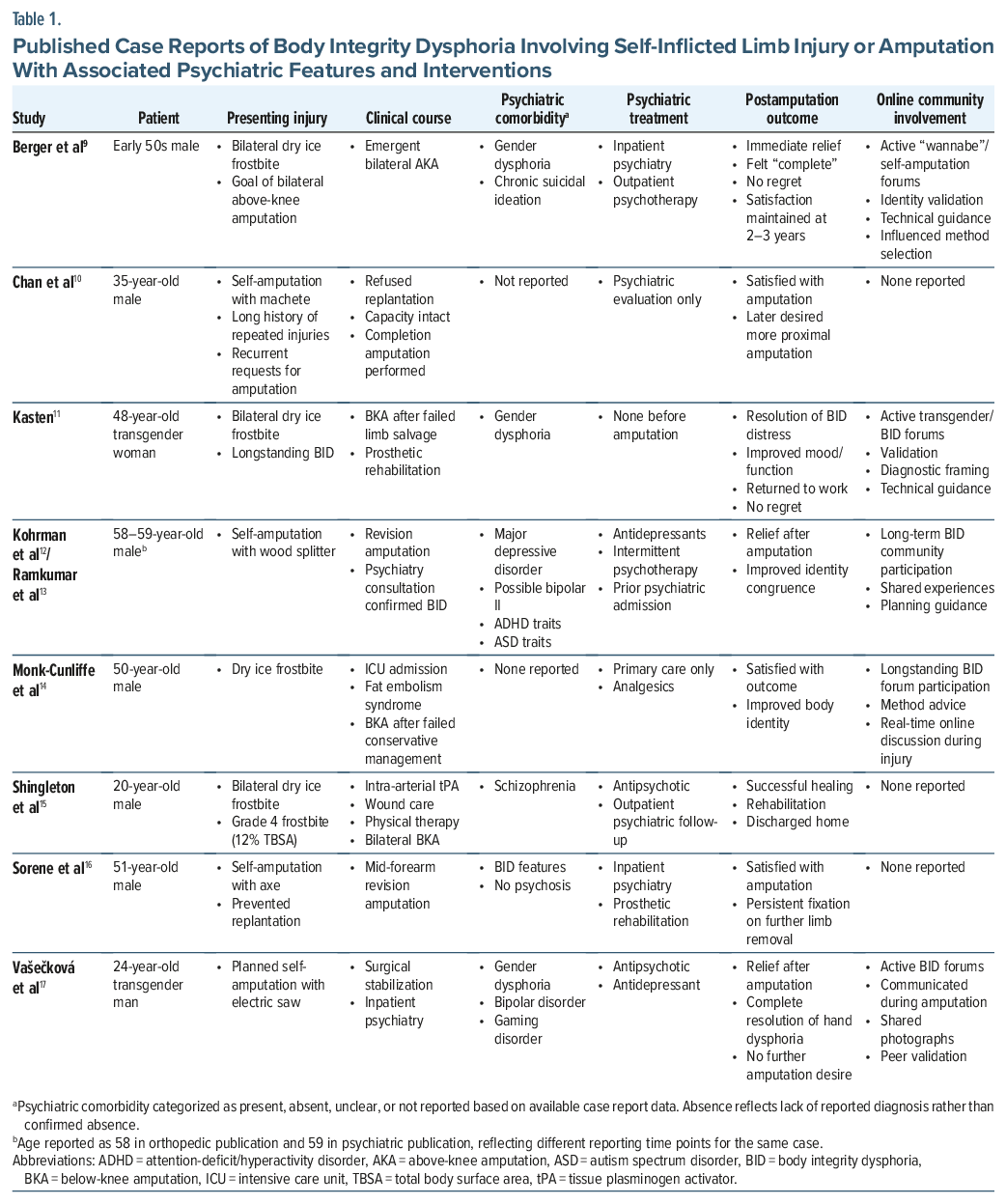
This review revealed several patterns among patients presenting with BID. Many gender-diverse and transgender patients were identified, and the impact of intersecting gender and body dysphoria on identity was suggested as a potential explanatory mechanism in some cases, a theory requiring further exploration.9,12,18 Additionally, several patients described histories of infatuation with the amputations or injuries of others in their lives, and their desire for amputation or disability typically started at a young age.9,12,15 Most of the patients described were not psychotic and denied suicidal ideation, and several of them did not have any formal psychiatric diagnoses.10,15 Patients frequently turned to their online BID communities for technical guidance and emotional support and encouragement before, during, and after their self-harm actions. These communities also seemed to provide validation and normalization of patients’ disability desire.9,12–14,18
Multiple patients presented with histories of prior self-inflicted injuries and amputation attempts, sometimes of multiple different body parts.12,13 Although intentional frostbite using dry ice was the most common method used, there was an array of other means of injury as well. The acts were intentionally carried out, required careful planning and implementation, and necessitated a high tolerance for pain, which was sometimes anticipated and managed by patients with preinjury substance use or other means of numbing.10,12 The majority required amputation due to the seriousness of their injuries, and most patients felt relieved or satisfied and reported a greater sense of identity congruence after amputation.9,10,12,15,17,18
Discussion
While our case situates well within existing literature on BID, prior reports have described a range of presentations, including patients without co-occurring self-harm behaviors or psychiatric diagnoses, as well as cases in which individuals pursued or obtained elective amputation.2,18–21 Our case differs from prior reports in several important respects and suggests the possibility of a mixed clinical picture, in which BID symptoms are accompanied by significant self-harm behaviors and co-occurring psychiatric pathology, including features consistent with borderline personality disorder. It also emphasizes the clinical importance of collateral assessment of online community engagement. This case expands the current understanding of BID by illustrating the convergence of severe self-inflicted injury, complex psychiatric comorbidity, and active, bidirectional engagement with online communities.
The postoperative course also differed from prior reports. Unlike several previously reported cases, amputation did not fully resolve the patient’s desired body configuration. Rather than expressing a sense of completeness, the patient remained disappointed that the amputations were below rather than above the knee. Several factors may explain this difference. First, the patient’s desired bodily identity specifically involved bilateral above-knee amputation, making the surgical outcome only partially congruent with their internal body representation. Second, co-occurring features of borderline personality disorder and longstanding identity disturbance may have contributed to a more unstable or evolving sense of self than is typically described in BID. Finally, reinforcement from online communities may have promoted increasingly rigid or escalating expectations regarding the desired disability. Although speculative, these factors may partially explain why amputation did not fully alleviate dysphoria in this case and suggest that postoperative satisfaction may not be universal among individuals with BID. While some individuals with BID experience a sense of completeness following amputation or actively pursue prosthetic rehabilitation, the patient expressed ambivalence regarding prosthesis use, suggesting a less clearly consolidated postamputation identity. The patient also engaged in drawing images of their desired postinjury body, reflecting a degree of preinjury visualization and identity construction not consistently described in the literature. Finally, the patient was younger than most previously reported cases, and their interaction with minor children within online BID communities introduced unique legal and ethical concerns related to potential influence on vulnerable individuals. These observations are best understood within the broader clinical context of BID and its associated diagnostic and management challenges.
BID presents profound diagnostic, ethical, and management challenges. It is an extremely rare and poorly understood condition characterized by a persistent desire to acquire a physical disability.2,3 BID most commonly involves a desire for lower limb amputation or paralysis, with affected individuals commonly reporting that body modification would allow them to achieve their “true” or most authentic identity.1,3 Some studies have explored neurobiological correlates of BID, with reported structural and functional differences in brain regions involved in body representation and multisensory integration.4,22–24 While these findings offer potential insight into the neurocognitive underpinnings of BID, they remain preliminary and should be interpreted cautiously given the limited and heterogeneous evidence base.
BID may manifest within a general medical and surgical setting, illustrating the substantial difficulty clinicians face when attempting to distinguish identity-driven volitional self-harm from dissociative, impulsive, or suicidal behavior.25–28 More broadly, this case raises important questions regarding the clinical, ethical, and legal complexity that arises when severe self-inflicted injury occurs in the context of disputed dissociative symptoms, layered psychopathology, and reinforcement of maladaptive behaviors through online communities.29
Decisional capacity is particularly challenging to assess following severe self-inflicted injuries associated with BID. Capacity to consent to or refuse treatment cannot be inferred solely from the presence of psychiatric illness and must be evaluated in relation to the specific decision at hand. In this case, assessment was particularly challenging because the patient’s expressed wish for bodily alteration was potentially consistent with the underlying psychopathology motivating the injury itself. Careful evaluation therefore focused on the patient’s ability to understand the nature of the injury, appreciate the consequences of treatment decisions, reason about available options, and communicate a stable choice. As the hospitalization progressed, it became increasingly clear that the injuries reflected deliberate, goal-directed behavior rather than an acute dissociative or impulsive act. The patient later acknowledged opening a window before activating the dry ice to prevent loss of consciousness, demonstrating anticipatory planning and preservation of self-directed agency. Additional collateral information revealed weeks to months of preparation, including acquiring dry ice, avoiding family members who might intervene, locking the bedroom door, and deliberately ventilating the room to limit carbon dioxide exposure. Enduring extreme pain for approximately 2 hours while submerged further argued against a prolonged dissociative or amnestic state. Although the patient initially reported amnesia, they later admitted feigning dissociation. Together, the extensive planning, sustained goal-directed behavior, and lack of grief or regret following bilateral limb loss strongly suggest that the injury represented the attainment of a long-desired bodily state rather than an impulsive, dissociative, or suicidal act. Similar reports of relief and perceived congruence following amputation have been described in individuals with BID.3,21
Beyond the diagnosis of BID, this case required careful diagnostic disentangling of overlapping psychiatric phenomena, which is not always the case among reported cases of BID. The patient endorsed chronic emotional instability, identity disturbance, fear of abandonment, impulsivity, recurrent self-harm, and unstable interpersonal relationships, features consistent with borderline personality disorder. Although the patient reported a history of DID, collateral information and subsequent psychiatric admissions suggested that this diagnosis had been intentionally fabricated, with deliberate attempts to simulate symptoms, raising concern for factitious disorder. This pattern of symptom fabrication and identity experimentation extended beyond dissociation to other psychiatric and medical conditions, including eating disorders and tic disorders, further complicating diagnostic clarity. Importantly, factitious disorder remained a relevant consideration despite the severity of the injuries, as the patient’s reported BID symptoms emerged only after online exposure to the condition, paralleling prior episodes of deliberate symptom simulation. The possibility of factitious disorder raises the question of psychological “gain,” which here appears driven less by external incentives and more by identity-related reinforcement within online communities. This differs from classic “sick role” presentations and may reflect an emerging intersection between digital identity formation and self-directed harm. Moreover, the presentation diverged from classical BID, which is typically characterized by distress related to a limb experienced as alien, appearing instead to involve a desire to possess the diagnosis itself. There was no clear evidence of psychosis, consistent with existing literature indicating that BID is not driven by psychotic processes.2,3
An additional diagnostic consideration was the patient’s gender dysphoria. They disclosed that they had independently obtained testosterone via the internet without medical supervision approximately 6 weeks prior to presentation. The comparison between body dissatisfaction in BID and gender dysphoria is well supported by the literature.1,2,30 Both conditions involve a core experience of a mismatch between one’s physical body and internal identity. Individuals with BID suffer “a chronic and dysphoric sense of inappropriateness regarding [being] able-bodied,” paralleling the distress in gender dysphoria.1 However, BID-related dissatisfaction is typically focal and limb-specific, whereas gender dysphoria centers on secondary sexual characteristics and socially recognized gendered features.11,17,30
From a management perspective, this case illustrates the limitations of repeated psychiatric hospitalizations in individuals with chronic personality pathology and identity-driven self-harm. Despite numerous prior inpatient admissions, the patient’s behavior escalated rather than improved, raising concern that hospitalization may at times reinforce maladaptive coping strategies or confer unintended secondary gains. At the same time, the severity of the patient’s injuries, poor insight, and persistent desire to achieve greater disability necessitated intensive safety measures during the acute hospitalization. This tension illustrates the importance of individualized risk assessment that carefully balances chronic versus imminent risk and prioritizes the least restrictive setting capable of maintaining safety without inadvertently reinforcing pathological contingencies.
The present case also highlights the potential role of online engagement as a secondary risk factor. Our patient’s extensive participation in BID-focused online communities provided a social context in which extreme self-injury was normalized, validated,3,31 and even encouraged.32,33 These digital spaces function as sites of identity formation and peer affirmation, where idealized representations of amputated bodies are commonly shared and reinforced.3,31 Such largely unmoderated environments may amplify maladaptive beliefs, obscure limits of decisional autonomy, and increase the risk of irreversible harm.4,32,34 Our patient remained highly active in online communities focused on BID during their hospitalization, posting updates and photographs from their hospital bed and receiving positive reinforcement from peers. Collateral information further suggested that the patient may have disseminated harmful guidance to others, potentially including a minor, expanding ethical obligations beyond the individual patient.4,5 Accordingly, assessment of online activity should become a routine component of psychiatric evaluation in suspected BID. Inquiry should extend beyond the presence of online community involvement to include the nature of interactions, exposure to instructional material, encouragement of self-injury, and the patient’s own role in producing or disseminating content.
An emerging consideration is the increasing integration of artificial intelligence (AI) into online environments. Large language models and AI-enabled conversational agents may unintentionally generate detailed information regarding methods of self-harm or reinforce maladaptive narratives in vulnerable individuals. Although there was no evidence that AI contributed to this patient’s planning or decision-making, clinicians should recognize that future patients may seek information or validation from both human peers and AI-generated content. As digital environments continue to evolve, the potential influence of AI on vulnerable individuals warrants further study.
In this context, restricting digital access and engaging hospital legal counsel functioned as safeguards while clinicians clarified diagnosis, decisional capacity, and imminent risk of harm to self and others. The primary legal consideration pertained to questions about mandated reporting obligations to child protective services given concerns regarding both the patient’s romantic engagement with a minor through the online community and the dissemination of self-harm methods tailored to that minor’s expressed interests. Protective measures, including involuntary hospitalization, were grounded in duties of beneficence and nonmaleficence and calibrated to the least restrictive environment compatible with safety. However, despite being implemented with preventive intent, these interventions were experienced by the patient as punitive, contributing to significant distress and conflict between the patient, nursing staff, and the treatment team. This divergence underscores a central ethical challenge in coercive care. Even proportionate, safety-driven interventions may erode trust and therapeutic alliance when experienced as disciplinary, highlighting the importance of transparent communication, ongoing reassessment, and acknowledgment of patient perceptions alongside risk management. Clinically, inquiry into online community engagement should be approached using a nonjudgmental and collaborative stance (eg, “Can you help me understand what these communities mean to you?”), emphasizing curiosity rather than surveillance to preserve therapeutic alliance. When safety concerns necessitate restriction of access, framing should center on time-limited, risk-based protection with ongoing reassessment and transparent communication, and when feasible, incorporating shared decision-making to maintain patient alliance.
Recent reports have further expanded the ethical debate surrounding BID by describing carefully selected patients who underwent elective amputations after extensive psychiatric evaluation and reported sustained symptom relief following surgery.35,36 Although these cases differ substantially from the present case, in which limb loss resulted from severe self-inflicted injury, they underscore the ongoing tension between respecting patient autonomy and the ethical obligations of beneficence and nonmaleficence. Together, these reports highlight the absence of evidence-based treatment guidelines and the need for continued multidisciplinary discussion regarding appropriate management of BID.
From a practical standpoint, this case reinforces several recommendations for CL psychiatrists and multidisciplinary teams. Evaluation should include careful collateral history, assessment of online community involvement, structured evaluation of decisional capacity, and early collaboration among psychiatry, surgery, ethics, legal counsel, rehabilitation specialists, and family members. Given the rarity of BID, maintaining diagnostic curiosity and recognizing the potential influence of online identity communities may improve patient safety and reduce future harm.
Conclusion
We contextualize a case of severe BID considering existing case report findings and emphasize the need for greater clinical awareness, particularly in acute medical settings where manifestations of BID may initially appear as nonsuicidal self-injury, dissociation, or suicide attempts. We emphasize the critical role of collateral assessment, particularly of online activity, in understanding patient motivation and risk. Given the rarity of BID and the lack of evidence-based treatments, long-term management remains challenging and likely requires highly specialized, interdisciplinary approaches that address identity disturbance, emotional regulation, and risk containment while minimizing reinforcement of harmful behaviors. Clinicians should remain vigilant to the role of online communities in reinforcing harmful behaviors and recognize the ethical complexities inherent in balancing autonomy, safety, and long-term prognosis in such cases. Further research is needed to better characterize BID, clarify its relation to personality pathology and online communities, and develop ethical frameworks for managing patients who pursue irreversible bodily harm in pursuit of identity congruence.
Article Information
Published Online: October 8, 2026. https://doi.org/10.4088/PCC.26cr04277
© 2026 Physicians Postgraduate Press, Inc.
Prim Care Companion CNS Disord 2026;28(5):26cr04277
Submitted: May 13, 2026; accepted July 17, 2026
To Cite: Schwartz AC, Robbins-Welty GA, Stiles C, et al. Limb loss after intentional dry ice frostbite in a patient with body integrity dysphoria and the role of online identity communities. Prim Care Companion CNS Disord 2026;28(5):26cr04277.
Authors Affiliations: Department of Psychiatry and Behavioral Sciences, Emory University School of Medicine, Atlanta, Georgia (Schwartz, Robbins-Welty, Stiles, Gimbel, Kaslow); Department of Family and Preventive Medicine, Emory University School of Medicine, Atlanta, Georgia (Robbins-Welty); Department of Surgery, Emory University School of Medicine, Atlanta, Georgia (Johnson); Department of Surgery, Trident Medical Center, Charleston, South Carolina (Ly).
Corresponding Author: Ann C. Schwartz, MD, FACLP, Department of Psychiatry and Behavioral Sciences, Emory University School of Medicine, 12 Executive Park Dr, Ste 142, Atlanta, GA 30329 ([email protected]).
Financial Disclosure: None.
Funding/Support: None.
Patient Consent: Consent was received from the patient to publish the case report, and information has been de-identified to protect patient anonymity.
Acknowledgements: The authors thank Joshua R. Jackson, PhD, for assistance with reference management. Dr Jackson has no financial conflicts to disclose.
References (36)

- Brugger P, Christen M, Jellestad L, et al. Limb amputation and other disability desires as a medical condition. Lancet Psychiatry. 2016;3(12):1176–1186. PubMed CrossRef
- First MB, Fisher CE. Body integrity identity disorder: the persistent desire to acquire a physical disability. Psychopathology. 2012;45(1):3–14. PubMed CrossRef
- Blom RM, Hennekam RC, Denys D. Body integrity identity disorder. PLoS One. 2012;7(4):e34702. PubMed CrossRef
- Saetta G, Hanggi J, Gandola M, et al. Neural correlates of body integrity dysphoria. Curr Biol. 2020;30(11):2191–5 e3. PubMed CrossRef
- Athar U, Johnstone L, Udegbe C. The emotional and ethical dilemmas of body integrity dysphoria: a case report from England. Cureus. 2024;16(10):e71121. PubMed CrossRef
- Borzekowski DL, Schenk S, Wilson JL, et al. e-Ana and e-Mia: a content analysis of pro-eating disorder Web sites. Am J Public Health. 2010;100(8):1526–1534. PubMed CrossRef
- Cosgrove V, Gliddon E, Berk L, et al. Online ethics: where will the interface of mental health and the internet lead us?. Int J Bipolar Disord. 2017;5(1):26. PubMed CrossRef
- Oksanen A, Celuch M, Oksa R, et al. Online communities come with real-world consequences for individuals and societies. Commun Psychol. 2024;2(1):71. PubMed CrossRef
- Berger BD, Lehrmann JA, Larson G, et al. Nonpsychotic, nonparaphilic self-amputation and the internet. Compr Psychiatry. 2005;46(5):380–383. PubMed CrossRef
- Chan JK, Jones SM, Heywood AJ. Body dysmorphia, self-mutilation and the reconstructive surgeon. J Plast Reconstr Aesthet Surg. 2011;64(1):4–8. PubMed CrossRef
- Kasten E. Case study about a patient suffering from body integrity dysphoria and gender dysphoria. Acad Ment Health Well-Being. 2024;1(3). CrossRef
- Kohrman SI, Rustad JK, Suhail-Sindhu T, et al. Self-inflicted limb amputation: a case of nonparaphilic, nonpsychotic Xenomelia. Psychosomatics. 2020;61(1):70–75. PubMed CrossRef
- Ramkumar DB, Brown MG, Lewis CY, et al. Self-inflicted hand amputation without replantation in a patient with body integrity identity disorder: a case report. JBJS Case Connect. 2021;11(3). PubMed CrossRef
- Monk-Cunliffe J, Lin J, Patel A. ICD-11 diagnosis of body integrity dysphoria: a case report. Case Rep Psychiatry. 2025;2025:6022329. PubMed CrossRef
- Shingleton S, Chambers M, Rowland M, et al. Self-inflicted frostbite with dry ice: a case report. J Burn Care Res. 2022. PubMed CrossRef
- Sorene ED, Heras-Palou C, Burke FD. Self-amputation of a healthy hand: a case of body integrity identity disorder. J Hand Surg Br. 2006;31(6):593–595. PubMed CrossRef
- Vašečková B, Patarak M, Petrusova V, et al. Self-amputation in patient with body integrity dysphoria in comorbidity with gender dysphoria: a case report. Psychopathology. 2022;55(5):310–316. PubMed CrossRef
- Braam AW, Visser S, Cath DC, et al. Investigation of the syndrome of apotemnophilia and course of a cognitive-behavioural therapy. Psychopathology. 2006;39(1):32–37. PubMed CrossRef
- Money J, Jobaris R, Furth G. Apotemnophilia: two cases of self-demand amputation as a paraphilia. J Sex Res. 1977;13(2):115–125. CrossRef
- Dyer C. Surgeon amputated healthy legs. BMJ. 2000;320(7231):332. PubMed
- First MB. Desire for amputation of a limb: paraphilia, psychosis, or a new type of identity disorder. Psychol Med. 2005;35(6):919–928. PubMed CrossRef
- Blom RM, van Wingen GA, van der Wal SJ, et al. The desire for amputation or paralyzation: evidence for structural brain anomalies in body integrity identity disorder (BIID). PLoS One. 2016;11(11):e0165789. PubMed CrossRef
- van Dijk MT, van Wingen GA, van Lammeren A, et al. Neural basis of limb ownership in individuals with body integrity identity disorder. PLoS One. 2013;8(8):e72212. PubMed CrossRef
- Giummarra MJ, Bradshaw JL, Nicholls ME, et al. Body integrity identity disorder: deranged body processing, right fronto-parietal dysfunction, and phenomenological experience of body incongruity. Neuropsychol Rev. 2011;21(4):320–333. PubMed CrossRef
- Calati R, Bensassi I, Courtet P. The link between dissociation and both suicide attempts and non-suicidal self-injury: meta-analyses. Psychiatry Res. 2017;251:103–114. PubMed CrossRef
- Cernis E, Chan C, Cooper M. What is the relationship between dissociation and self-harming behaviour in adolescents?. Clin Psychol Psychother. 2019;26(3):328–338. PubMed CrossRef
- Sommer JL, Blaney C, Mota N, et al. Dissociation as a transdiagnostic indicator of self-injurious behavior and suicide attempts: a focus on posttraumatic stress disorder and borderline personality disorder. J Trauma Stress. 2021;34(6):1149–1158. PubMed CrossRef
- Briere J, Eadie EM. Compensatory self-injury: posttraumatic stress, depression, and the role of dissociation. Psychol Trauma. 2016;8(5):618–625. PubMed CrossRef
- DePew R, Lal A, Sivertsen E, et al. Navigating the ethical challenges of clinical decision-making for patients with mental illness presenting with self-inflicted burns. J Burn Care Res. 2024;45(6):1641–1644. PubMed CrossRef
- van de Grift TC, Cohen-Kettenis PT, Elaut E, et al. A network analysis of body satisfaction of people with gender dysphoria. Body Image. 2016;17:184–190. PubMed CrossRef
- Noll S, Kasten E. Body integrity identity disorder (BIID): how satisfied are successful wannabes. Psychol Behav Sci. 2014;3(6):222–232. PubMed CrossRef
- Messina ES, Iwasaki Y. Internet use and self-injurious behaviors among adolescents and young adults: an interdisciplinary literature review and implications for health professionals. Cyberpsychol Behav Soc Netw. 2011;14(3):161–168. PubMed CrossRef
- Goncalves AF, Avanci JQ, Njaine K. “Razors always speak louder”: the topic of self-harm in online communities. Cad Saude Publica. 2023;39(4):e00197122. PubMed
- Lavis A, Winter R. Online harms or benefits? An ethnographic analysis of the positives and negatives of peer-support around self-harm on social media. J Child Psychol Psychiatry. 2020;61(8):842–854. PubMed CrossRef
- Nadeau N. Successful treatment of body integrity dysphoria with amputation: a case report. Clin Case Rep. 2024;12(4):e8720. PubMed CrossRef
- Nadeau N. One-year follow-up of amputation as a curative treatment for body integrity dysphoria: a case report. Clin Case Rep. 2024;12(7):e9156. PubMed CrossRef
Please sign in or purchase this PDF for $40.