

Catatonia is a psychomotor syndrome characterized by abnormalities of movement, behavior, and speech, with one of the symptoms being mutism. Catatonia occurs in approximately 10% of psychiatric inpatients.1 It is seen in approximately 30% of individuals with schizophrenia, 43% of individuals with bipolar disorder, and 25% of cases secondary to medical or neurological illness.2 This report describes chronic organic catatonia following cerebral malaria with a marked response to lorazepam.
Case Report
A 17-year-old male with no prior comorbidities presented to the hospital in February 2024 with a complete absence of speech since December 2017 (dates have been changed). The illness began with intermittent fever, chills, headache, and vomiting. On day 4, he developed 2 episodes of generalized tonic-clonic seizures over 2 days, with uprolling of eyes, teeth clenching, and frothing (once at home and once in the intensive care unit). Peripheral smear was positive for Plasmodium falciparum, and cerebral malaria was diagnosed. He received treatment and was discharged after 1 week.
Eight days later, he developed brief unconsciousness (∼15 minutes) without head injury, focal deficits, or abnormal movements. On regaining consciousness, mutism was the only deficit. As mutism persisted, 2 months later he was evaluated at a private ear, nose, and throat (ENT) facility; grade 1 facial nerve palsy was noted. Pure tone audiometry was normal, and magnetic resonance imaging of the brain showed no abnormalities; however, mutism persisted. He communicated through writing and gestures.
In February 2024, he presented to the hospital for reevaluation. ENT assessment led to referral to psychiatry with a provisional diagnosis of functional aphonia. The Bush-Francis Catatonia Rating Scale3 score was 3 (mutism only). A lorazepam challenge (4 mg IV) elicited speech within 5 minutes, though slurred. He was started on tablet lorazepam 4 mg/day for 10 days.
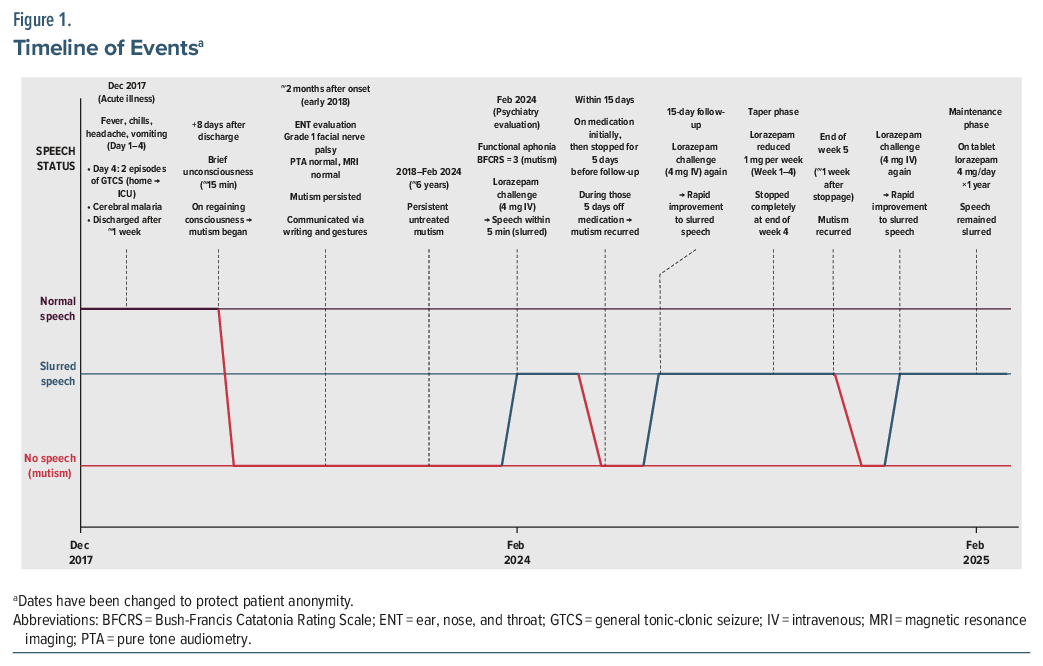
At the 15-day follow-up, mutism recurred after 5 days off medication. Repeat 4-mg IV lorazepam again produced rapid improvement. Tablet lorazepam 4 mg/day was restarted for 15 days; speech therapy was advised but discontinued due to logistical and financial constraints. He remained stable on tablet lorazepam 4 mg/day with persistent slurring. Lorazepam was tapered at a rate of 1 mg per week and stopped; mutism recurred approximately 1 week after stopping. Following another positive lorazepam challenge test, he was maintained on tablet lorazepam 4 mg/day for 1 year; his speech remained slurred. At 1-year follow-up, he was assisting his father with farm work, including tractor operation. Figure 1 depicts the timeline of events.
Discussion
A clear temporal association was observed between cerebral malaria and the onset of catatonic symptoms. Since publication of the Diagnostic and Statistical Manual of Mental Disorders, Fourth Edition, catatonia due to a general medical condition has been recognized as a distinct diagnostic category.4 Infections and immune-mediated central nervous system inflammation account for ∼29% of organic catatonia cases. Proposed mechanisms include direct neurotoxicity, infection-related stress, and immune activation via the acute-phase response, with proinflammatory cytokine release contributing to catatonia.5
Cerebral malaria is a severe neurological complication occurring in ∼1% of Plasmodium falciparum infections. Despite treatment, acute and chronic neurological sequelae may persist.6 Complications are classified as immediate or delayed, the latter termed postmalaria neurological syndrome, which presents with confusion, psychosis, seizures, abnormal speech or behavior, catatonia, hallucinations, tremors, and behavioral disturbances.7
Regardless of the etiology, benzodiazepines remain first-line treatment for catatonia. As positive allosteric modulators of γ-aminobutyric acid (GABA)-A receptors, they enhance GABAergic transmission in frontal cortical circuits.8 A positive lorazepam challenge predicts response. Remission rates of 70%–80% are reported, with usual doses of 8–24 mg/day. An Indian report described successful treatment of chronic catatonia with lorazepam without recurrence.9 The optimal duration of therapy remains unclear; relapse during tapering may require prolonged treatment.10
Existing literature describes catatonia resurgence within 3 days to 6 weeks after lorazepam tapering or discontinuation. Multiple resurgences often required maintenance lorazepam (4–6 mg/day) between 3 months and 5 years.11–13 This case demonstrates the effectiveness of lorazepam in long-standing organic catatonia and emphasizes the importance of evaluation of catatonia in persistent mutism following neurological illness.
Article Information
Published Online: September 10, 2026. https://doi.org/10.4088/PCC.26cr04217
© 2026 Physicians Postgraduate Press, Inc.
Prim Care Companion CNS Disord 2026;28(5):26cr04217
Submitted: February 25, 2026; accepted May 11, 2026.
To Cite: Eashwar GS, Singh LK, Kumar N. Resurrecting voice: role of lorazepam in chronic catatonia reversal. Prim Care Companion CNS Disord 2026;28(5):26cr04217.
Author Affiliations: Department of Psychiatry, All India Institute of Medical Sciences, Raipur, Chhattisgarh, India (all authors).
Corresponding Author: Lokesh Kumar Singh, MD, Department of Psychiatry, All India Institute of Medical Sciences, Raipur, Pin code 492099, Chhattisgarh, India ([email protected]).
Funding/Support: None.
Patient Consent: Consent was received from the patient and guardian to publish the case report, and information, including dates, has been de-identified to protect patient anonymity.
ORCID: G. Shreya Eashwar: https://doi.org/0009-0007-5241-2233; Lokesh Kumar Singh: https://doi.org/0000-0002-1819-6676; Namish Kumar: https://doi.org/0009-0000-8172-1173
References (13)

- Edinoff AN, Kaufman SE, Hollier JW, et al. Catatonia: clinical Overview of the diagnosis, treatment, and clinical challenges. Neurol Int. 2021;13(4):570–586. PubMed
- Sienaert P, Dhossche DM, Vancampfort D, et al. A clinical review of the treatment of catatonia. Front Psychiatry. 2014;5:181. PubMed
- Bush G, Fink M, Petrides G, et al. Rating scale and standardized examination. Acta psychiatr Scand. 1996;93(2):129–136. PubMed
- American Psychiatric Association. Diagnostic and Statistical Manual of Mental Disorders (DSM-IV). 4th ed. Arlington: American Psychiatric Association; 1994.
- Rogers JP, Pollak TA, Blackman G, et al. Catatonia and the immune system: a review. The lancet Psychiatry. 2019;6(7):620–630. PubMed
- Monteiro M. Neurological and behavioral manifestations of cerebral malaria: an update. World J Transl Med. 2014;3(1):9–16.
- Moryś JM, Jeżewska M, Korzeniewski K. Neuropsychiatric manifestations of some tropical diseases. Int Marit Health. 2015;66(1):30–35. PubMed
- Daniels J. Catatonia: clinical aspects and neurobiological correlates. The J neuropsychiatry Clin Neurosci. 2009;21(4):371–380. PubMed
- Singh LK, Praharaj SK. Immediate response to lorazepam in a patient with 17 years of chronic catatonia. J neuropsychiatry Clin Neurosci. 2013;25(3):E47–E48. PubMed CrossRef
- Rogers JP, Oldham MA, Fricchione G, et al. Evidence-based consensus guidelines for the management of catatonia: Recommendations from the British Association for Psychopharmacology. J Psychopharmacol Oxf Engl. 2023;37(4):327–369. PubMed CrossRef
- Thamizh JS, Harshini M, Selvakumar N, et al. Maintenance lorazepam for treatment of recurrent catatonic states: a case series and implications. Asian J Psychiatry. 2016;22:147–149. PubMed CrossRef
- Grover S, Aggarwal M. Long-term maintenance lorazepam for catatonia: a case report. Gen Hosp Psychiatry. 2011;33(1):82.e81–83.
- Ali SF, Gowda GS, Jaisoorya TS, et al. Resurgence of catatonia following tapering or stoppage of lorazepam: a case series and implications. Asian J Psychiatry. 2017;28:102–105. PubMed CrossRef
Please sign in or purchase this PDF for $40.