
Lessons Learned at the Interface of Medicine and Psychiatry
The Psychiatric Consultation Service at Massachusetts General Hospital sees medical and surgical inpatients with comorbid psychiatric symptoms and conditions. During their twice-weekly rounds, Dr Stern and other members of the Consultation Service discuss diagnosis and management of hospitalized patients with complex medical or surgical problems who also demonstrate psychiatric symptoms or conditions. These discussions have given rise to rounds reports that will prove useful for clinicians practicing at the interface of medicine and psychiatry.
Prim Care Companion CNS Disord 2026;28(4):26f04189
Author affiliations are listed at the end of this article.
From the Editors
Are you a healthcare provider?
Add your NPI to personalize your JCP experience.
Have you ever wondered whether a neuromodulatory device or wearable technology might manage depression, posttraumatic stress disorder (PTSD), cognitive fog, or chronic pain? Have you been uncertain about which of these treatments have been US Food and Drug Administration (FDA) approved and which conditions they can treat? Have you been uncertain how to integrate these tools and techniques into your practice and what type of training is needed to provide or prescribe them? If you have, the following case vignette and discussion should prove useful.
CASE VIGNETTE
Mr A, a 54-year-old veteran, has suffered from generalized anxiety disorder (GAD), childhood abuse, a distant history of an alcohol use disorder, military service–related PTSD, and major depressive disorder (MDD), which interfered with his ability to perform household chores or manage work-related stressors. When not at work, he spends most of his time in bed, and he often feels as though he might be “better off dead.” Intermittently, he has considered taking his own life, and he had been psychiatrically hospitalized for suicidal ideation on 2 occasions. Currently, he has no plan for suicide. The last time he felt relatively well was more than 10 years ago when he felt productive and appreciated. He has had many antidepressant trials including several selective serotonin reuptake inhibitors (SSRIs), serotonin-norepinephrine reuptake inhibitors, and tricyclic antidepressants, with atypical antipsychotic augmentation, as well as buspirone and benzodiazepines for anxiety. His antidepressant trials have never been associated with remission of his depression. He has been taking duloxetine (90 mg/d) for the past 4 months. Intermittently, he uses cannabis “gummies” to improve his sleep.
Mr A (divorced and without children) lives alone and has limited social support. His medical history is notable for chronic back pain, obesity, type II diabetes, hypertension, and obstructive sleep apnea (for which he uses continuous positive airway pressure; due to difficulty tolerating the mask, he typically wears it for only 3 to 4 hours per night).
His assessment score on the Patient Health Questionnaire-9 (PHQ-9)1 inventory for depression was 18, indicative of moderately severe depression; the PTSD Checklist for DSM-5 (PCL-5)2 inventory for symptoms of PTSD was 46, indicative of significant symptom severity; and the Brief Symptom Inventory-18 (BSI-18) global symptom inventory3 for multiple domains of psychological distress was 62, indicative of significantly elevated psychological distress over multiple symptom domains.
Recently, Mr A started cognitive-behavioral therapy (CBT) for his depression, but he is doubtful about whether this will be helpful, and he has missed several sessions. Instead, he wonders whether he should undergo transcranial magnetic stimulation (TMS).
DISCUSSION
What Are Neuromodulatory and Wearable Technologies, and How Can They Be Used in Psychiatric and Neuropsychiatric Conditions?
Neuromodulatory technologies represent a rapidly expanding class of interventions that directly alter neural activity by delivering electrical stimulation to the nervous system and by modulating nerve signals to the brain. Contemporary neuromodulation spans noninvasive approaches (eg, TMS, transcranial direct-current stimulation [tDCS], cranial electrotherapy stimulation [CES], noninvasive vagus nerve stimulation [nVNS], as well as implantable modalities, such as deep brain stimulation [DBS]).4 These tools move beyond symptom suppression toward targeting circuits that are involved in mood, cognition, arousal, affect, and pain, and they reflect advances in neuroscience and network-based models of neurological and mental health. Neuromodulation is increasingly recognized as a treatment for refractory disease and as a means of restoring adaptive brain function in conditions (eg, MDD, PTSD, obsessive-compulsive disorder [OCD], migraine headaches, chronic pain, and traumatic brain injury), where dysregulated stress, salience, and reward networks play a key role.4
Along with neuromodulation, wearable and digital health technologies have emerged as ubiquitous, scalable tools for monitoring, modulating, and supporting brain-body regulation in real-world settings. Wearable devices that incorporate physiological sensors (eg, heart rate variability, electrodermal activity, sleep, and activity patterns) allow for continuous assessment of autonomic tone, stress reactivity, and recovery—domains that are highly relevant for psychiatric and neuropsychiatric illness. The integration of these data with digital interventions (eg, biofeedback, mindfulness-based applications, and adaptive behavioral prompts) enables personalized, motivational support that extends care beyond medical clinics. Recent work highlights how wearable technologies can complement neuromodulatory interventions by identifying physiological signatures of treatment response, informing dosing or timing of stimulation, and capturing functional outcomes (eg, sleep quality, fatigue, pain, and emotional regulation).5,6
Together, neuromodulatory and wearable technologies signal a broader shift in psychiatry and neuropsychiatry toward precision, personalization, and prevention. Rather than relying solely on episodic symptom self-report, these approaches allow clinicians to engage with their patients in dynamic brain-body systems over time, while aligning with emerging models of psychiatry that emphasize resilience, recovery, and functional well-being. The convergence of neuromodulation, wearable sensing, and digital therapeutics offers promise to populations exposed to chronic stress, trauma, and moral injury, including military service members, veterans, and health care workers, for whom field-expedient, nonpharmacologic, and scalable interventions may provide interventions with less stigma and greater acceptance. As emphasized in recent translational and clinical studies, thoughtful integration of these technologies into clinical workflows will require attention to ethics, accessibility, and patient-centered outcomes, but their potential to reshape psychiatric care across the lifespan is increasingly promising.4–6
What Are Repetitive TMS, Theta-Burst Stimulation, and Accelerated TMS, and How Do These Treatment Approaches Differ?
TMS is a noninvasive neurostimulatory technique that involves the application of a strong, pulsed magnetic field to a targeted brain region.7 TMS is usually administered in bundles, or “trains,” of pulses with rest intervals during treatment protocols; thus, it is called repetitive TMS (rTMS).7 The key parameters for TMS include brain area or network targeted, amplitude, frequency, and duration. The treatment amplitude is based on the resting motor threshold (rMT), which is the minimum intensity needed to induce a muscle contraction in the contralateral hand half of the time after stimulation. Typically, the stimulation intensity for standard TMS is set at 120% of the rMT. High-frequency stimulations (ie, ≥10 Hz) increase cortical excitability, while low-frequency stimulations (ie, 1–5 Hz) decrease it.
Theta-burst stimulation (TBS) is a type of TMS that involves delivering pulses in bursts of 3. These bursts are administered at a frequency of 50 Hz, with an interburst interval of 200 ms (that results in a frequency of 5 Hz). This stimulation approach was developed from studies conducted in rodent and human brains, which showed that theta rhythms are linked to long-term potentiation (LTP).8 Two commonly used patterns of TBS are used: continuous TBS (cTBS) and intermittent TBS (iTBS). In cTBS, either 300 pulses are delivered over 20 seconds or 600 pulses are administered over 40 seconds, without interruption. In contrast, iTBS involves delivering pulses in 2-second bursts that are repeated every 10 seconds (totaling 600 pulses).
cTBS reduces the amplitude of motor-evoked potentials (MEPs), producing an effect that is like that of long-term depression. On the other hand, iTBS enhances MEPs, which results in an effect like that of LTP.8 The primary benefit of TBS protocols over traditional TMS methods is its shorter treatment duration. While conventional TMS procedures take between 20 and 45 minutes, TBS paradigms require only 1–3 minutes of stimulation.8
Accelerated rTMS (arTMS) protocols deliver 2 or more TMS sessions per day, thereby reducing the number of weeks that comprise a course of TMS therapy. Cole and colleagues9 performed a high-dosage, highly accelerated, and personalized iTBS arTMS feasibility study10 that reported remission rates of up to ∼90% while delivering treatment over 5 days. These preliminary findings suggested that accelerated approaches may be efficacious, and as a result, they have attracted international attention. Cole and associates10 subsequently reported on a sham-controlled randomized controlled trial (RCT) that used functional connectivity-guided TMS targeting. The authors utilized resting-state functional magnetic resonance imaging (fMRI) to target the brain structure (left dorsolateral prefrontal cortex [DLPFC]) that is most functionally anticorrelated (ie, brain regions whose activity tends to be inversely related—when one region is more active, another tends to be less active) with the subgenual anterior cingulate cortex (sgACC). Indirect modulation of the sgACC is one proposed mechanism of the anti-depressive effects of TMS in individuals with MDD. The primary outcome was a Montgomery-Asberg Depression Rating Scale (MADRS)11 score 4 weeks after treatment. The authors reported that active treatment scores were superior to the scores of the sham group, with a mean reduction of 52.5% from baseline on the MADRS score 4 weeks after treatment of the active treatment group (n = 14) and 11.1% in the sham treatment group (n = 15). This study10 led to the FDA approval of arTMS for the treatment of MDD in 2022.
Which Neuromodulation Treatments Have Been FDA Approved for Psychiatric Disorders, and Which Conditions Do They Treat?
Neuromodulatory treatments, including electroconvulsive therapy (ECT), TMS, VNS, and DBS, have received FDA approval and are used for the treatment of several psychiatric disorders (Table 1).12,13 ECT uses electricity to stimulate the brain to induce a seizure. In modern practice, ECT is performed under general anesthesia after the administration of a muscle relaxant, and it is referred to as “modified ECT.” ECT is used for the treatment of severe psychiatric disorders in which other therapies have been ineffective or when rapid symptom relief is required.14 In 2018, the FDA formally reclassified ECT devices as class II (moderate risk) devices, for severe MDD, catatonia, and mania. ECT is indicated for the treatment of severe episodes of MDD when they are accompanied by suicidal ideation or behavior, psychotic features, or catatonia. ECT can be lifesaving for the treatment of catatonia, especially when benzodiazepines have been ineffective. ECT is used to treat mania, especially when it is severe, treatment resistant, or associated with psychosis or severe agitation.14
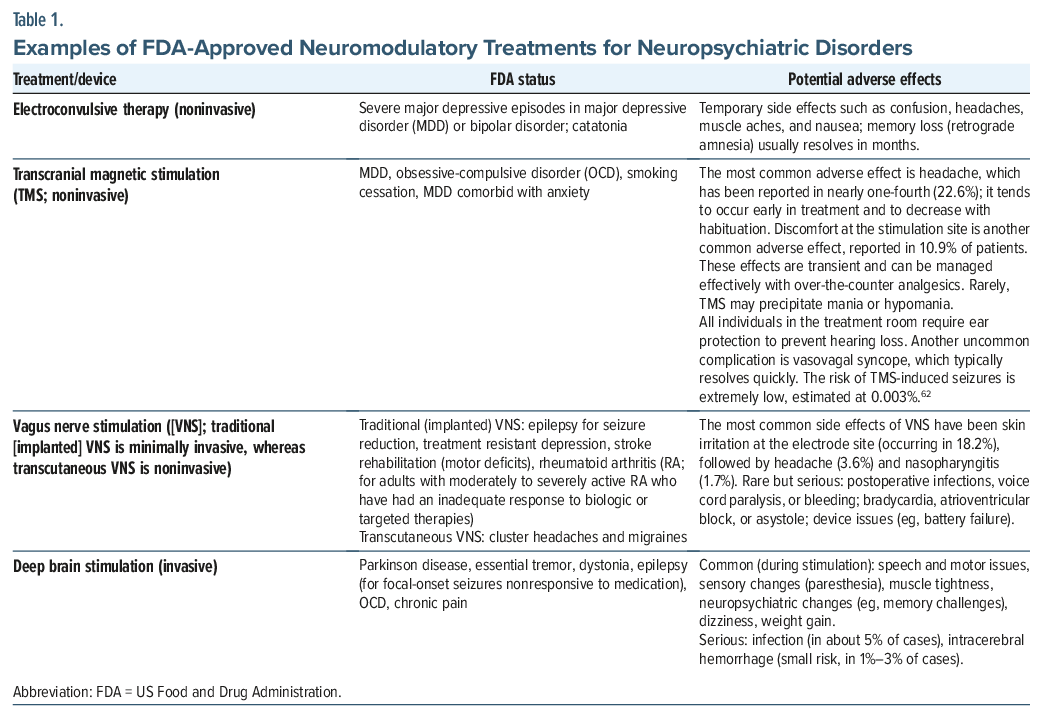
TMS was approved by the FDA for MDD in 2008, for OCD in 2018, for smoking cessation in 2020, and for MDD comorbid with anxiety in 2022.15 TMS is a safe, effective, and well-tolerated noninvasive treatment designed for the acute management of unipolar MDD in adults and adolescents. The TMS devices cleared by the FDA for use in MDD and MDD with anxious distress include NeuroStar (Neuronetics Inc), Brainsway Deep TMS (H-1 Coil), Horizon Inspire TMS (Magstim), and the Magventure TMS system. The most researched brain target for TMS administration is the left DLPFC. The criteria for consideration of TMS therapy in MDD include a DSM-5 diagnosis of MDD (as a single episode or a recurrence); failure of an adequate antidepressant trial(s) (+/- psychotherapy) during the current episode; and absence of a contraindication to TMS.16
A systematic review and meta-analysis of randomized sham-controlled trials conducted over the past 2 decades examined both unilateral and bilateral TMS. The analysis found a weighted mean difference (WMD) of 3.36 (with a 95% CI of 1.85–4.88) when comparing unilateral TMS to sham treatment. The results indicated that the effect of TMS was more pronounced when used along with antidepressant medications, showing a WMD of 3.64 (95% CI, 1.52–5.76). In contrast, when TMS was used as a stand-alone treatment, the WMD was 2.47 (95% CI, 0.90–4.05). The pooled remission and response rates for unilateral TMS were 16.0% and 25.1%, respectively, compared to 5.7% and 11.0% for sham treatment. For bilateral TMS, the pooled remission and response rates were 16.6% and 25.4%, while sham treatment yielded rates of 2.0% and 6.8%. In conclusion, the investigators determined that TMS provided a moderate antidepressant effect for the acute treatment of treatment-resistant depression (TRD).17 An investigation demonstrated the real-world outcomes of TMS administered by nonresearch psychiatrists across 42 clinics that treat patients with MDD, encompassing 307 participants. The psychiatrists customized the TMS parameters and treatment protocols to optimally support their patients. The results were promising; they indicated that positive outcomes from TMS were achievable in a variety of clinical settings. These data revealed a substantial reduction in depression severity from the initiation to the conclusion of treatment, with response rates reaching 58.0% and remission rates of 37.1%.18
Several TMS devices have received FDA approval for the adjunctive treatment of OCD. These devices include the Brainsway Deep TMS system (H7 coil), the Magventure TMS Therapy System (DB-80 coil), the Magstim Horizon Inspire TMS system, and the Neurostar TMS therapy system.19,20 The brain targets for the H7 coil include the medial prefrontal cortex and the anterior cingulate cortex. In comparison, the Magventure and the Neurostar TMS therapy systems target the dorsomedial prefrontal cortex (dmPFC) for OCD treatment, and the Magstim Horizon Inspire TMS system targets the dmPFC and the supplementary motor area. The criteria for using TMS as an adjunctive treatment for OCD include age >18 years, a confirmed diagnosis of OCD, lack of response to 2 adequate trials of a SSRI or clomipramine, and 1 adequate trial of CBT with exposure and response prevention (ERP).21 A meta-analysis by Steuber and McGuire22 reported that TMS was moderately efficacious in reducing OCD symptom severity with a threefold increased likelihood of treatment response (relative risk = 3.15) compared with sham stimulation. The authors reported that TMS may be beneficial in patients with treatment-resistant OCD and in those with comorbid MDD.22
Deep TMS (using an H4 coil), targeting the bilateral insula and prefrontal cortex, has been approved by the FDA for the treatment of nicotine dependence.23 The general eligibility criteria for deep TMS treatment for nicotine dependence include an age of 18–65 years, regular smoking (with a minimum of 10 cigarettes/day) for at least 12 months, moderate-high levels of nicotine dependence, and unsuccessful attempts at quitting smoking (using standard pharmacologic and behavioral interventions). Clinical studies suggest that deep TMS (using an H4 coil) can reduce nicotine cravings and withdrawal symptoms, thus leading to higher rates of nicotine abstinence, as compared to sham TMS.23
VNS is another invasive neuromodulatory treatment that involves implanting a pulse generator that is connected to bipolar electrodes that are placed around the left vagus nerve. The pulse generator is implanted under the skin on the left side of the chest. It delivers intermittent electrical currents to the left vagus nerve, which then transmits signals through the nucleus tractus solitarius to various brain regions.24 The stimulation parameters of VNS include current (mA), frequency (Hz), pulse width (μs), and duty cycle (with a duration of stimulation is on or off).25
The criteria for selection of patients for VNS include the patient must be ≥18 years of age, diagnosed with chronic or recurrent depression (either unipolar or bipolar), and lack of response to at least 4 adequate antidepressant medication trials. Patients need not have failed ECT. In addition, the diagnosis must be of nonpsychotic MDD.25 Exclusion criteria include having a substance use disorder (SUD) within the last 12 months, a history of borderline personality disorder or a severe personality disorder, a schizophrenia-spectrum or other psychotic disorder, or a rapid-cycling bipolar disorder (type I or II).26
When Bottomley and colleagues27 conducted a systematic review and meta-analysis of 22 studies to assess the efficacy and safety of VNS in TRD, they found that response rates based on the MADRS scores for patients receiving VNS in combination with treatment as usual (TAU) were 23.9% at 6 months, 38.9% at 12 months, and 52.6% at 24 months. The remission rates for this group were 12.1%, 25.1%, and 37.7% at the same intervals. In contrast, patients who received TAU alone had response rates of 13.8%, 17.5%, and 18.5% and remission rates of 6.3%, 8.2%, and 11%. When evaluating response rates based on the Hamilton Depression Rating Scale, the results for VNS combined with TAU showed 29.9% at 6 months, 43.4% at 12 months, and 36.7% at 24 months. The corresponding remission rates were 14.4%, 27.3%, and 21.7%, respectively. The analysis showed no funding bias but highlighted heterogeneity among studies. VNS was generally well-tolerated, with approximately 5.5% of patients reporting significant adverse events after 12 months.27
DBS is a neurosurgical procedure that involves the electrical stimulation of deep neural targets. The DBS system comprises 3 main components: an implantable pulse generator (IPG), which generates electrical pulses; a lead with electrodes at its tip to deliver these pulses to the target brain region; and an extension that connects the lead to the IPG. The stimulation parameters for DBS include amplitude (mA/V), pulse width (μs), and pulse frequency (Hz). DBS is FDA approved to treat Parkinson disease, essential tremor, dystonia, epilepsy, and OCD (humanitarian device exemption only).28
The clinical criteria for DBS are not uniform across treatment centers, but they represent a consensus in treatment-refractory OCD. The inclusion criteria include a confirmed diagnosis of OCD; chronic/severe OCD (commonly ≥5 years of illness); high symptom severity, eg, with a Yale-Brown Obsessive-Compulsive Scale (Y-BOCS)29 score in the severe range (≥ 30); significant social/occupational functioning impairment; failure of multiple SSRIs and clomipramine; failure of augmentation strategies (eg, use of atypical antipsychotics); failure to respond adequately to a minimum number of sessions of CBT/ERP (eg, ≥16–20 or ≥20 hours) done by an experienced OCD therapist; being aged ≥18 years; being medically stable and able to undergo neurosurgery; and not having contraindications to an MRI scan or surgery. The exclusion criteria include a lifetime history of psychotic disorders or bipolar disorder; a SUD (recent or unstable); a severe personality disorder; a neurological disorder that interferes with surgery or assessments (eg, dementia, structural brain abnormalities); a high acute risk of suicide or suicidal behavior; and prior neurosurgery in the target brain region.30,31
In 1999, Nuttin and colleagues32 reported the initial application of modern DBS for treatment-refractory OCD. The authors used bilateral DBS electrodes in the anterior limb of the internal capsule and reported clinical benefits in patients with treatment-refractory OCD.32 Choosing a different site of stimulation, a groundbreaking study led by Greenberg and colleagues33 examined the efficacy of ventral capsule/ventral striatum DBS for patients with treatment-refractory OCD. The authors reported that active DBS treatment led to a reduction of the average baseline Y-BOCS score from 34.0 to an average of 21.0 after 3 months in 26 patients with treatment-refractory OCD.33
Are Virtual Reality–Based Interventions Viable Neuromodulatory Tools for Psychiatric Conditions?
Virtual reality (VR) is a digital 3-dimensional environment that allows users to move and interact freely, creating an immersive experience. Within VR, individuals can become engaged deeply (emotionally, cognitively, and behaviorally); this immersion underlies many of the technology’s educational and therapeutic advantages. VR environments can be so realistic that users’ psychophysiological and neurocognitive responses often closely resemble their reactions to comparable real-world situations. 34–36 This realism underpins VR’s potential as a transformative platform, particularly for psychiatric conditions (eg, PTSD and specific phobias). In these contexts, VR functions as a behaviorally mediated neuromodulation platform that influences neural circuits that are involved in threat detection, salience processing, and emotional regulation through emotionally engaging experiences that leverage experience-dependent plasticity.37 In PTSD, trauma-relevant immersive scenarios allow for precise cue exposure, which can produce clinically meaningful symptom reductions that are comparable to those achieved with trauma-focused therapies. By providing controlled exposure to feared cues, manipulating social and interoceptive contexts, and facilitating guided cognitive restructuring, VR fosters safe learning and strengthens the cognitive control of patients. This integration of mechanisms enables VR to modulate neural pathways effectively and support adaptive changes in emotional and cognitive responses in therapeutic settings.38–40
VR-based interventions have emerged as versatile therapeutic tools for multiple psychiatric conditions. In the context of psychotic disorders, VR leverages avatars and immersive social environments to target social skills, modulate paranoid thoughts, and rehearse adaptive responses to imagined sounds. Although current studies, which are often constrained by small samples and short follow-up periods, limit the generalizability of findings, the available evidence suggests that VR can meaningfully reduce paranoia and psychotic symptoms while enhancing self-esteem and emotional regulation.41,42 In mood disorders, VR-based behavioral activation, self-compassion, and mindfulness exercises have been associated with reduced levels of depression and anxiety and increased happiness and well-being; however, many trials have reported variable outcomes and lacked adequately controlled designs.43,44 Beyond these domains, VR has been applied to eating disorders (by addressing body image issues and promoting activity),45 addiction (through cue exposure to reduce cravings),46 and stress-related conditions (by enhancing coping mechanisms and emotional support).47,48 Across these diagnostic groups, VR appears promising for targeting transdiagnostic mechanisms (eg, avoidance, stress reactivity, and impaired emotional recognition). However, the evidence remains preliminary, and larger, methodologically rigorous RCTs are needed to establish efficacy and generalizability. VR has demonstrated good efficacy in the management of acute and procedural pain,49,50 with meta-analyses showing significant reductions in pain intensity, as well as lower levels of anxiety and opioid requirements, thereby positioning VR as a valuable nonpharmacologic adjunct to analgesics.51,52
Across multiple psychiatric conditions, virtual reality exposure therapy (VRET) yields improved outcomes when embedded within comprehensive CBT protocols that incorporate cognitive restructuring and homework assignments. VR offers large effects compared with waitlist conditions and comparable efficacy to standard CBT, alongside high acceptability and low dropout rates.53 VRET has demonstrated generally positive efficacy for the treatment of phobias, and it can function as a stand-alone intervention and as an adjunct to in vivo exposure; however, for certain specific phobias, it appears less efficacious than traditional in vivo exposure, a difference that may reflect limitations in immersion and presence as well as the small sample sizes found in existing studies.54
Research that has combined VR with psychophysiological monitoring (eg, heart rate and skin conductance) has demonstrated modulation of arousal and durable brain-behavior change. This integrated approach has enabled the real-time tracking of autonomic and neural responses during immersive experiences, which permitted precise therapeutic adjustments.55,56 By supporting graded, controllable exposure in customizable environments, VR can facilitate the extinction of maladaptive fears through exposure in a safe, controlled environment.
Numerous challenges (including protocol heterogeneity, small sample sizes, and sparse mechanistic data) limit making definitive conclusions about the efficacy of VR.57–59 Additional barriers include its cost, cybersickness, and inequitable access to VR technology. Unlike TMS, which operates as a stand-alone core therapeutic device, VR currently functions primarily as an experience-engineering platform that augments psychotherapy for specific anxiety disorders and pain management. At present, VR is not FDA approved as a medical device or as treatment for any psychiatric condition, and its approval for pain management is restricted to chronic low back pain. Regarding anxiety disorders, symptoms of PTSD and pain, existing data suggest that VR meets basic viability thresholds, whereas in other areas, large methodologically rigorous RCTs that incorporate neurophysiological measures remain necessary.
VR interventions provide versatile neuromodulation with demonstrated efficacy in anxiety disorders, specific phobias, PTSD, and pain. These approaches yield outcomes that are comparable to best practice therapies (eg, CBT and in vivo exposure), while offering additional advantages (including greater controllability through customizable virtual environments, higher patient engagement via immersive and interactive environments, and the potential to reduce reliance on opioid medications). In contrast, for mood disorders and psychosis, VR remains an investigational tool, because of limitations in methodologies and barriers to implementation. Future large-scale RCTs that incorporate neurophysiological measures, standardize intervention frameworks, and offer head-to-head comparisons are critical to determine whether VR can progress from an innovative delivery channel to a core component of psychiatric care. Collectively, current evidence supports VR as a viable neuromodulation tool with promising, though still evolving, applications in precision psychiatric care.
Are Neuromodulatory Devices/Techniques Safe and Tolerable?
Neuromodulatory devices are generally safe and well-tolerated when used as directed (Table 1). The FDA has approved several neuromodulatory devices and techniques for use in central nervous system and psychiatric disorders, which indicates that those devices have undergone rigorous clinical testing to establish their efficacy, safety, and tolerability. Side effects associated with such neuromodulatory devices are often mild and transient, but they vary among devices and depend on how those devices are used.12
Both traditional rTMS and its TBS derivative have similar side effects and tolerability profiles.60 The most common adverse effect with their use is headache, which has been reported in nearly one-fourth (22.6%) of those receiving TMS61; it tends to occur early in treatment and to decrease with habituation. Discomfort at the stimulation site is the second most common adverse effect, reported in 10.9% of patients.61 These effects are transient and can be managed effectively with over-the-counter (OTC) analgesics. Rarely, TMS may precipitate mania or hypomania. As a result, daily screening assessments are recommended (ie, standardized, self-administered questionnaires and/or questions to elicit for irritable, elevated, or energized states) so that symptoms can be detected and treated in a timely fashion. All individuals in the treatment room require ear protection to prevent hearing loss. Another uncommon complication is vasovagal syncope, which typically resolves quickly. The risk of TMS-induced seizures is extremely low, estimated at 0.003%.62 The risk for seizures is during TMS treatment and patients can still drive themselves to and from appointments. A meta-analysis of RCTs found that dropout rates due to adverse effects were not noticeably higher with TMS interventions (3.3%) than with sham treatment (2.3%).61
nVNS has shown to be safer and more tolerable than implanted VNS by avoiding surgical complications. Side effects of transcutaneous VNS (tVNS) are generally mild. Moreover, a systematic review found that only 2.6% of patients discontinued treatment due to adverse effects of VNS. The most common side effects of VNS have been skin irritation at the electrode site (occurring in 18.2%), followed by headache (3.6%) and nasopharyngitis (1.7%).63 Another meta-analysis of transcutaneous auricular VNS (taVNS) identified ear pain and a tingling sensation as common adverse effects. Newer devices that can deliver nVNS along the neck show a myriad of side effects, with the most common being lip or facial drooping/twitching (11%) and skin irritation at the electrode site (2.7%).64
Another neuromodulatory treatment, CES, has been extremely well tolerated. A systematic review found that adverse effects were limited to mild tingling, skin irritation, fatigue, malaise, sleepiness, and transient visual symptoms.65 A meta-analysis that assessed the efficacy and tolerability of CES for anxiety disorders reported ear discomfort and ear pain as the only adverse effects.66 In an RCT that evaluated the efficacy of the Alpha Stim-AID device for depression, the most common side effect was headache, which was mild and did not result in participant dropout.67
What Are Emerging or Investigational Neuromodulatory Technologies, and How Do They Differ in Application, Evidence, and Invasiveness From One Another?
tDCS is a noninvasive neuromodulatory technique that uses 2 electrodes, often integrated into a cap or headgear system, which is placed on the bifrontal regions of the scalp to deliver a constant electrical current. Depending on the direction of the current, tDCS alters the neuronal membrane potential toward either depolarization or hyperpolarization, thereby altering neuronal excitability. Long-term effects of tDCS involve the promotion of neuroplasticity through modulation of glutamatergic, dopaminergic, and serotonergic systems.68,69
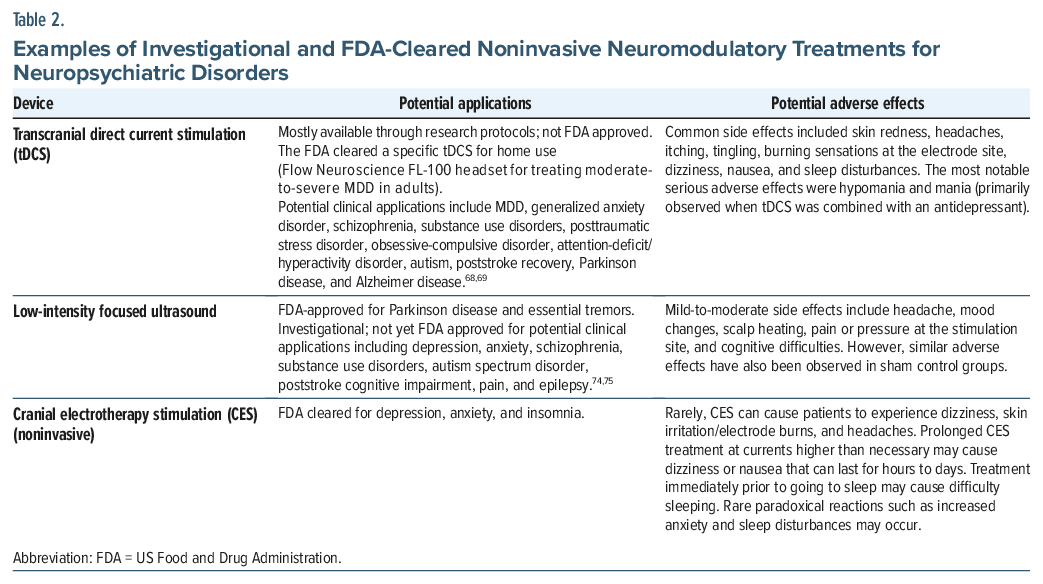
tDCS is emerging as a promising neuromodulatory technique due to its portability, accessibility for home use, cost, and tolerability.68 In the United States, tDCS is mostly available through research protocols (ie, not FDA approved). The FDA cleared a specific tDCS for home use (Flow Neuroscience FL-100 headset for treating moderate-to-severe MDD in adults). In Europe, tDCS has been approved for both pain and depression.
There is no standardized protocol for tDCS (study parameters vary, eg, in the electrode size, placement, current intensity, session duration, and number of sessions). Even minor variations can alter the spread, depth, and intensity of the electrical field, which may explain the variability in outcomes of clinical trials. Treatment protocols using a current of 1–2mA for 5–30 minutes are safe for humans. While a consensus on the number of sessions or handling missed sessions has not been reached, most clinical trials deliver between 5 and 30 sessions.69
tDCS is being investigated for use in a wide array of psychiatric and neurological disorders, including MDD, GAD, schizophrenia, SUDs, PTSD, OCD, attention-deficit/hyperactivity disorder, autism spectrum disorder, poststroke recovery, Parkinson disease, and Alzheimer disease. Among these conditions, depression has been the most studied and has the strongest evidence for tDCS’s efficacy. A recent systematic review and meta-analysis70 found that tDCS was associated with improvement in MDD and led to a greater benefit in comorbid depression than in depression alone. Combining tDCS with psychopharmacology yielded better outcomes in those with MDD and in comorbid depression with additional psychiatric conditions than tDCS alone, whereas combining tDCS with psychotherapy did not outperform control conditions.70 In contrast, the DepressionDC trial in Germany found no significant benefit when tDCS was added to SSRIs.71 Another meta-analysis that examined the dose-response relationship of tDCS across multiple psychiatric disorders found improved outcomes for depression and SUDs.72
tDCS is generally well tolerated, with only mild-to-moderate side effects. In a meta-analysis, the dropout rate due to adverse effects was low (0.6% in the active groups vs 0.4% in the sham groups). Common side effects included skin redness, headaches, itching, tingling, burning sensations at the electrode site, dizziness, nausea, and sleep disturbances. The most notable serious adverse effects were hypomania and mania, which was primarily observed when tDCS was combined with an antidepressant.70
Transcranial focused ultrasound (tFUS) is another emerging noninvasive neuromodulatory technique for the treatment of neurological and psychiatric disorders. Unlike other neuromodulatory devices and techniques that use electromagnetic stimulation, tFUS delivers acoustic energy to target brain regions via ultrasound beams. tFUS offers several advantages over traditional electromagnetic neuromodulatory techniques. First, tFUS has superior precision, achieving a resolution of 1–5 mm, compared to 3–5 cm for TMS and 5–7 cm for tDCS. Second, tFUS can penetrate the skull and stimulate deep brain structures that are inaccessible to TMS and tDCS. Finally, tFUS induces both acousto-mechanical and thermal effects, thereby offering a novel approach to neuromodulation.73
The neuromodulation applications of tFUS remain investigational for more neuropsychiatric conditions and utilize low-intensity focused ultrasound (LIFU), typically at intensities below 100W/cm2. This contrasts with high-intensity focused ultrasound that operates through thermal ablation. LIFU stimulation parameters include frequency, pulse duration, pulse repetition frequency, interstimulus interval, and sonication duration. Research indicates that adjusting these parameters can produce either excitatory or inhibitory effects. These cellular-level changes cascade into network-level modifications, influencing serotonergic, dopaminergic, and γ-aminobutyric acid-ergic systems. Even minor variations in stimulation parameters can lead to a wide range of neuromodulatory effects. Further investigation and optimization of these parameters, combined with the superior precision of tFUS, position LIFU as a promising neuromodulatory treatment for a broad spectrum of clinical applications.73
LIFU neuromodulation is FDA approved for Parkinson disease and essential tremors. LIFU is also being studied for psychiatric disorders, pain, epilepsy, and stroke; however, most clinical research consists of uncontrolled pilot or feasibility studies with small sample sizes. A systematic review of LIFU for depression included only 8 human studies, 4 of which were RCTs. The response rate for LIFU was 56.3% compared to 18.2% in the control group.74 One RCT on poststroke cognitive impairment showed more improvement in cognition when LIFU was combined with cognitive rehabilitation. Another RTC in those with autism spectrum disorder demonstrated significant improvement in symptoms of autism and global clinical impressions compared to those of the control group. Open-label pilot studies have reported reductions in anxiety and improvement in both positive and negative symptoms of schizophrenia.75
Human trials indicate that LIFU neuromodulation is safe and well-tolerated. No serious adverse effects have been reported. Mild-to-moderate side effects include headache, mood changes, scalp heating, pain or pressure at the stimulation site, and cognitive difficulties. However, similar adverse effects have also been observed in sham control groups. Future research requires not only larger sample sizes but also longer-term studies to assess the safety of repeated treatment protocols and to identify any delayed side effects.73
CES is a safe and noninvasive modality that applies a low-level pulsed, alternating electric microcurrent to the brain via electrodes placed on the earlobes, maxilla-occipital junction, mastoid processes, or temples. The FDA granted clearance of CES devices for the treatment of anxiety, insomnia, and depression in 1979.
Alpha-Stim is a CES device that attaches to the earlobes via clip-on and employs microcurrent waveforms of various frequencies to alter the brain’s electrical activity, increase relaxation, and decrease anxiety, depression, and insomnia. Alpha-Stim may induce a calming “alpha state,” where a prevailing electrophysiologic α rhythm as detected by electroencephalogram in the brain diminishes subjective feelings of anxiety. Table 2 provides examples of investigational and FDA-cleared noninvasive neuromodulatory treatments for neuropsychiatric disorders.
When and How Should Clinicians Decide Upon Recommending or Using a Neuromodulatory Device/Technique?
Neuromodulatory devices and techniques are commonly used for individuals who do not respond well to conventional treatments or who prefer to avoid pharmacologic options. However, many forms of neuromodulation should not be thought of as “treatments of last-resort”; instead, they should be considered earlier during treatment. When recommending a neuromodulatory method, the severity and burden of disease, the intensity and frequency of the proposed treatment, as well as its side effects, contraindications, and cost should be considered.
Invasive neuromodulatory techniques (eg, DBS, VNS) are generally recommended for those who have failed to respond to less invasive treatments.76 Even nonsurgical approaches, eg, ECT, are infrequently used. Despite extensive evidence for its high efficacy, ECT is used in less than 1% of severely depressed patients in the United States due to stigma and to concerns about its adverse effects.77 Moreover, the American Psychiatric Association’s 2001 task force advised against reserving ECT for a last-resort treatment for mood and psychotic disorders.77 Therefore, clinicians should weigh the risks and benefits of invasive forms of neuromodulatory treatments for neuropsychiatric conditions and consider using them earlier in the course of psychiatric illnesses.
Contraindications to the use of neuromodulatory devices should be considered. When evaluating a patient as a candidate for neuromodulatory devices, clinicians should obtain a full medical and psychiatric history, screen for conditions that may increase the risk of seizures, and assess for any implanted metal or medical devices.78 For example, GammaCore, a hand-held vagal nerve stimulator used to treat migraines, is contraindicated in patients with an active implantable medical device (eg, a pacemaker, a hearing aid implant, or any implanted electronic device).79
The frequency of treatment and ease of use are also important considerations when recommending neuromodulatory treatment. Some rTMS protocols require daily administration, which may prove burdensome for some patients.80 At-home neuromodulatory devices (including gammaCore, SAVI Dual, and Alpha-Stim) reduce barriers related to transportation and in-clinic visits and may lead to greater patient utilization.
Cost may also affect decision-making of clinicians when arranging for neuromodulatory interventions. Insurance carriers may require patients to fail multiple pharmacologic trials and nonpharmacologic treatments before approving some neuromodulatory therapies. Since some at-home devices may not be covered by insurance, clinicians should consider the potential financial burden on patients before recommending such treatments.
Where Can My Patients Receive a Neuromodulatory Treatment?
ECT and DBS are procedures performed under anesthesia in specialized settings after an appropriate provider (eg, a psychiatrist, neurosurgeon) conducted an evaluation. TMS is administered under the guidance of a licensed clinician with TMS training (in private practices, institutions, TMS centers, and shared practice models).78 Various TMS treatment protocols (ranging from daily sessions to more accelerated approaches) are available for the treatment of depression and other neuropsychiatric disorders.80 TMS may be applied as a single pulse, in pairs, or as hundreds or thousands of pulses delivered in rapid succession.78 Insurance carriers may require that patients have failed an evidence-based psychotherapy and medication trials before TMS therapy is approved.78
In addition to clinic- or hospital-administered neuromodulation techniques, several neuromodulatory devices (eg, SAVI Dual, Alpha-Stim, and GammaCore) are available for at-home use. SAVI Dual by eNeura administers single-pulse TMS (sTMS) for acute and preventative migraine treatment. By delivering a current to modulate the electrical environment of neurons, sTMS is thought to calm overactive nerves that are associated with migraines.81 When used as a prophylactic strategy, sTMS can prevent hyperactivity from developing.82 SAVI Dual is a hand-held device that is applied to the back of the head and administered with the press of a button. SAVI Dual is available through a monthly prescription plan, and insurance coverage for it varies.82 Providers who are looking to prescribe SAVI Dual should go to the eNeura website to find the order form. ENeura ships SAVI Dual directly to patients.
Alpha-Stim has been approved by the FDA for the treatment of anxiety, insomnia, and pain in the United States and approved for depression outside the United States.83 It is a small, hand-held device that uses ear clip electrodes to deliver cranial electrotherapy for anxiety and insomnia and microcurrent electrical therapy for pain.83 A prescription is required for its use, and insurance coverage varies. Providers who are recommending Alpha-Stim for patients may go to the Alpha-Stim web page for prescribing information. Rustad and associates84 conducted an open-label study administering Alpha-Stim to 9 veterans with PTSD. Alpha-Stim showed an excellent safety profile with no adverse effects, and the results suggest preliminary efficacy for improving PTSD symptoms and concomitant depression, insomnia, and pain symptoms.
GammaCore is a noninvasive vagal nerve stimulator designed to prevent and treat migraines, cluster headaches, hemicrania continua, and paroxysmal hemicrania.79 By activating the vagus nerve with gentle electrical stimulation through a small device held against the neck, pain signals for multiple headache types can be blocked.85 GammaCore is available by prescription only through the GammaCore website. It can be provided at the point of care or by mail. Eligible patients can access GammaCore through the prosthetics department of the Veteran’s Affairs.
Are Neuromodulatory Treatments Covered By Most Health Insurance Policies?
Neuromodulation treatments, which have a longstanding and well-established track record for success in treatment of psychiatric conditions, are generally covered by most health insurance plans, Medicare, and Medicaid. ECT typically has widespread acceptance for insurance coverage for this reason. In some cases, coverage may require prior authorization and verification of medical necessity. TMS for TRD is also typically covered by most health insurance plans86 as well as by Medicare,87 although Medicaid coverage varies by state, since each state’s Medicaid program has discretion to determine which services are covered. Preauthorization is typically required, and documentation of previous failed antidepressant treatment trials may be required to meet criteria for coverage. Some health insurance plans may not cover TMS for all the FDA-approved indications (eg, OCD, nicotine dependence). Insurance coverage of VNS for MDD varies significantly between major insurance plans, although some plans cover it for epilepsy but not TRD.88 Some insurance companies as well as Medicare and Medicaid approve coverage only if treatment is part of certain approved Centers for Medicare and Medicaid Services (CMS) clinical trials. Extensive documentation and many appeals may be necessary to get approval outside of participation in a CMS clinical trial. DBS for TRD is typically not covered by insurance, as it is still classified as investigational by some insurers. Some insurance plans may cover part of the costs within approved clinical trials. DBS may be more likely to be covered for OCD, even though this is still not an FDA-approved indication for general use for most patients with OCD, though it is approved under a humanitarian device exemption which covers a small subset of very ill patients with OCD, typically as an alternative to capsulotomy neurosurgery.89
Insurance coverage for other neuromodulation devices, which are designed for home use, varies. VR devices may be covered by some insurance policies when integrated as part of an evidence-based therapy program. These devices may be covered by Medicare as durable medical equipment under current procedural terminology (CPT) code E1905 for VR-specific durable medical equipment covering the hardware and the software as a unit.90 As described above for TMS coverage, Medicaid coverage for at-home neuromodulation devices varies from state to state. Coverage for nVNS and Alpha-Stim devices varies greatly among insurers, with some insurers considering these devices investigational and therefore not covering their use. Some providers offer in-clinic treatment with these devices, and thus, it is a billed service, which can be covered by some insurance companies. Coverage may be approved for CES or CPT code E1399 (for “durable medical equipment, miscellaneous”). Alpha-Stim devices require a prescription to obtain the device. These devices may require self-pay or can be covered using a flexible spending account or health savings account for device purchase, but insurance coverage is more likely for in-office sessions than for purchase of the device outright.91 tDCS is generally not covered by most insurers, as there is no established procedural code for billing, and it is still considered investigational.
What Happened to Mr A?
Mr A underwent 30 daily high-frequency TMS treatments over the left DLPFC using standard treatment parameters at 120% of the measured motor threshold. This was well tolerated and without complications and was followed by 7 additional treatments to “taper” from daily treatments, completing his course within 3 months of the initial treatment. Mr A completed weekly assessments of his symptoms using the same instruments that were used before treatment, and they demonstrated a gradual improvement in scores starting at the third week of treatment. At his final treatment, he met criteria for remission from MDD, as documented by his PHQ-9 score, and with only minimal symptoms of PTSD on his PCL-5 assessment. He reported improved functioning and attendance at work, his sleep felt more restorative, and he had more hours of uninterrupted sleep, and he spent little time in bed during the daytime and had renewed motivation to attend to housekeeping as well as his personal hygiene. He was euthymic, and he felt as though he had “gotten his life back” for the first time in many years. He had no thoughts of wishing he was dead since his third week of TMS treatment. He was reassessed in the TMS clinic 3 and 6 months after completing his treatment, and the gains he had made during treatment persisted. Mr A’s assessment scores demonstrated persistent remission, as measured by marked improvements on the PHQ-9, the PCL-5, and the BSI-18, compared to pretreatment scores.
CONCLUSION
Neuromodulation treatments helpful for neuropsychiatric syndromes include ECT, TMS, CES, and invasive treatments (eg, VNS, DBS). Neuromodulatory devices and techniques are generally considered to be safe and well-tolerated when used as directed. ECT is indicated for the treatment of severe episodes of MDD, associated with either MDD or bipolar disorder, when accompanied by suicidal ideation or behavior, psychotic features, or catatonia. The FDA approved TMS for MDD, OCD, smoking cessation, and MDD comorbid with anxiety. VNS selection criteria for patients include aged ≥ 18 years, a diagnosis with chronic or recurrent depression (either unipolar or bipolar), and a lack of response to at least 4 adequate antidepressant medication trials (patients need not have had unsuccessful trial of ECT). DBS can be considered for patients with a confirmed diagnosis of chronic/severe OCD who have not responded adequately to first-line and augmentation psychopharmacologic strategies or evidence-based psychotherapy modalities. VR-based interventions have emerged as versatile therapeutic tools for multiple psychiatric conditions (ie, psychosis, mood disorders, eating disorders, PTSD, and specific phobias) and pain. In addition to clinic- or hospital-administered neuromodulation techniques, several neuromodulatory devices (eg, SAVI Dual, Alpha-Stim, and GammaCore) are available for at-home use.
Article Information
Published Online: August 13, 2026. https://doi.org/10.4088/PCC.26f04189
© 2026 Physicians Postgraduate Press, Inc.
Submitted: January 15, 2026; accepted April 13, 2026.
To Cite: Rustad JK, Chopra A, Bonvie JL, et al. Neuromodulatory and wearable technologies for central nervous system disorders: clinical applications and contraindications. Prim Care Companion CNS Disord 2026;28(4):26f04189.
Author Affiliations: Geisel School of Medicine, Dartmouth, Lebanon, New Hampshire (Rustad); Larner College of Medicine, University of Vermont, Burlington, Vermont
(Rustad); White River Junction VA Medical Center White River Junction, Vermont (Rustad); Massachusetts General Hospital/Harvard Medical School Boston, Massachusetts (Chopra, Bonvie, Joy, Picard, Matta, Stern).
Rustad, Chopra, Bonvie, Joy, Picard, Matta, and Felde are co-first authors; Stern is the senior author.
Corresponding Author: James K. Rustad, MD, Geisel School of Medicine, Dartmouth, Lebanon, New Hampshire ([email protected]).
Financial Disclosure: Dr Chopra has received royalties from Oxford University Press for editing a textbook in psychiatry. Drs Rustad and Felde are employed by the US Department of Veterans Affairs, but the opinions expressed in this article do not reflect those of the Department of Veterans Affairs. Drs Matta and Bonvie and Mss Joy and Picard have no conflicts of interest or disclosures to report. Dr Stern has received royalties from Elsevier for editing textbooks on psychiatry.
Funding/Support: None.
Clinical Points
- Neuromodulation treatments helpful for neuropsychiatric syndromes include electroconvulsive therapy, transcranial magnetic stimulation, and invasive treatments (eg, vagus nerve stimulation, deep brain stimulation).
- Neuromodulatory devices and techniques are generally considered to be safe and well-tolerated when used as directed.
- Virtual reality–based interventions have emerged as versatile therapeutic tools for multiple psychiatric conditions, eg, psychosis, mood disorders, eating disorders, posttraumatic stress disorder, specific phobias, and pain.
- In addition to clinic- or hospital-administered neuromodulation techniques, several neuromodulatory devices (eg, SAVI Dual, Alpha-Stim, and GammaCore) are available for at-home use.
References (91)

- Kroenke K, Spitzer RL, Williams JB. The PHQ-9. J Gen Intern Med. 2001;16(9):606–613. PubMed
- Blevins CA, Weathers FW, Davis MT, et al. The posttraumatic stress disorder checklist for DSM-5 (PCL-5): Development and initial psychometric evaluation. J Trauma Stress. 2015;28(6):489–498. PubMed CrossRef
- Derogatis LR. The Brief Symptom Inventory-18 (BSI-18): Administration, scoring, and procedures manual. 3rd ed.. National Computer Systems; 2001.
- Ginsburg GS, Picard RW, Friend SH. Key issues as wearable digital health technologies enter clinical care. N Engl J Med. 2024;390(12):1118–1127. PubMed
- Fujimoto S, Fujimoto A, Elorette C, et al. What can neuroimaging of neuromodulation reveal about the basis of circuit therapies for psychiatry?. Neuropsychopharmacology. 2024;50(1):184–195. PubMed
- Green M, Hayley A, Gunnersen JM, et al. Transforming chronic pain management: Integrating neuromodulation with advanced technologies to tackle cognitive dysfunction: a narrative review. J Pain Res. 2025;18:2497–2507. PubMed
- Garnaat SL, Yuan S, Wang H, et al. Updates on transcranial magnetic stimulation therapy for major depressive disorder. Psychiatr Clin North Am. 2018;41(3):419–431. PubMed
- Chung SW, Hoy KE, Fitzgerald PB. Theta-burst stimulation: a new form of TMS treatment for depression?. Depress Anxiety. 2015;32(3):182–192. PubMed CrossRef
- Cole EJ, Stimpson KH, Bentzley BS, et al. Stanford accelerated Intelligent neuromodulation therapy for treatment-resistant depression. Am J Psychiatry. 2020;177(8):716–726. PubMed
- Cole EJ, Phillips AL, Bentzley BS, et al. Stanford Neuromodulation Therapy (SNT): a double-blind randomized controlled trial. Am J Psychiatry. 2022;179(2):132–141. PubMed
- Montgomery SA, Asberg M. A new depression scale designed to be sensitive to change. Br J Psychiatry. 1979;134(4):382–389. PubMed CrossRef
- Menon SN, Torrico T, Luber B, et al. Educating the next generation of psychiatrists in the use of clinical neuromodulation therapies: what should all psychiatry residents know?. Front Psychiatry. 2024;15:1397102. CrossRef
- Rosa MA, Lisanby SH. Somatic treatments for mood disorders. Neuropsychopharmacology. 2012;37(1):102–116. PubMed
- Kritzer MD, Peterchev AV, Camprodon JA. Electroconvulsive therapy: mechanisms of action, clinical considerations, and future directions. Harv Rev Psychiatry. 2023;31(3):101–113. PubMed
- Cohen SL, Bikson M, Badran BW, et al. A visual and narrative timeline of US FDA milestones for transcranial magnetic stimulation (TMS) devices. Brain Stimul. 2022;15(1):73–75. PubMed
- Perera T, George MS, Grammer G, et al. The clinical TMS Society consensus review and treatment recommendations for TMS therapy for major depressive disorder. Brain Stimul. 2016;9(3):336–346. CrossRef
- Sehatzadeh S, Daskalakis ZJ, Yap B, et al. Unilateral and bilateral repetitive transcranial magnetic stimulation for treatment-resistant depression: a meta-analysis of randomized controlled trials over 2 decades. J Psychiatry Neurosci. 2019;44(3):151–163. PubMed CrossRef
- Carpenter LL, Janicak PG, Aaronson ST, et al. Transcranial magnetic stimulation (TMS) for major depression: a multisite, naturalistic, observational study of acute treatment outcomes in clinical practice. Depress Anxiety. 2012;29(7):587–596. PubMed CrossRef
- Carmi L, Tendler A, Bystritsky A, et al. Efficacy and safety of deep transcranial magnetic stimulation for obsessive-compulsive disorder: a prospective multicenter randomized double-blind placebo-controlled trial. Am J Psychiatry. 2019;176(11):931–938. PubMed
- Dunlop K, Woodside B, Olmsted M, et al. Reductions in cortico-striatal hyperconnectivity accompany successful treatment of obsessive-compulsive disorder with dorsomedial prefrontal rTMS. Neuropsychopharmacology. 2016;41(5):1395–1403. PubMed
- Rostami R, Kazemi R, Jabbari A, et al. Efficacy and clinical predictors of response to rTMS treatment in pharmacoresistant obsessive-compulsive disorder (OCD): a retrospective study. BMC Psychiatry. 2020;20(1):372. PubMed CrossRef
- Steuber ER, McGuire JF. A meta-analysis of transcranial magnetic stimulation in obsessive-compulsive disorder. Biol Psychiatry Cogn Neurosci Neuroimaging. 2023;8(11):1145–1155. PubMed
- Zangen A, Moshe H, Martinez D, et al. Repetitive transcranial magnetic stimulation for smoking cessation: a pivotal multicenter double-blind randomized controlled trial. World Psychiatry. 2021;20(3):397–404. CrossRef
- George MS, Aston-Jones G. Noninvasive techniques for probing neurocircuitry and treating illness: vagus nerve stimulation (VNS), transcranial magnetic stimulation (TMS) and transcranial direct current stimulation (tDCS). Neuropsychopharmacology. 2010;35(1):301–316. PubMed CrossRef
- O’Reardon JP, Cristancho P, Peshek AD. Vagus nerve stimulation (VNS) and treatment of Ddepression: to the brainstem and beyond. Psychiatry (Edgmont). 2006;3(5):54–63. PubMed
- Conway CR, Olin B, Aaronson ST, et al. A prospective, multi-center randomized, controlled, blinded trial of vagus nerve stimulation for difficult to treat depression: a novel design for a novel treatment. Contemp Clin Trials. 2020;95:106066. PubMed CrossRef
- Bottomley JM, LeReun C, Diamantopoulos A, et al. Vagus nerve stimulation (VNS) therapy in patients with treatment resistant depression: a systematic review and meta-analysis. Compr Psychiatry. 2019;98:152156. PubMed CrossRef
- Krauss JK, Lipsman N, Aziz T, et al. Technology of deep brain stimulation: current status and future directions. Nat Rev Neurol. 2021;17(2):75–87. PubMed
- Goodman WK, Price LH, Rasmussen SA, et al. The Yale-Brown Obsessive Compulsive Scale. I. Development, use, and reliability. Arch Gen Psychiatry. 1989 Nov;46(11):1006–1011. PubMed CrossRef
- Garnaat SL, Greenberg BD, Sibrava NJ, et al. Who qualifies for deep brain stimulation for OCD? Data from a naturalistic clinical sample. J Neuropsychiatry Clin Neurosci, 2014;26(1):81-2014486. PubMed
- Tastevin M, Spatola G, Régis J, et al. Deep brain stimulation in the treatment of obsessive-compulsive disorder: current perspectives. Neuropsychiatr Dis Treat. 2019;15:1259–1272. PubMed CrossRef
- Nuttin B, Cosyns P, Demeulemeester H, et al. Electrical stimulation in anterior limbs of internal capsules in patients with obsessive-compulsive disorder. Lancet. 1999;354(9189):1526. PubMed CrossRef
- Greenberg BD, Gabriels LA, Malone DA Jr, et al. Deep brain stimulation of the ventral internal capsule/ventral striatum for obsessive-compulsive disorder: worldwide experience. Mol Psychiatry. 2010;15(1):64–79. PubMed CrossRef
- Schöne B, Kisker J, Lange L, et al. The reality of virtual reality. Front Psychol. 2023;14(125):1093014. PubMed
- Kisker J, Schöne B, Gruber T. Behavioral realism and lifelike psychophysiological responses in virtual reality by the example of a height exposure. Psychol Res. 2019;85(1):68–81. PubMed
- Minderer M, Harvey CD, Donato F, et al. Neuroscience: virtual reality explored. Nature. 2016;533(7603):324–325. PubMed
- Wankhede NL, Koppula S, Ballal S, et al. Virtual reality modulating dynamics of neuroplasticity: Innovations in neuromotor rehabilitation. Neurosci. 2025;566:97–111. CrossRef
- Carl E, Stein AT, Levihn-Coon A, et al. Virtual reality exposure therapy for anxiety and related disorders: a meta-analysis of randomized controlled trials. J Anxiety Disord. 2019 Jan;61:27–36. PubMed CrossRef
- Opriş D, Pintea S, García-Palacios A, et al. Virtual reality exposure therapy for anxiety disorders: a quantitative meta-analysis. Depress Anxiety. 2012;29(2):85–93.
- Parsons TD, Rizzo AA. Affective outcomes of virtual reality exposure therapy for anxiety and specific phobias: a meta-analysis. J Behav Ther Exp Psychiatry. 2008;39(3):250–261. PubMed CrossRef
- Bisso E, Signorelli MS, Caponnetto P, et al. Immersive virtual reality applications in schizophrenia spectrum therapy: a systematic review. Int J Environ Res Public Health. 2020;17(17):6111. PubMed
- Veling W, Moritz S, Van Der Gaag M. Brave new worlds-review and update on virtual reality assessment and treatment in psychosis. Schizophrenia Bull. 2014;40(6):1194–1197. PubMed CrossRef
- Kiper P, Cieślik B, Przysiężna E, et al. Effects of immersive virtual therapy as a method supporting recovery of depressive symptoms in post-stroke rehabilitation: randomized controlled trial. Clin Interventions Aging. 2022;17:1673–1685. CrossRef
- Paul M, Bullock K, Bailenson J. Virtual reality behavioral activation as an intervention for major depressive disorder: case report. JMIR Ment Health. 2020;7(11):e24331. PubMed
- Di Natale AF, Pizzoli SFM, Brizzi G, et al. Harnessing immersive virtual reality: a comprehensive scoping review of its applications in assessing, understanding, and treating eating disorders. Curr Psychiatry Rep. 2024;26(9):470–486. CrossRef
- Segawa T, Baudry T, Bourla A, et al. Virtual reality (VR) in assessment and treatment of addictive disorders: a systematic review. Front Neurosci. 2020;13:1409. PubMed
- Housand J, Cornelius A, Shackleford KE. Greater usage and positive mood change for users of a dynamic VR app before and after the COVID-19 pandemic onset. Front Psychol. 2024;15:1278207. PubMed
- Moustafa F, Steed A. A longitudinal study of small group interaction in social virtual reality. In: Proceedings of VRST ’18 Proceedings of the 24th ACM Symposium on Virtual Reality Software and Technology. Tokyo: ACM;2018:22: 1–22:10. Article No. 22.
- Phelan I, Fehily O, Lindley SA, et al. Designing effective virtual reality environments for pain management in burn-injured patients. Virtual Real. 2021;27(1):201–215. PubMed
- Pourmand A, Davis S, Sikka N, et al. Virtual reality as a clinical tool for pain management. Curr Pain Headache Rep. 2018;22(8).
- Teh JJ, Pascoe DJ, Hafeji S, et al. Efficacy of virtual reality for pain relief in medical procedures: a systematic review and meta-analysis. BMC Med. 2024;22(1):64. CrossRef
- Theingi S, Leopold I, Ola T, et al. Virtual reality as a non-pharmacological adjunct to reduce the use of analgesics in hospitals. J Cogn Enhancement. 2021;6(1):108–113. CrossRef
- Scozzari S, Gamberini L. Virtual Reality as a Tool for Cognitive Behavioral Therapy: A Review. Springer Berlin Heidelberg;2011:63–108. CrossRef
- Freitas JRS, Velosa VHS, Abreu LTN, et al. Virtual reality exposure treatment in phobias: a systematic review. Psychiatr Q. 2021;92(4):1685–1710. PubMed
- Parsons TD, Courtney CG. Interactions between threat and executive control in a virtual reality Stroop task. IEEE Trans Affect Comput. 2018;9(1):66–75. CrossRef
- Rahman MA, Brown DJ, Mahmud M, et al. Enhancing biofeedback-driven self-guided virtual reality exposure therapy through arousal detection from multimodal data using machine learning. Brain Inf. 2023;10(1):14. CrossRef
- Cieślik B, Mazurek J, Rutkowski S, et al. Virtual reality in psychiatric disorders: a systematic review of reviews. Complement Ther Med. 2020;52:102480. PubMed CrossRef
- Machado S, Paes F, Ferreira-Garcia R, et al. Virtual reality: challenges and perspectives in mental health. Alpha Psychiatry. 2025;26(5):47536. PubMed
- Rus-Calafell M, Garety P, Sason E, et al. Virtual reality in the assessment and treatment of psychosis: a systematic review of its utility, acceptability, and effectiveness. Psychol Med. 2018;48(3):362–391. PubMed CrossRef
- Blumberger DM, Vila-Rodriguez F, Thorpe KE, et al. Effectiveness of theta burst versus high-frequency repetitive transcranial magnetic stimulation in patients with depression (THREE-D): a randomized non-inferiority trial. Lancet. 2018;391(10131):1683–1692. PubMed CrossRef
- Wang W, Wang S, Hung H, et al. Safety of transcranial magnetic stimulation in unipolar depression: a systematic review and meta-analysis of randomized controlled trials. J Affect Disord. 2022;301:400–425. PubMed
- McClintock SM, Reti IM, Carpenter LL, et al. Consensus recommendations for the clinical application of repetitive transcranial stimulation (rTMS) in the treatment of depression. J Clin Psychiatry. 2018;29(1):16cs10905.
- Redgrave J, Day D, Leung H, et al. Safety and tolerability of transcutaneous vagus nerve stimulation in humans: a systematic review. Brain Stimul. 2018;11(6):1225–1238. PubMed CrossRef
- Silberstein SD, Mechtler LL, Kudrow DB, et al. Non-invasive vagus nerve stimulation for the acute treatment of cluster headache: findings from the randomized, double-blind, sham-controlled ACT1 study. Headache. 2016;56(8):1317–1332. PubMed
- Shekelle PG, Cook I, Miake-Lye IM, et al. The effectiveness and risks of cranial electrical stimulation for the treatment of pain, depression, anxiety, PTSD, and insomnia: A systematic review. VA-ESP Project #05-226;2018.
- Ching P, Hsu T, Chen G, et al. Efficacy and tolerability of cranial electrotherapy stimulation in the treatment of anxiety: a systematic review and meta-analysis. Front Psychiatry. 2022;13:899040. CrossRef
- Morriss R, Patel S, Boutry C, et al. Clinical effectiveness of active Alpha-Stim AID versus shame Alpha-Stim AID in major depression in primary care in England (Alpha-Stim-D): a multicentre, parallel group, double-blind, randomized controlled trial. Lancet Psychiatry. 2023;10(3):172–183. PubMed
- Bhattacharya A, Mrudula K, Sreepada SS, et al. An overview of noninvasive brain stimulation: basic principles and clinical applications. Can J Neurological Sci. 2022;49(4):4790492–492.
- Herrera-Melendez AL, Bajbouj M, Aust S. Application of transcranial direct current stimulation in psychiatry. Neuropsychobiology. 2020;79(6):372–383. PubMed
- Ren C, Pagali SR, Wang Z, et al. Transcranial electrical stimulation in treatment of depression. JAMA Netw Open. 2025;8(6):e2516459. PubMed
- Burkhardt G, Kumpf U, Crispin A, et al. Transcranial direct current stimulation as an additional treatment to selective serotonin reuptake inhibitors in adults with major depressive disorder in Germany (DepressionDC); A triple-blind, randomized, shame-controlled, multicentre trial. Lancet. 2023;402(10401):545–554. PubMed
- Sabe M, Hyde J, Cramer C, et al. Transcranial magnetic stimulation and transcranial direct current stimulation across mental disorders: a systemic review and dose-response meta-analysis. JAMA Netw Open. 2024;7(5):e2412616. PubMed
- Shi Y, Cai G, Wu W. A panoramic review of transcranial focused ultrasound neuromodulation: from basic research to clinical applications. J Neuroeng Rehabil. 2025;22(1):227. PubMed
- Tan G, Chen H, Leuthardt EC. Ultrasound applications in the treatment of major depressive disorder (MDD): a systematic review of techniques and therapeutic potentials in clinical trials and animal model studies. Neuromodulation. 2025:S1094-7159(25)00275-2.
- Matt E, Radjenovic S, Mitterwallner M, et al. Current state of clinical ultrasound neuromodulation. Front Neurosci. 2024;18:1420255. CrossRef
- Elias GJB, Boutet A, Parmar R, et al. Neuromodulatory treatments for psychiatric disease: a comprehensive survey of the clinical trial landscape. Brain Stimul. 2021;14(5):1393–1403. PubMed
- Kellner CH, Obbels J, Sienaert P. When to consider electroconvulsive therapy (ECT). Acta Psychiatr Scand. 2020;141(4):304–315.
- Marder KG, Barbour T, Ferber S, et al. Psychiatric applications of repetitive transcranial magnetic stimulation. Focus. 2022;20(1):8–18. PubMed
- Electrocore. GammaCoreTM – non-invasive vagus nerve stimulation. 2025. https://www.gammacore.com/
- Chen L, Fukuda AM, Jiang S, et al. Treating depression with repetitive transcranial magnetic stimulation: a clinician’s guide. Am J Psychiatry. 2025;182(6):525–541. https://doi.org/10.1176/appi.ajp.20240859
- Starling AJ, Tepper SJ, Marmura MJ, et al. A multicenter, prospective, single arm, open label, observational study of sTMS for migraine prevention (ESPOUSE Study). Cephalalgia. 2018;38(6):1038–1048. PubMed CrossRef
- eNeura. sTMS migraine therapy from eNeura. Retrieved December 7, 2025, from. https://eneura.com/
- Alpha-Stim. Alpha-Stim – Relieve anxiety, insomnia, depression & pain. 2025. https://alpha-stim.com/?srsltid=AfmBOoqbRvjDdPmwHwAqUfpqPSAdIPab_HWKWWLJhRdW9Vys3z4R2r8n
- Rustad JK, Waaland RP, Sippel LM, et al. Cranial electrotherapy stimulation in the treatment of posttraumatic stress disorder: a feasibility, safety, and preliminary efficacy study. Personalized Med Psychiatry. 2022;35-36:100096. CrossRef
- Najib U, Smith T, Hindiyeh N, et al. Non-invasive vagus nerve stimulation for prevention of migraine: the multicenter, randomized, double-blind, sham-controlled PREMIUM II trial. Cephalalgia Int J Headache. 2022;42(7):560–569. CrossRef
- Bermudes RA. Guidance on navigating insurance plans for TMS-eligible patients. Psychiatr News. 2021;56(10).
- Centers for Medicare & Medicaid Services. Transcranial Magnetic Stimulation (TMS) in the treatment of adults with major depressive disorder. 2026, Jan 9. https://www.cms.gov/medicare-coverage-database/view/lcd.aspx?LCDId=34998
- Medical Billers and Coders. Medicare coverage for vagus nerve stimulation (VNS). 2026, Jan 9. https://www.medicalbillersandcoders.com/blog/medicare-coverage-for-vagus-nerve-stimulation-vns/
- Medtronic. Frequently asked questions: DBS for OCD; 2026. https://www.medtronic.com/en-us/l/patients/treatments-therapies/deep-brain-stimulation-ocd/about/frequently-asked-questions.html
- O’Conner K, Chaudhary A. Your guide to virtual reality reimbursement in the U.S. healthcare market. Rebecca-gwilt.squarespace.com. 2023. https://www.nixonlawgroup.com/resources/your-guide-to-virtual-reality-reimbursement-in-the-us-healthcare-market?.
- Alpha-stim. What is cranial electrotherapy stimulation or CES? Alpha-stim.com. 2026, Jan 9. https://alpha-stim.com/what-is-cranial-electrotherapy-stimulation-or-ces/
Please sign in or purchase this PDF for $40.