
Rectal foreign body insertion is an uncommon but potentially life-threatening surgical presentation.1,2 Motivations include sexual activity, concealment, psychiatric illness, and accidental insertion.3 Individuals with intellectual or developmental disabilities may be vulnerable given impaired conceptual and adaptive functioning and limited access to sexual health resources.4,5 Cocaine and other stimulants can increase impulsivity, risk taking, and sexual drive via dopaminergic reward pathways, sometimes precipitating compulsive sexual behavior.6,7 Although stimulant-associated hypersexuality has been described, longitudinal cases of recurrent rectal foreign body insertion temporally linked to intoxication and culminating in irreversible morbidity are rarely reported. We present a longitudinal case illustrating these risks and underscoring the importance of integrated psychiatric and substance use care.
Case Report
Mr C is a 61-year-old man with heart failure, atrial fibrillation on anticoagulation, hypertension, chronic cocaine use, and intellectual disability who presented to the emergency department (ED) after intentional insertion of a bottle of furniture cleaner into his rectum. He reported smoking cocaine on the day of presentation and that the insertion occurred while he was intoxicated and watching pornography. With rectal insertion, a behavior in which he engaged 1 to 3 times weekly during periods of cocaine use, the patient endorsed feeling sexual pleasure followed by shame and regret.
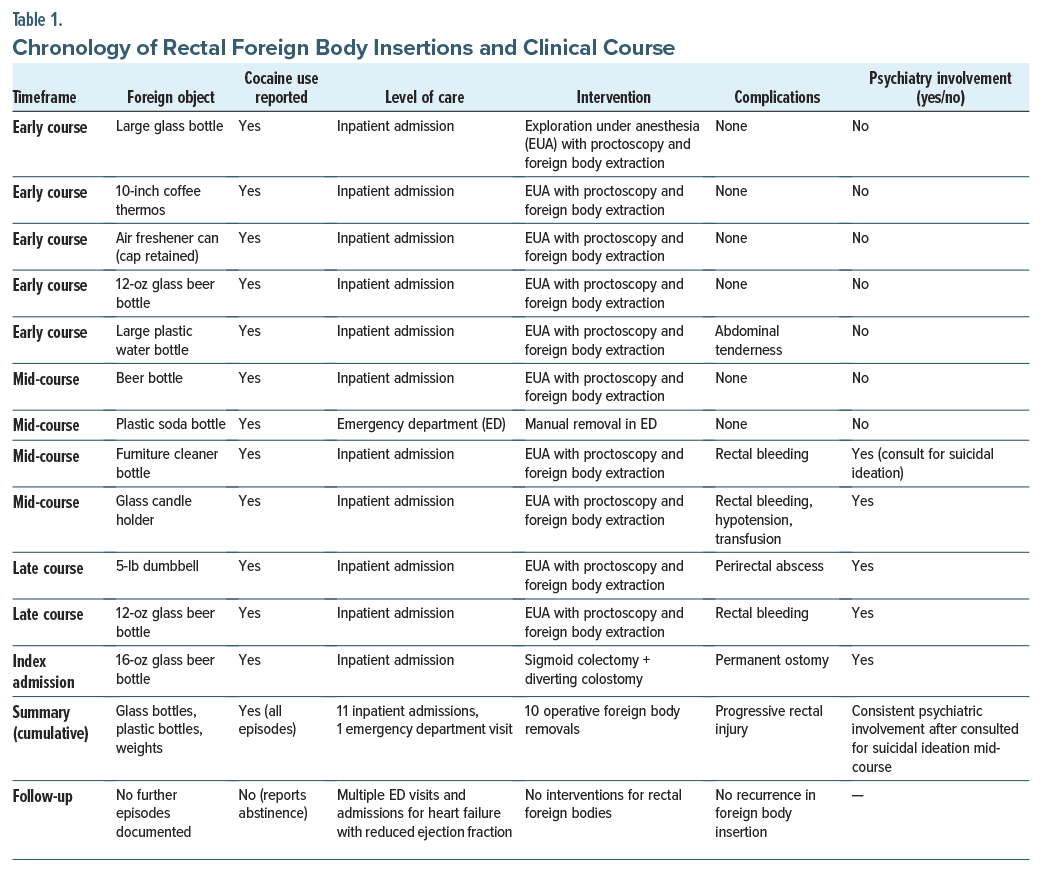
Over the prior 7 years, he had 12 ED visits for rectal foreign body insertion involving objects including glass beer bottles, plastic soda bottles, glass candle holders, air freshener cans, a 5-pound dumbbell weight, and chemical cleaning bottles, summarized chronologically in Table 1. He required at least 10 operative removals, several complicated by hypotension and bleeding in the setting of anticoagulation. Due to progressive rectal and sigmoid injury, repeated failed transanal removals, and severe colonic dilation and mucosal injury from chronic insertion, he ultimately required sigmoid colectomy with diverting colostomy.
Despite repeated presentations with progressively severe injuries, psychiatric consultation was delayed and ultimately prompted by suicidal ideation during a related hospitalization. The acute safety concerns were assessed as occurring in the setting of cocaine intoxication and interpersonal conflict. During that psychiatric evaluation, he described lifelong learning difficulties including leaving school in the seventh grade but denied exposure to abuse and other traumas. He also reported marked sexual frustration related to prolonged absence of sexual activity with his wife. Although safer sexual alternatives were discussed, he was ambivalent about stopping insertion behaviors, and counseling emphasized harm-reduction and injury prevention strategies. Collateral from his wife corroborated the impulsive nature of episodes and absence of intent to self-harm. He reported over 30 years of intermittent cocaine use without formal treatment. Following colectomy and subsequent cardiac hospitalizations, he reported cessation of cocaine use, and subsequent records documented no further episodes of rectal foreign body insertion.
Discussion
This case illustrates recurrent rectal foreign body insertion occurring in the context of intellectual and developmental disabilities and cocaine intoxication, with progressive escalation in risk and severity, ultimately resulting in permanent colostomy. The temporal relationship with stimulant use and remission following abstinence supports substance-induced compulsive sexual behavior rather than primary paraphilic disorder.
Cocaine enhances dopaminergic signaling within mesolimbic and frontostriatal reward circuits, increasing impulsivity, sexual drive, novelty seeking, and compulsivity while impairing inhibitory control.8–10 In cognitively vulnerable individuals, these effects may be amplified by limited insight and reduced executive functioning, increasing vulnerability to repetitive high-risk behavior.11,12
This case highlights how recurrent surgical presentations related to substance-associated compulsive behavior can outpace sustained, longitudinal behavioral intervention, particularly when psychiatric and addiction care are not integrated early. When abstinence is not immediately achievable, harm-reduction strategies and structured counseling that match cognitive capacity may reduce injury risk while treatment engagement is built.3 Earlier recognition of stimulant-associated compulsive sexual behavior and proactive linkage to substance use treatment may help prevent severe outcomes.
Article Information
Published Online: July 16, 2026. https://doi.org/10.4088/PCC.26cr04212
© 2026 Physicians Postgraduate Press, Inc.
Prim Care Companion CNS Disord 2026;28(4):26cr04212
Submitted: February 13, 2026; accepted April 6, 2026.
To Cite: Schwartz AC, Smith A, Stiles C, et al. Recurrent rectal foreign body insertion associated with cocaine-induced compulsive sexual behavior resulting in permanent colostomy. Prim Care Companion CNS Disord 2026;28(4):26cr04212.
Author Affiliations: Department of Psychiatry and Behavioral Sciences, Emory University School of Medicine and Grady Memorial Hospital, Atlanta, Georgia (Schwartz, Stiles, Robbins-Welty); Department of Orthopaedics, Emory University School of Medicine, Atlanta, Georgia (Smith); Departments of Family and Preventative Medicine, Division of Palliative Medicine, Emory University School of Medicine, Atlanta, Georgia (Robbins-Welty).
Corresponding Author: Ann C. Schwartz, MD, 12 Executive Park Drive, Ste 142, Atlanta, GA 30329 ([email protected]).
Financial Disclosure: None.
Funding/Support: None.
Additional Information: The information in this case has been de-identified to protect patient anonymity.
ORCID: Ann C. Schwartz: https://orcid.org/0000-0002-5892-0833; Gregg A. Robbins-Welty: https://orcid.org/0000-0003-4516-7368
References (12)

- Tarasconi A, Perrone G, Davies J, et al. Anorectal emergencies: WSES-AAST guidelines. World J Emerg Surg. 2021;16(1):48. PubMed CrossRef
- Fritz S, Killguss H, Schaudt A, et al. Proposal of an algorithm for the management of rectally inserted foreign bodies: a surgical single-center experience with review of the literature. Langenbecks Arch Surg. 2022;407(6):2499–2508. PubMed CrossRef
- Unruh BT, Nejad SH, Stern TW, et al. Insertion of foreign bodies (polyembolokoilamania): underpinnings and management strategies. Prim Care Companion CNS Disord. 2012;14(1):PCC.11f01192. PubMed CrossRef
- Skryabin VY, Khoryaev D, Torrado M. Changes in sexual behavior patterns due to stimulants use: three case reports. J Addict Dis. 2020;38(3):375–379. PubMed CrossRef
- Clinical Guideline Committee (CGC) Members; ASAM Team; AAAP Team; IRETA TeamASAM TeamAAAP Team, et al. The ASAM/AAAP Clinical Practice Guideline on the Management of Stimulant Use Disorder. J Addict Med. 2024;18(1S Suppl 1):1–56. PubMed CrossRef
- Ashok AH, Mizuno Y, Volkow ND, et al. Association of stimulant use with dopaminergic alterations in users of cocaine, amphetamine, or methamphetamine: a Systematic review and meta-analysis. JAMA Psychiatry. 2017;74(5):511–519. PubMed CrossRef
- Winstanley CA. The orbitofrontal cortex, impulsivity, and addiction: probing orbitofrontal dysfunction at the neural, neurochemical, and molecular level. Ann N Y Acad Sci. 2007;1121:639–655. PubMed CrossRef
- Hu Y, Salmeron BJ, Gu H, et al. Impaired functional connectivity within and between frontostriatal circuits and its association with compulsive drug use and trait impulsivity in cocaine addiction. JAMA Psychiatry. 2015;72(6):584–592. PubMed CrossRef
- Johnson MW, Herrmann ES, Sweeney MM, et al. Cocaine administration dose-dependently increases sexual desire and decreases condom use likelihood: the role of delay and probability discounting in connecting cocaine with HIV. Psychopharmacol Berl. 2017;234(4):599–612. PubMed CrossRef
- Cami J, Farré M. Drug addiction. New Engl J Med. 2003;349(10):975–986. PubMed CrossRef
- Chamberlain SR, Lust K, Grant JE. Cocaine use in university students: relationships with demographics, mental health, risky sexual practices, and trait impulsivity. CNS Spectr. 2021;26(5):501–508. PubMed CrossRef
- Mahoney JJ. Cognitive dysfunction in individuals with cocaine use disorder: Potential moderating factors and pharmacological treatments. Exp Clin Psychopharmacol. 2019;27(3):203–214. PubMed CrossRef
Please sign in or purchase this PDF for $40.