
Mutism is the absence or reduction of speech associated with a range of psychiatric and neurological conditions including selective mutism, autism, psychosis, and catatonia. When mutism is present, a workup including imaging, neurological examination, laboratory testing, and psychiatric assessment is performed to determine the underlying etiology. In rare cases, mutism can be entirely volitional. Here, we present a case of volitional mutism in an adult and highlight the differential diagnosis.
Case Report
Ms A is a 42-year-old white woman with hypothyroidism (on levothyroxine) and major depressive disorder (MDD) in remission who presented to the emergency department with bizarre behavior. Her family reported an acute onset of mutism and unusual dietary changes, including eating only brown rice. Initial workup included complete blood count, comprehensive metabolic panel, urinalysis, urine drug screen, thyroid function tests, and head noncontrast computed tomography (CT). Results revealed lactic acidosis and ketonuria consistent with starvation ketosis; otherwise, findings were unremarkable. Psychiatry was consulted due to concern for catatonia or MDD with psychotic features. The patient received a lorazepam challenge (2 mg intravenous), mirtazapine 15 mg nightly, and olanzapine 2.5 mg nightly and underwent brain magnetic resonance imaging (MRI) and electroencephalogram (EEG)—none of which revealed abnormalities.
Despite interventions, Ms A’s clinical picture remained unchanged. She consistently failed to respond to verbal or tactile prompts, though nursing observed that she ambulated frequently and pretended to be asleep when approached. During this period, her oral intake remained minimal, consistent with her reported restrictive dietary behavior. Five days after presentation, she was admitted to the inpatient psychiatric unit.
On the psychiatric unit, Ms A remained mute but continued walking around the unit. Due to persistent concerns for catatonia or psychotic depression, electroconvulsive therapy (ECT) was discussed with her next of kin and the ethics department. On day 17, when approached about ECT, she abruptly began speaking. She explained that she had been undertaking a “month-long fast and vow of silence” as a form of discipline to prevent “speaking before thinking” and as defiance against her “overbearing” family. She reported that her lack of autonomy since moving in with her parents and their insistence on strict religious practices prompted this behavior. She denied auditory or visual hallucinations, thought insertion, ideas of reference, or paranoia.
Following disclosure, her oral intake improved and returned to baseline over the subsequent days. Furthermore, she engaged in group therapy and conversed freely. She was discharged 2 days later on mirtazapine 30 mg nightly and olanzapine 10 mg nightly. At the time of discharge, the patient demonstrated clinical improvement, and continuation of medications was deferred to outpatient management with the expectation that tapering could be considered if symptoms did not recur. However, the patient was lost to follow-up, and no further data regarding medication management are available.
Discussion
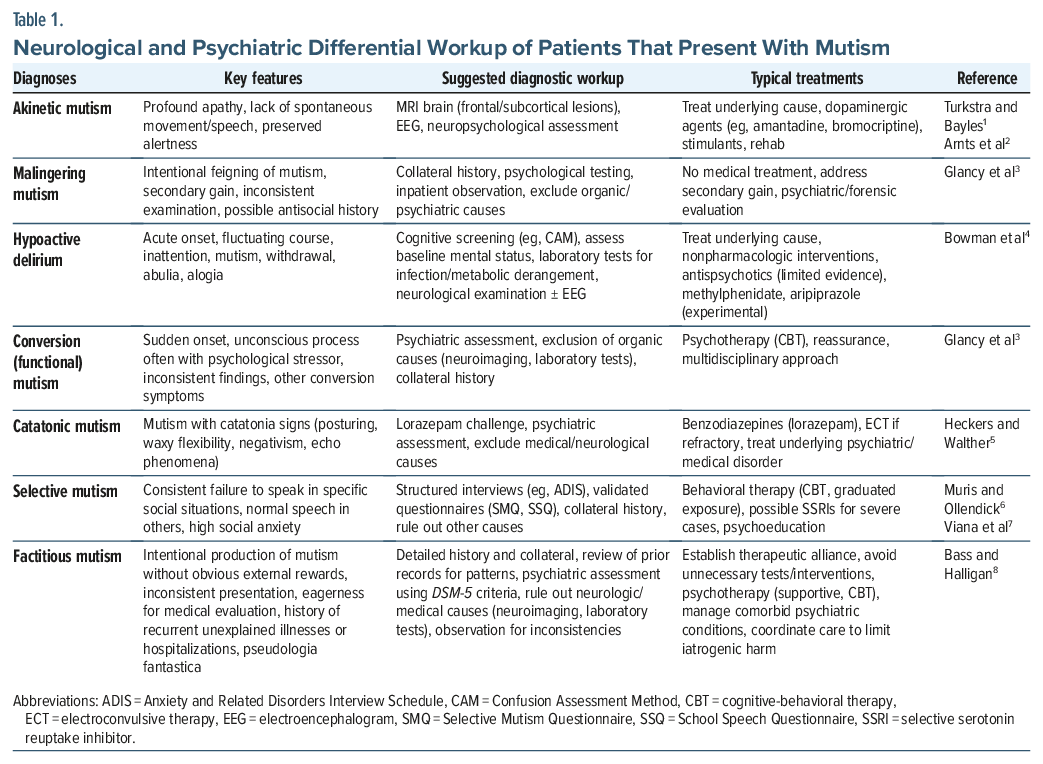
In patients that present with mutism, neurological and psychiatric workup is performed to distinguish the case among the conditions listed in the differential (Table 1).1–8 Volitional mutism represents a rare diagnosis wherein mutism occurs in the absence of psychiatric dysfunction, neurological disease, or overt secondary gain. To our knowledge, only one other case of volitional mutism has been described in the literature. Babikian et al9 reported a Nepalese soldier who developed mutism, initially prompting a psychosis workup. After several days, he spontaneously spoke when engaged about his home country. As in our patient, standard investigations (MRI, CT, EEG, interviews) ruled out psychiatric and neurological conditions, and mutism resolved spontaneously.
From a psychodynamic perspective, volitional mutism may function as a defense mechanism or symbolic protest, allowing individuals to exert control in environments where they feel powerless. In our case, the patient’s silence and restrictive eating appeared to serve as an act of resistance against her family’s demands and loss of autonomy. Restrictive eating, in particular, can be conceptualized as an expression of control, mirroring the communicative refusal inherent in mutism.10 Both behaviors may symbolize autonomy, defiance, and an attempt to reclaim agency.
In addition to volitional mutism, factitious disorder was considered, as the patient’s presentation resulted in hospitalization and removal from a stressful home environment. However, factitious disorder is characterized by falsification or feigning of symptoms, whereas this patient explicitly endorsed her behaviors as fully voluntary and did not attempt to present them as involuntary or deceptive. While this distinction argues against factitious disorder, it remains an important consideration in similar presentations of unexplained mutism.
When encountered, the available literature suggests that volitional mutism often resolves spontaneously, and insistence on speech or punitive approaches should be avoided. Furthermore, there is no evidence supporting pharmacologic intervention for volitional mutism in the absence of comorbid psychiatric symptoms.11 Rather, a supportive approach with ongoing assessment is recommended.
Conclusion
This case highlights a rare presentation of volitional mutism, illustrating that mutism is not always attributable to psychiatric or neurological pathology. Careful evaluation is required to exclude more common causes. Although rare, volitional mutism should be considered in the differential diagnosis of adult patients presenting with mutism, particularly when there is no evidence of psychosis, secondary gain, or neurological impairment.
Article Information
Published Online: August 6, 2026. https://doi.org/10.4088/PCC.26cr04195
© 2026 Physicians Postgraduate Press, Inc.
Prim Care Companion CNS Disord 2026;28(4):26cr04195
Submitted: January 25, 2026; accepted May 1, 2026.
To Cite: Hill G, Noe G, Munjal S. Silence as defiance: a case of volitional mutism in adulthood. Prim Care Companion CNS Disord 2026;28(4):26cr04195.
Author Affiliations: Wake Forest School of Medicine,Winston-Salem, North Carolina (Hill, Noe); Department of Psychiatry, Wake Forest University, Winston-Salem, North Carolina (Noe, Munjal); Psychiatry Residency Program, Wake Forest University, Winston-Salem, North Carolina (Munjal).
Hill is the first author; Munjal is the senior author.
Corresponding Author: Greg Noe, MD, Department of Psychiatry, Wake Forest University, Winston-Salem, North Carolina ([email protected]).
Financial Disclosure: None.
Funding/Support: None.
Patient Consent: Consent was received from the patient to publish the case report, and information has been de-identified to protect patient anonymity.
References (11)

- Turkstra LS, Bayles KA. Acquired mutism: physiopathy and assessment. Archives Phys Med rehabilitation. 1992;73(2):138–144.
- Arnts H, van Erp WS, Lavrijsen JCM, et al. On the pathophysiology and treatment of akinetic mutism. Neurosci Biobehav Rev. 2020;112:270–278. PubMed
- Glancy GD, Ash P, Bath EP, et al. AAPL practice guideline for the forensic assessment. J Am Acad Psychiatry L. 2015. https://jaapl.org/content/43/2_Supplement/S3.long
- Bowman EML, Cunningham EL, Page VJ, et al. Phenotypes and subphenotypes of delirium: a review of current categorisations and suggestions for progression. Crit Care London, Engl. 2021;25(1):334. PubMed CrossRef
- Heckers S, Walther S. Catatonia. New Engl J Med. 2023;389(19):1797–1802. PubMed
- Muris P, Ollendick TH. Selective mutism and its relations to social anxiety disorder and autism spectrum disorder. Clin child Fam Psychol Rev. 2021;24(2):294–325. PubMed CrossRef
- Viana AG, Beidel DC, Rabian B. Selective mutism: a review and integration of the last 15 years. Clin Psychol Rev. 2009;29(1):57–67. PubMed CrossRef
- Bass C, Halligan P. Factitious disorders and malingering: challenges for clinical assessment and management. Lancet London, Engl. 2014;383(9926):1422–1432. PubMed CrossRef
- Babikian S, Emerson L, Wynn GH. Significance of cultural beliefs in presentation of psychiatric illness: a case report of selective mutism in a man from Nepal. Mil Med. 2007;172(11):1213–1216. PubMed CrossRef
- Sharkey L, McNicholas F. More than 100 years of silence’, elective mutism: a review of the literature. Eur child Adolesc Psychiatry. 2008;17(5):255–263. PubMed CrossRef
- Gordon N. Mutism: elective or selective, and acquired. Brain Dev. 2001;23(2):83–87. PubMed
Please sign in or purchase this PDF for $40.