
Abstract
Objective: Community psychiatry, recognized as the “third psychiatry revolution,” plays a pivotal role in mental health care by offering deinstitutionalized, accessible, and recovery-based approaches that promote social inclusion. The objective of this study was to conduct a bibliometric analysis to evaluate global research in community psychiatry, aiming to examine publication trends and document types in the field; the most active authors, institutions, and journals; and the most-cited articles.
Methods: A bibliometric analysis was conducted from 2015 to 2025 using data from the Scopus database. The search strategy included the keywords TITLE-ABS-KEY (“community psychiatry”) for publications between 2015 and 2025 (specifically up to October 10, 2025), limited to English-language publications. VOSviewer was utilized for visualization and analysis.
Results: The analysis included 447 articles, predominantly original research. Publication volume showed a peak in 2020, potentially linked to the COVID-19 pandemic, while 2018 recorded the lowest output. Thematic analysis revealed a focus on community psychiatry’s response to COVID-19, technological innovations, recovery-oriented models, and community engagement strategies. A notable limitation was the underrepresentation of research from non-Western countries.
Conclusion: The findings underscore the growing importance of community psychiatry and can guide future research priorities and the development of more effective mental health care strategies.
Prim Care Companion CNS Disord 2026;28(3):25m04107
Author affiliations are listed at the end of this article.
From the Editors
Are you a healthcare provider?
Add your NPI to personalize your JCP experience.
Community psychiatry is commonly identified as the “third psychiatry revolution” (the first 2 revolutions being moral treatment and psychoanalysis), playing a pivotal role in mental health care.1 It offers a deinstitutionalized, accessible, affordable, preventive, and recovery-based approach, constantly promoting social inclusion.2,3 Community-based psychiatric services are therefore crucial in reducing stigma, enhancing continuity of care, increasing treatment adherence, and improving community participation in mental health delivery.4
Over the past several decades, different countries have seen the growth of community psychiatry in various ways. In India, it began in the early 1950s, notably with pioneering work by Dr Vidya Sagar in Amritsar and the shift toward integrating psychiatric care with general hospitals, while the United States and Western Europe saw their inception in the early 1960s.5,6,7 This interesting variation underscores the distinct historical trajectories in the development of community psychiatry initiatives between Western and developing countries.8
Moreover, despite the considerable body of research in community psychiatry, there remains a notable gap in bibliometric evidence that comprehensively outlines the global research landscape, identifies important contributors, and reveals emerging themes. While previous bibliometric studies have examined general mental health research, parental mental illness, and mental health output from particular nations, global, focused bibliometric analyses specifically within community psychiatry remain limited.9–11
Consequently, this gap highlights the value of bibliometric analysis as a critical approach for evaluating research outputs from authors, countries, journals, and institutions. Such analysis also provides valuable visual representations of information.12 This understanding enables policymakers, educators, and researchers to grasp the progress of research in community psychiatry and helps inform future research priorities.
Against this backdrop, this bibliometric analysis aims to evaluate worldwide research on community psychiatry from 2015 to 2025, with the objectives of examining publication trends and article types in the field; the most active authors, institutions, and journals; and the most-cited articles. In this study, we operationalized community psychiatry as the spectrum of psychiatric practices and services that are primarily delivered in and oriented toward the community, rather than long-term institutional settings. This encompasses models that prioritize deinstitutionalization, accessibility, continuity of care, recovery-oriented and person-centered methodologies, family and community engagement, and social inclusion (eg, supported housing, community mental health centers, assertive community treatment, and community-based crisis and rehabilitation services).
METHODS
The Scopus database was searched using the query TITLE-ABS-KEY (“community psychiatry”) for the period 2015–2025, and results were limited to English-language publications. This search strategy identified documents in which the exact phrase “community psychiatry” appeared in the title, abstract, or author keywords. We then screened titles and abstracts to determine whether the publication substantively addressed community-based psychiatric services, models, or interventions in line with the operational definition above. Records that mentioned community psychiatry only tangentially (eg, in passing, historically, or as a nonsubstantive label) and did not focus on community-based psychiatric practice or systems were excluded.
All collected data were exported in CSV format and analyzed to identify publication trends; article types; top contributing authors, journals, and institutions; and highly cited articles. Authorship analyses used the Scopus author metadata (ie, all authors listed in each record). Institutional contributions were derived from Scopus affiliation fields as indexed for each publication; because publications may include multiple affiliations, institution counts reflect all indexed affiliations rather than only the first author’s institution. The bibliometric mapping and visualization were performed using VOSviewer to identify publication trends, coauthorship networks, institutional collaborations, and keyword co-occurrence patterns. This approach enabled the identification of key contributors, thematic areas, and emerging research trends in community psychiatry. Thematic categories were identified by reviewing the most frequent and co-occurring author keywords and terms in titles and abstracts within the retrieved dataset and grouping them into higher-order topic areas. Themes were finalized through iterative discussions among the authors to ensure conceptual coherence and minimize overlap.
RESULTS
A total of 447 publications on community psychiatry were identified using the Scopus database. The publication trends in community psychiatry worldwide were analyzed under the following themes: distribution across journals, author contributions, and contributing organizations.
Publication Trend of Community Psychiatry Worldwide in the Last 10 Years
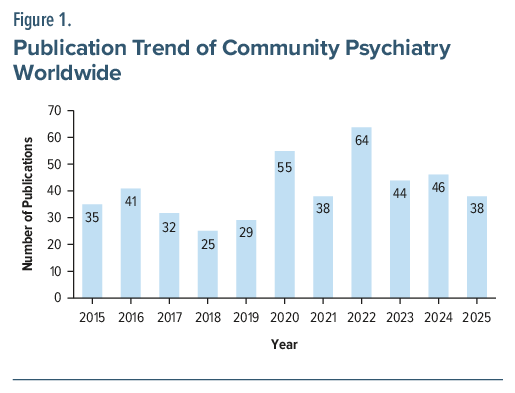
Figure 1 shows the number of research publications on community psychiatry published annually from 2015 to 2025. Between 2015 and 2019, the number of publications ranged from 25 to 41, showing minor fluctuations and an overall stable pattern. A sharp increase was noted in 2020, with publications increasing to 55 during the COVID-19 pandemic. The highest number of publications was recorded in 2022 (64), followed by a gradual dip in subsequent years.
Types of Research in Community Psychiatry
In a search of the Scopus database, the majority of studies identified were research articles, accounting for 62% (n = 277). The next largest categories were book chapters, representing 13% (n = 58), and review papers, comprising 10.1% (n = 45). Other types of publications included letters, 5.8% (n = 26); editorials, 4.0% (n = 18); notes, 2.5% (n = 11); books, 2.5% (n = 11); and a few conference papers, 0.2% (n = 1).
Publication Distribution Across Journals
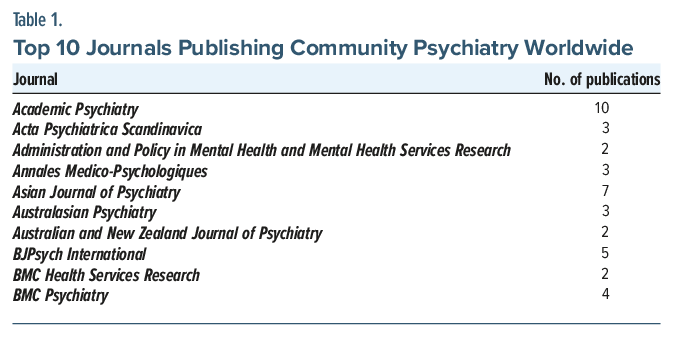
Table 1 presents the top 10 journals worldwide publishing research in community psychiatry. Academic Psychiatry contributed the highest number of publications (10), while the remaining journals published less than one-third of this number. The next most active journals were the Asian Journal of Psychiatry (7) and BJPsych International (5). Other journals contributed only a small number of publications, including Acta Psychiatrica Scandinavica, Annales Medico-Psychologiques, and Australasian Psychiatry (3 each), as well as Administration and Policy in Mental Health and Mental Health Services Research, Australian and New Zealand Journal of Psychiatry, and BMC Health Services Research (2 each).
Top 15 Contributing Authors
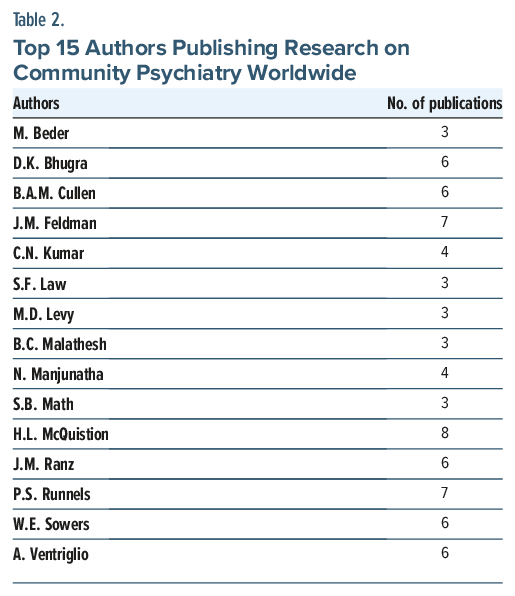
Table 2 presents the top 15 authors publishing research on community psychiatry. H.L. McQuistion, contributed the most with 8 publications, followed by J.M. Feldman and P.S. Runnels, each with 7 papers. D.K. Bhugra, B.A.M. Cullen, J.M. Ranz, W.E. Sowers, and A. Ventriglio each published 6 papers. Other notable contributors included C.N. Kumar, and N. Manjunatha, with 4 publications each, while M. Beder, S.F. Law, M.D. Levy, B.C. Malathesh, and S.B. Math each authored 3 papers.
Top 10 Contributing Organizations
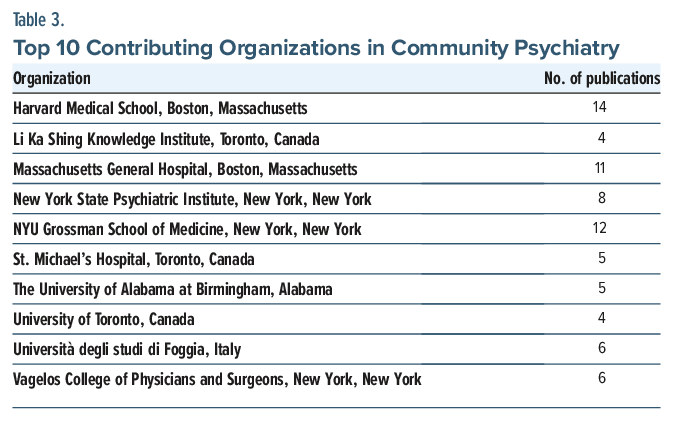
Table 3 provides data on organizations publishing research in community psychiatry worldwide. Harvard Medical School, Boston, Massachusetts, contributed the highest number of papers (14), followed by NYU Grossman School of Medicine, New York, New York (12), and Massachusetts General Hospital, Boston, Massachusetts, which ranked third with 11 publications. Other notable contributors included the Università degli studi di Foggia, Foggia, Italy, and the Vagelos College of Physicians and Surgeons, New York, New York, each with 6 papers. The University of Alabama at Birmingham, and St. Michael’s Hospital, Toronto, Canada, produced 5 papers each, while the Li Ka Shing Knowledge Institute, Toronto, Canada, and the University of Toronto, Canada, contributed 4 papers each.
Top 10 Most-Cited Research Publications in Community Psychiatry
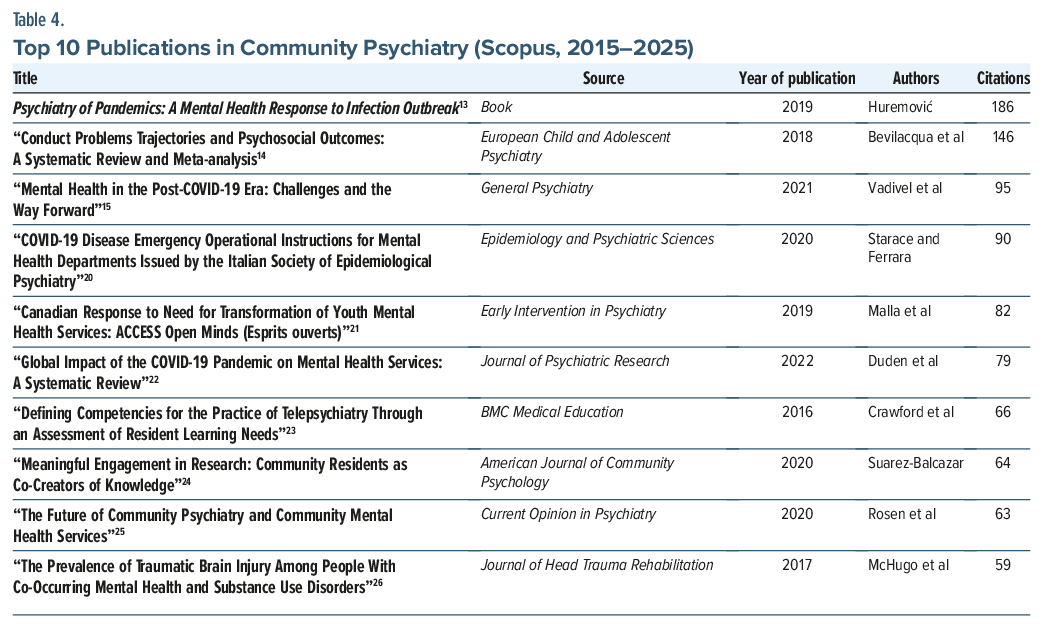
Table 4 provides information on the top 10 most-cited research publications in community psychiatry worldwide. Psychiatry of Pandemics: A Mental Health Response to Infection Outbreak published in 2019 was cited 186 times.13 This was followed by a study published in European Child and Adolescent Psychiatry in 2018, titled “Conduct Problems Trajectories and Psychosocial Outcomes: A Systematic Review and Meta-Analysis,” which received 146 citations.14 Another highly cited study, “Mental Health in the Post-COVID-19 Era: Challenges and the Way Forward,” published in General Psychiatry in 2021, was cited 95 times.15
DISCUSSION
Across the study period, publication activity varied year to year, with a noticeable increase around 2020, which may reflect heightened global attention to mental health service organization and continuity of care during the COVID-19 pandemic. From a timeline perspective, this pattern is consistent with community psychiatry functioning as a field that responds to system-level shocks (eg, public health emergencies) by emphasizing service delivery models, outreach, and coordination across sectors. At the same time, the observed fluctuations should be interpreted cautiously because bibliometric counts reflect publication and indexing dynamics as well as underlying research activity.
The outlets, authors, and institutions appearing most frequently in the dataset likely reflect where community psychiatry scholarship is most visible within English-language Scopus-indexed publishing channels, including education- and service-oriented journals. This concentration should not be interpreted as a definitive measure of global leadership or research quality but rather as an indicator of publishing networks, indexing coverage, and sustained programmatic activity within the indexed literature.
The thematic analysis suggested that the literature centers on 4 broad, overlapping clusters: community psychiatry’s response to COVID-19, technology-enabled psychiatric care, recovery-oriented service models, and community engagement strategies. Taken together, these themes indicate a field increasingly oriented toward improving access, resilience, and sustainability of mental health services through community-based platforms and partnerships.16 Importantly, the thematic mapping represents patterns within the retrieved corpus; it does not, on its own, establish causality or the effectiveness of specific models. In addition, while the dataset supports the identification of dominant themes, the present analysis does not formally test whether themes shifted across subperiods or whether particular authors/institutions specialized in specific themes; these remain valuable directions for future bibliometric and mixed-method follow-up work.
A notable limitation of this analysis is the underrepresentation of research from non-Western countries, particularly the Global South and Africa. This imbalance should be interpreted as underrepresentation within an English-language, Scopus-indexed dataset that required the explicit term “community psychiatry,” rather than as evidence of limited research activity in those regions. Relevant scholarship may be published in local languages, in nonindexed outlets, or under alternative descriptors (eg, community mental health services) and therefore may not be captured by the current search strategy. Consequently, the geographic skew creates knowledge gaps and limits our understanding of community psychiatry practices and challenges in these regions.
This bibliometric analysis underscores the critical role of evidence-based policies in advancing equitable and accessible community psychiatry services. Such analyses enable policymakers and researchers to identify research gaps and prioritize future investigations.17 The World Health Organization recognizes community-based mental health services as essential to achieving universal health coverage for mental health.18 However, it is important to acknowledge that bibliometric analyses, by their quantitative nature, may not fully capture the policy relevance and contextual nuances of community psychiatry research.19 Accordingly, these findings are best used to map research visibility and to motivate complementary qualitative and implementation-focused studies that evaluate context, feasibility, and equity impact at the service level.
Strengths and Limitations
VOSviewer was used to visualize collaborations, thematic areas, and emerging trends. However, it only includes English-language publications from Scopus, so relevant studies in other languages or databases may be missed. Moreover, Scopus affiliation metadata can reflect multiple institutions and countries per record and does not consistently encode community- level characteristics (eg, rural vs urban focus); therefore, geographic and setting-level inferences should be interpreted cautiously.
CONCLUSION
Community psychiatry research has increased, with notable contributions from specific authors, institutions, and journals. COVID-19 responses, technology in psychiatry, recovery-oriented services, and community engagement were the focus of most included studies. These findings underscore the growing importance of community psychiatry and the development of more effective mental health care strategies.
Article Information
Published Online: June 2, 2026. https://doi.org/10.4088/PCC.25m04107
© 2026 Physicians Postgraduate Press, Inc.
Submitted: October 12, 2025; accepted January 30, 2026.
To Cite: Mangalamchery V, Rahman AMAU, Uvais NA. Global research trends in community psychiatry: a bibliometric analysis (2015–2025). Prim Care Companion CNS Disord 2026;28(3):25m04107.
Author Affiliations: Iqraa International Hospital and Research Centre, Kozhikode, Kerala, India (Mangalamchery, Uvais); Department of Psychiatry, Government Medical College, Kozhikode, India (Rahman).
Corresponding Author: N. A. Uvais, MBBS, DPM, IFAPA, FRSPH, FRSB, Iqraa International Hospital and Research Centre, Calicut, Kerala, India ([email protected]).
Financial Disclosure: None.
Funding/Support: None.
Clinical Points
This bibliometric mapping identifies the practice-relevant areas most emphasized in the “community psychiatry” literature (2015–2025), which clinicians can use to prioritize local quality-improvement targets aligned with current service trends.
The most-cited and most-visible topics in the indexed literature (notably COVID-related service responses and technology-enabled care) can guide clinicians on where protocols and training are most commonly discussed, while recognizing that citation prominence reflects visibility rather than clinical effectiveness.
Apparent geographic or thematic gaps in the indexed corpus can help clinicians and service leaders identify underdocumented settings or populations to focus audit, implementation, and partnership efforts, given likely language, indexing, and terminology constraints.
References (26)

- Bellak L. Community psychiatry and social power. Soc Probl. 1969;16(4):490–498.
- Ciobanu AM, Ciobanu AC, Catrinescu LM, et al. Community-based psychiatric treatment in Romania: past, present, future. Consort Psychiatr. 2022;3(2):129–136. PubMed CrossRef
- Anthony WA. Recovery from mental illness: the guiding vision of the mental health service system in the 1990s. Psychosoc Rehabil J. 1993;16(4):11–23. CrossRef
- Forkuo AY, Mustapha AY, Mbata AO, et al. The role of mental health integration in primary healthcare: a policy and implementation framework. J Front Multidiscip Res. 2024;5(1):87–102. CrossRef
- Chadda RK. Six decades of community psychiatry in India. Int Psychiatry. 2012;9(2):45–47. PMID: 31508119; PMCID: PMC6735056. PubMed CrossRef
- Caldas De Almeida JM. Community psychiatry in Portugal. Epidemiol Psichiatr Soc. 1996 Aug;5(2):92–95. CrossRef
- Burns T. Community psychiatry’s achievements. Epidemiol Psychiatr Sci. 2014;23(4):337–344. PubMed CrossRef
- Ranjith G, Duddu V. Psychiatric services in developing countries. Br J Psychiatry J Ment Sci. 2001 Oct;179:368–369. PubMed CrossRef
- Ranta RS, Sharma T, Sharma A. A bibliometric analysis on mental health research over the past two decades. J Med Health Res Psychiatry [Internet]. 2025;02(01). https://medical-health-psychiatry.com/1/article/view/47
- Andersen N, Lund IO. Mapping the literature on parents with mental illness, across psychiatric sub-disciplines: a bibliometric review. BMC Psychiatry. 2020 Dec;20(1):468. PubMed CrossRef
- Severino F, Scotti V, Zhang T, et al. A bibliometric analysis of international publications and citation trends of articles in mental health produced by Chinese institutions in mainland China (1990–2019). Glob Ment Health. 2021;8:e37. PubMed CrossRef
- Yue YY, Fan XY, Zhang Q, et al. Bibliometric analysis of subject trends and knowledge structures of gut microbiota. World J Clin Cases. 2020;8(13):2817–2832. PubMed CrossRef
- Huremović D, ed. Psychiatry of Pandemics: A Mental Health Response to Infection Outbreak [Internet]. Springer International Publishing; 2019. http://link.springer.com/10.1007/978-3-030-15346-5
- Bevilacqua L, Hale D, Barker ED, et al. Conduct problems trajectories and psychosocial outcomes: a systematic review and meta-analysis. Eur Child Adolesc Psychiatry. 2018 Oct;27(10):1239–1260. PubMed CrossRef
- Vadivel R, Shoib S, El Halabi S, et al. Mental health in the post-COVID-19 era: challenges and the way forward. Gen Psychiatry. 2021;34(1):e100424. PubMed CrossRef
- Yadav RK. Community Psychiatry, Unit-III, Paper-IV. Department of Social Work, University of Lucknow. 2024. https://www.lkouniv.ac.in/site/writereaddata/ siteContent/202004221613338445rajnesh_sw_Community_Psychiatry.pdf
- Wang L, Ye L, Jin Y, et al. A bibliometric analysis of the knowledge related to mental health during and post COVID-19 pandemic. Front Psychol. 2024;15:1411340. PubMed CrossRef
- World Health Organization. Transforming mental health for all [Internet]. WHO; 2022. https://www.who.int/teams/mental-health-and-substance-use/world- mental-health-report
- Judijanto L, Lesmana T. Bibliometric Insights into mental health challenges and innovations in Contemporary Society. ESSSH. 2024;2(01):37. Available from:. https://esj.eastasouth-institute.com/index.php/esssh/article/view/343
- Starace F, Ferrara M. COVID-19 disease emergency operational instructions for mental health Departments issued by the Italian Society of Epidemiological psychiatry. Epidemiol Psychiatr Sci. 2020;29:e116. PubMed CrossRef
- Malla A, Iyer S, Shah J, et al. ACCESS open Minds Youth mental health network. Canadian response to need for transformation of youth mental health services:ACCESS open Minds (Esprits ouverts). Early Interv Psychiatry. 2019;13(3):697–706. PubMed CrossRef
- Duden GS, Gersdorf S, Stengler K. Global impact of the COVID-19 pandemic on mental health services:a systematic review. J Psychiatr Res. 2022;154:354–377. PubMed CrossRef
- Crawford A, Sunderji N, López J, et al. Defining competencies for the practice of telepsychiatry through an assessment of resident learning needs. BMC Med Educ. 2016;16:28. PubMed CrossRef
- Suarez-Balcazar Y. Meaningful engagement in research:community Residents as Co-creators of knowledge. Am J Community Psychol. 2020;65(3–4):261–271. PubMed CrossRef
- Rosen A, Gill NS, Salvador-Carulla L. The future of community psychiatry and community mental health services. Curr Opin Psychiatry. 2020;33(4):375–390. PubMed CrossRef
- McHugo GJ, Krassenbaum S, Donley S, et al. The prevalence of traumatic brain injury among people with co-occurring mental health and substance use disorders. J Head Trauma Rehabil. 2017;32(3):E65–E74. PubMed CrossRef
Please sign in or purchase this PDF for $40.